A2 French: How to Start Reading Real Content
You do not need to wait until B1 or B2 to start reading real French. At A2, you know enough to tackle short news articles, simple blog posts, and adapted content -- especially with translation support. What matters is choosing the right material, accepting partial comprehension as productive, and building a daily reading habit that compounds over weeks and months.
There is a widespread belief among French learners that reading real content is something you do "later" -- once you reach B1 or B2, once your grammar is solid, once your vocabulary is big enough. This belief is wrong, and it costs learners months of potential progress.
I remember reading my first real French article at A2. I understood maybe half. But that half was more useful than a hundred textbook exercises, because every word was connected to something real -- a place, an event, a piece of France I could picture.
Whether you are studying in a classroom in Seoul or self-learning from your apartment in Mexico City, A2 is when real content becomes accessible. At A2, you already know roughly 1,000 to 2,000 words. You can form basic sentences, understand simple descriptions, and follow straightforward narratives. That is enough to start reading real French -- not perfectly, not without help, but meaningfully. And the act of reading at this stage accelerates your learning in ways that textbook exercises simply cannot match.
What A2 Actually Means in Practice
The Common European Framework of Reference (CEFR) defines A2 as the ability to understand sentences and frequently used expressions related to areas of immediate relevance -- personal information, shopping, local geography, employment. In practical reading terms, this means you can handle:
- Short factual texts -- weather reports, simple news briefs, event announcements
- Familiar topic coverage -- articles about sports results, local events, food, travel, and daily life
- Structured, predictable formats -- menus, timetables, simple advertisements, short emails
- Stories with clear chronology -- "this happened, then this happened" narratives
What you cannot comfortably handle yet: opinion pieces with abstract arguments, complex political analysis, literary prose, or texts heavy with subjunctive constructions and idiomatic expressions. That is fine. There is an enormous amount of useful, engaging content between "textbook exercises" and "Le Monde editorials."
Why 60% Comprehension Is Not Failure
Understanding 60-70% of a text is not a problem to solve. It is the optimal condition for learning.
Language acquisition research consistently shows that the most productive reading happens when learners understand most of a text but encounter enough unknown elements to push their level upward. If you understand 95% of everything you read, you are not learning much. If you understand 40%, you are frustrated and guessing randomly. The sweet spot -- 60-80% comprehension -- is where vocabulary acquisition happens fastest.
At A2, when you read a short news article from an accessible source, you will probably understand the topic, the main actors, and the general situation. You will miss some details, some nuance, and some vocabulary. That is exactly where you should be. Each article you read at this level deposits a few new words into your passive vocabulary, reinforces grammar patterns you have studied, and builds your tolerance for ambiguity -- a skill that is essential for real-world language use.
French News Was Never Written for You
Here is the part that usually goes unsaid, because saying it sounds like an excuse. Every article on 20 Minutes, France Info or Ouest-France was written by a French journalist for a French reader. That reader already knows who is prime minister this month. They know what the SNCF is, what happens at a préfecture, why a sentence about the RSA makes half the country furious. The journalist assumes all of it, because assuming it is the job. Explaining it would insult the audience they actually have.
So when you open that article at A2, you hit three walls at once, and only one of them is your French.
The words are not at your level, and nothing is glossed. A native writes for a native's vocabulary. There is no version of that article pitched lower, no note in the margin, no help of any kind. The text does not know you are there.
The context is assumed and never supplied. You can know every single word in a sentence about a government using le 49.3 and still have no idea what just happened, or why the person quoted underneath is so angry about it. Vocabulary was never the missing piece. The country was.
There is nothing to check yourself against. You finish, you think you got the gist, and nobody tells you whether you did. At A2 you are guessing constantly, which is correct and healthy, but a wrong guess that goes uncorrected quietly hardens into something you now believe about French.
At A2, that is not a difficulty problem. It is a mismatch. The text was not built for the reader, and no amount of persistence fixes a mismatch. This is why so many A2 learners try French news once, feel stupid, and retreat to a textbook that never made them feel that way. The retreat is a reasonable response to a badly matched text. It is also the moment most people stop making real progress, because the textbook cannot teach them what France is actually talking about this week.
So Can You Read Real French News at A2? Not Raw. Rewritten, Yes.
Both halves of that answer are true, and the second half is the whole reason Better French exists.
Every morning it reads around 800 articles from more than 40 French sources and keeps fourteen. That number is small on purpose. The fourteen are chosen because they are worth a French learner's time, not because they were the loudest stories of the day, and that choosing is half the work. A firehose of French news is not a gift to somebody at A2. It is fourteen decisions somebody else already made for you.
The other half of the work is that each of those fourteen stories is written again at five levels. The A2 version is the same story a C1 reader opens that same morning: same event, same people, same day in France. Shorter sentences, commoner words, and the context written down instead of assumed. You are not reading the easy corner of the news while everyone else reads the real thing. You are reading what France read, in the French you currently have.
Since these three things get assumed every time: it is not a summary, so you get the whole story rather than a three-line digest. It is not baby French, so the names, the numbers and the events are the real ones. And it is not a different, softer story from the one your French colleagues argued about at lunch. It is that story, told at your level.
That last point is the one that matters for your French, not just for your general knowledge. Words you meet inside a story you understand are words attached to something -- a strike, a heatwave, an election, a bakery closing after 90 years. They stick because they mean something to you. Learning French on its own was never going to be enough; learning it out of the things French people are actually discussing is what finally makes it hold.
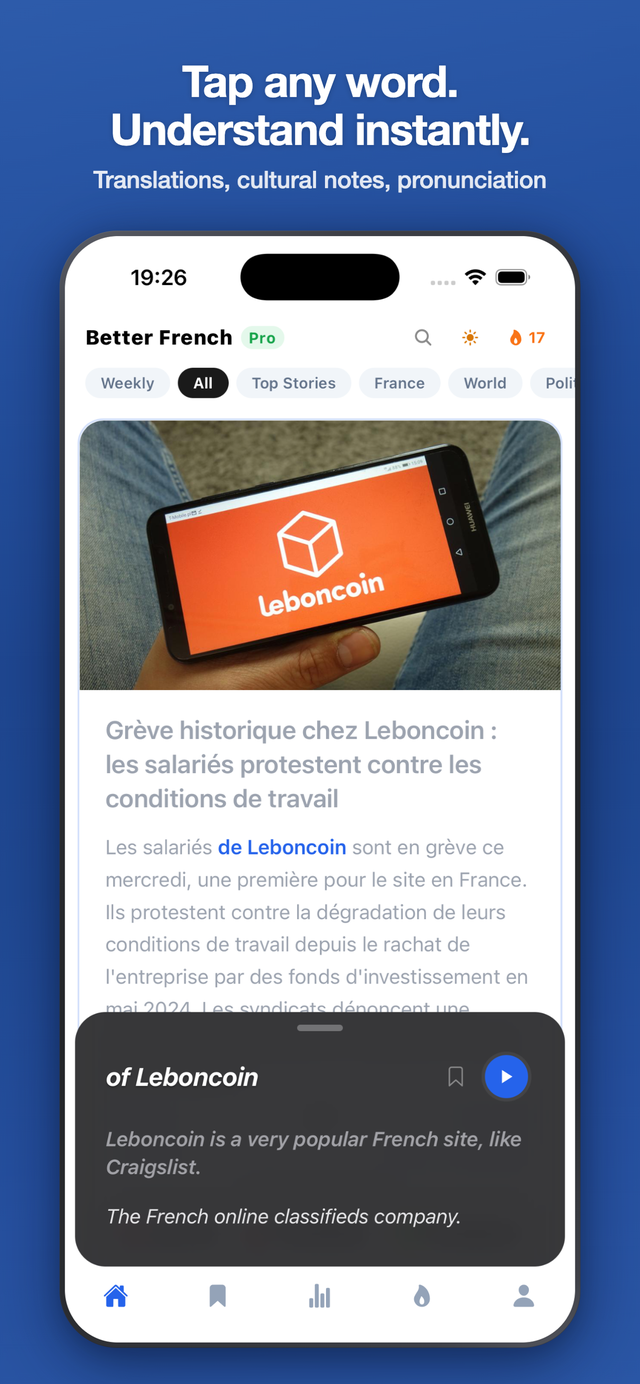
Two things sit on top of the rewriting, and both were built for exactly the reader this article is about. Better French Context: tap any word or short phrase and you get the translation, an explanation of how it is being used, and the cultural note behind it. That is what turns the guess-then-check technique below into something you can actually do at speed, instead of a wall. And Read in Your Language: when you lose the thread completely, flip the article into English, read the paragraph that broke you, then flip straight back into French. At A2 that is the difference between abandoning an article halfway and finishing it, which over a month is the difference between a habit and another thing you tried.
If you want to hear a word rather than read it, Audioplay plays any word or phrase in natural French, at a rate set just under native speed so you can catch the shape of it. There is no narration of the whole article. It is there for the words you cannot hear in your head.
What to Read at A2
The right reading material at A2 sits at what researchers call "i+1" -- just slightly above your current level. Here are the best sources, roughly ordered from most to least accessible. Better French is deliberately not on this list, because it is not a source. Two of the outlets below are among the papers it reads every morning; the list is where the French comes from, and the section above is what happens to it before you see it.
Children's news sites. Mon Quotidien (for ages 10-14) and 1jour1actu explain current events in simple, clear French. The vocabulary is real and practical. The sentence structures are short. There is no shame in reading content aimed at younger audiences -- the language is genuine, just simpler. These sites are perfect for A2 readers who want to engage with real topics.
Accessible news sources. 20 Minutes writes short articles with straightforward language. France Info has brief news pieces that get to the point quickly. These are real news outlets used by millions of French people daily. At A2, you will understand the headlines and get the gist of most articles, especially on familiar topics like sports, weather, entertainment, and local events.
News read slowly, for learners. RFI's Journal en français facile is a daily news bulletin spoken at a gentler pace, with a transcript you can read along to. Reading and listening to the same sentence at once is unusually effective at A2, because your ear starts recognising words your eye already knows. The stories are the real ones of the day, which is the point.
Graded readers. Publishers like CLE International and Hachette produce fiction adapted to CEFR levels. A2-level readers use limited vocabulary and simple grammar. They are useful for building reading stamina and confidence, though the simplified language can feel artificial compared to real content.
French Wikipedia on topics you know. If you are an expert on cooking, football, or the history of cinema, reading the French Wikipedia article on that topic is surprisingly accessible. Your background knowledge fills in the gaps that your vocabulary cannot.
Reading Techniques for A2
Reading in a foreign language at A2 requires different techniques than reading in your native language. These four approaches make the biggest difference at this stage.
Read the headline first. The headline gives you the topic and often the main point. If the headline is La France bat l'Italie 2-0 en match amical, you already know the subject (football), the outcome (France won), and the score. That context makes the entire article dramatically easier to understand.
Guess before you translate. When you hit an unknown word, pause and try to figure it out. Is it similar to an English word? Does the sentence still make sense if you skip it? Can you guess from the surrounding words? This mental effort strengthens the neural pathways for inference -- a skill you will rely on every day as your French improves. Only look up a word after you have genuinely tried to guess it.
Focus on high-frequency words. Not all unknown words are equally worth learning. Prioritize words that appear multiple times in the article, words that seem essential to the meaning, and words you recognize from other contexts. Ignore rare or technical terms. At A2, your goal is to build a broad base of common vocabulary, not to catalog every word you encounter.
Read the same article twice. On your first pass, read for the general idea without stopping. On your second pass, slow down and look up the words that matter. This two-pass approach is more effective than stopping at every unknown word on a single read-through. The first pass gives your brain a framework; the second pass fills in the details.
Building a Daily A2 Reading Habit
The single most important factor in reading improvement is consistency. Here is a realistic daily routine that works at A2 level.
Time commitment: 15 minutes per day. That is one short article plus vocabulary review. Five days a week is better than one long session on the weekend.
Step 1: Review yesterday's words (2 minutes). Look at the five words you noted yesterday. Can you remember what they mean? Can you recall the sentence you saw them in? This retrieval practice is what makes words stick.
Step 2: Read one article (10 minutes). Choose something short and on a topic that interests you. Read it through once for the general idea, then again more carefully. Use translation support for key words but resist the urge to look up everything.
Step 3: Note five new words (3 minutes). Write each word, its meaning in context, and the sentence you found it in. Context is crucial -- un match amical (a friendly match) is more memorable and useful than amical = friendly. This is the reason Saved Words in Better French keeps the story and the cultural note attached to every word you save. A word ripped out of the article it came from is a flashcard, and flashcards are the thing you already tried.
Step 4, if you have five more minutes: make the story check you. This is the wall from earlier -- nothing to test yourself against -- and it is the one an A2 reader can least afford, because a wrong guess you never catch becomes a habit. Three games are built from the story you just read, not from a generic word list. Quiz Me asks you three questions about it, and the questions test what you understood about France as much as what you understood in French. VocaMatch uses the vocabulary from that same article: three lives, no timer at all, and its easiest band is the A1-A2 one, which is exactly where you are. Breakdown has you say the story out loud one phrase at a time across three tiers, and the A1 tier is the one to start on at A2 -- speaking a sentence you have just read is how it stops being a sentence you recognise and starts being one you own.
After two weeks of this routine, you will notice that articles feel slightly easier. After a month, you will recognize words from previous reading sessions appearing in new articles. The improvement is gradual and uneven -- some days will feel harder than others. But the trajectory is unmistakable, and you will wonder why you waited so long to start.
Common A2 Mistakes to Avoid
Waiting until you feel ready. You will never feel ready. Start now, with the vocabulary you have. Discomfort is part of the process.
Looking up every word. This turns reading into a dictionary exercise. Let some words go. Understanding the gist is the goal at A2, not perfection.
Choosing material that is too hard. If you understand less than half of an article, it is too advanced. Drop down to an easier source and build from there.
Reading without noting vocabulary. Reading alone helps, but reading plus active vocabulary work helps dramatically more. The three-minute note-taking step is worth the effort.
Giving up after a hard day. Some articles will feel impossible. That is normal -- even at the same level, topics vary in difficulty. A sports article and a political analysis are completely different reading experiences. If one article is too hard, pick a different one. Do not let one bad session stop the habit.
Frequently Asked Questions
Can I really read French at A2 level?
Yes, with one honest distinction. A2 means you know roughly 1,000 to 2,000 words. Raw French news, written by French journalists for French readers, will leave you around 60-70% comprehension on a good day, and accepting that as productive rather than as failure is the key mindset shift. News rewritten at A2 is a different experience: Better French rewrites each story it picks for five levels, so the A2 telling is the same story a C1 reader gets, with shorter sentences, commoner words, and the context spelled out instead of assumed.
What percentage of a text should I understand before reading it?
For learning purposes, 60-70% comprehension is the sweet spot -- you understand enough to follow the meaning while encountering enough new words to grow. For comfortable, unsupported reading, you need 95-98% comprehension. At A2, use translation support to bridge the gap and focus on accessible sources.
What are the best reading sources for A2 French learners?
Children's news sites like Mon Quotidien and 1jour1actu, accessible news sources like 20 Minutes and France Info, RFI's Journal en français facile, and graded readers from CLE International for building stamina. Better French is not a source in that list: it reads around 800 articles a day from more than 40 French outlets, picks the fourteen that matter to a French learner, and rewrites each one for five levels, so an A2 reader opens the A2 telling of the same story a C1 reader gets that morning.
How many new words should I learn per reading session?
Aim for five new words per session. Choose words that appear multiple times, are essential to the main idea, or that you are curious about. Write each word with its context sentence. After a month of daily reading, that is roughly 150 new words -- a meaningful vocabulary expansion.
Should I use a dictionary or a translation tool while reading?
Use one, but strategically. Do not look up every unknown word. Try to guess meaning from context first. Only look up words that are blocking your understanding of the main idea or that appear repeatedly. In Better French this is Better French Context: tap a word or short phrase for the translation, an explanation, and the cultural note behind it, then carry on reading. If a whole paragraph has lost you, Read in Your Language flips the article to English and back to French.
How long does it take to go from A2 to B1 in French reading?
There is no fixed timeline. With consistent daily reading of 15-20 minutes, most learners see meaningful improvement in comprehension within a few months. The jump is primarily about vocabulary depth and comfort with longer sentences. Daily reading accelerates this more than any other single activity.
Is it better to read easy content perfectly or harder content partially?
A mix of both is ideal. Easy content builds fluency and confidence. Harder content builds vocabulary and pushes your level. Aim for mostly easy content with regular doses of slightly harder material. If every session feels like a struggle, your material is too difficult.
Get Better French
Fourteen stories worth your time each day, chosen out of around 800, and every one of them rewritten at your level -- so at A2 you read the same story a C1 reader reads that morning. Tap any word for Better French Context, flip to English and back when you lose the thread, then let Quiz Me, VocaMatch and Breakdown check that you actually got it. On the App Store and Google Play. Better French is a subscription and it starts with a free trial. It works out at under €5 a month, and the exact price for your country is shown in the app before you pay.
Download the App