How to Read French News (At Any Level)
Reading French news is the single highest-leverage daily habit for improving your French. This guide covers why news beats textbooks, the best sources for every level from A2 to C1, a concrete 15-minute daily routine, five techniques that actually build comprehension, what to do when every source is either too hard or written for children, and how to track your progress over weeks and months. Whether you are in Paris or studying from your kitchen table in Toronto, this is the same approach I used to go from closing Le Monde tabs in frustration to reading it with my morning coffee.
The first time I opened Le Monde, I closed the tab after one paragraph. I recognized maybe a third of the words. The sentences felt three times longer than anything in my textbook. I remember thinking: this is not the same language I have been studying.
That was two years ago. Now I read Le Monde with my morning coffee, most days before I check anything in English. The shift did not happen because I became some kind of genius. It happened because I stopped studying French in the abstract and started reading French about things I actually cared about.
This guide is everything I learned in between. Whether you are in France or studying from home in London, Sao Paulo, or Tokyo, the approach is the same. French news does not care where you live. It only cares that you show up.
Why News Beats Textbooks
Textbooks are fine for the first few months. They teach you verb forms, basic sentence structure, and how to order a coffee. But there comes a point -- usually around A2 or B1 -- where the textbook approach stops producing meaningful gains. You keep learning grammar rules but cannot understand a real French sentence. You keep practicing dialogues but cannot follow a real conversation.
The gap between textbook French and the French you actually encounter is not subtle. Look at the difference:
| Textbook French | Real French (News) |
|---|---|
| Je voudrais un café, s'il vous plaît | La hausse du prix du café inquiète les torréfacteurs |
| Il fait beau aujourd'hui | Météo France place 12 départements en vigilance orange |
| Le train arrive à 14 heures | SNCF: perturbations attendues sur le réseau TGV ce week-end |
| Mon père travaille dans un bureau | Le télétravail recule, les entreprises rappellent leurs salariés |
Textbook French is simple, declarative, personal. Real French news is dense, institutional, and packed with vocabulary that no textbook covers -- vigilance orange, torréfacteurs, perturbations. These are not obscure words. They are everyday French. You hear them on the radio, in conversations, in the mail your landlord sends. But Chapter 7 of your textbook will never teach them to you.
News fixes this in three ways that textbooks cannot.
You learn vocabulary that people actually use. Words like gouvernement, manifestation, pouvoir d'achat, and selon appear in French news constantly -- and they appear in French life constantly. When someone at dinner starts debating pension reform and you can follow along, that is not because you memorized a vocabulary list. It is because you read about it yesterday morning.
You absorb culture alongside language. When you read about la rentrée, the 49.3 constitutional mechanism, or why there is a manifestation blocking traffic every other Saturday, you are learning how France thinks. This is what separates knowing words from understanding a country. Whether you live in France or dream of visiting, this cultural fluency makes French come alive in a way flashcards never will.
The content refreshes every day. Unlike a textbook you eventually finish, news is infinite. There is always a new article, a new topic, new words to encounter. You never run out of material. You never get bored. And after two weeks reading about the same topic, the vocabulary compounds -- each article gets easier because you are building domain knowledge alongside language knowledge.
The Catch Nobody Puts in the Pitch
All of that is true, and it leaves out the obvious problem. French news was not written for you. It was written by French journalists for French readers who already know who the ministers are, what the 49.3 does, and why the letters CSE turn up in a paragraph about a factory closing. Nothing gets explained, because for the intended reader there is nothing to explain.
So you get real French, which is exactly the point, and you get no help with it. No definition where you need one. No note telling you what a French person hears in a phrase, as opposed to what it literally says. Nothing at the end to tell you whether you understood the article or only recognized enough words to feel like you did. You finish, you are not sure, and you open the next tab. That is how most people quit reading French news in week two, and it is not a discipline problem.
Hold on to that, because it decides which of the sources below will actually work for you.
Where to Start Based on Your Level
Not all French news is the same difficulty. Le Monde editorials can challenge native speakers. A short article on 20 Minutes is accessible at A2. The trick is finding your starting point and working up from there.
I have organized these by CEFR level, but treat these as rough guidelines. If something feels too easy, move up. If you are understanding less than half, move down. There is no shame in any starting point. The language is real at every level.
A2: Your First Real French
- 1jour1actu -- Written for French children ages 8 to 14. Clear sentences, short paragraphs, current events explained simply. This is the single most accessible French news source, and it is genuinely useful. The French is real; it is just approachable.
- 20 Minutes -- Free, short articles in clear, direct language. Stories cover daily life, local events, and trending topics. Sentences tend to be shorter. This is the best general news starting point for A2 learners because you can finish one article in ten minutes even with frequent word lookups.
- France Info (en bref) -- The public news service publishes short news briefs in their "en bref" section. Typically five to eight sentences, factual, standard vocabulary. Good for daily micro-practice.
B1: Building Confidence
- Le Parisien -- National and Paris-region news in an approachable style. Sits between tabloid and broadsheet -- accessible but substantive. Good when you are ready for three to four paragraphs instead of two.
- France 24 -- International news from a French perspective. Because it targets a global audience, the writing tends to be clear and avoids purely domestic jargon. Good for learners worldwide who follow world news.
- BFM TV (articles) -- Short, punchy news stories with straightforward vocabulary. The written articles are more accessible than the broadcast.
- Ouest-France -- France's most-read daily newspaper. Regional news from western France, written clearly. Everyday topics that build practical vocabulary.
B2 and Beyond: The Real Thing
- Le Monde -- The newspaper of record. Analytical, literary, authoritative. If you can read Le Monde comfortably, your reading level is genuinely strong. Start with their headlines and short news briefs before tackling full editorials.
- Le Figaro -- France's oldest daily. More conservative editorial line, excellent political and cultural coverage. Dense but well-structured writing.
- Les Echos -- Business and economics. If you work in finance, tech, or business, this is where you find the vocabulary relevant to your professional life. Precise and formal.
- Mediapart -- Investigative journalism. Long-form, complex, rewarding. This is the deep end. When you can read Mediapart, you can read anything in French.
A practical approach: start one tier below where you think you are. If it feels too easy after a week, move up. You want to understand roughly 70-80% of an article without help. That remaining 20-30% is where the learning happens.
What to Do When Every Source Is Either Too Hard or Too Young
Work down that list honestly and you hit the trap that kept me stuck for about a year. 1jour1actu is written for French eleven-year-olds, so you can read it, but it is not what French adults were talking about at lunch. Le Monde is precisely what they were talking about, and at B1 it costs you forty minutes and leaves you unsure. The sources are either at your level or in the conversation. Almost never both.
So I built the thing I wanted. People call Better French a news app, which I understand and which is wrong. It is an app for French learners who want to read what French people are reading. The news is the raw material. It was never the pitch.
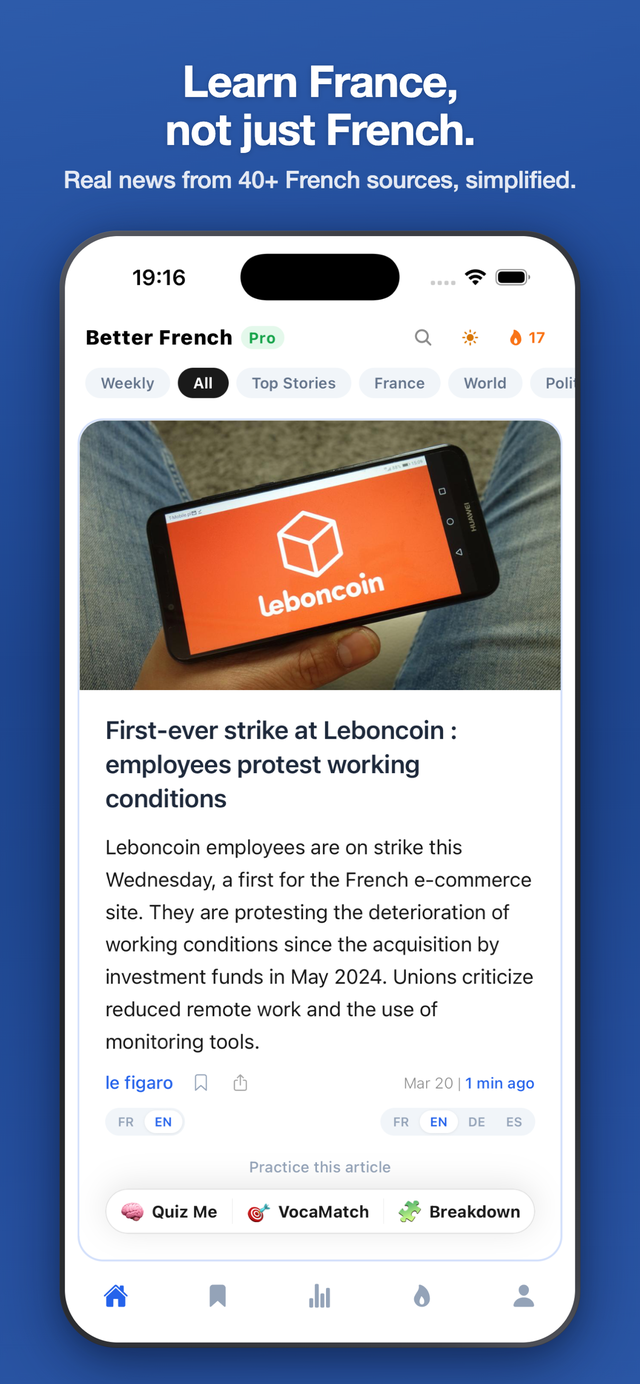
Most of the work happens before you open it. Every day we read around 800 articles from more than 40 French sources and pick the fourteen or so that matter to someone learning the language: the story that will come up at work, the reform everyone has an opinion about, the reason the trains are not running on Thursday. Then each of those stories is rewritten at five levels. You read the version written for where you are right now, about the same event a French colleague read this morning. The picking and the rewriting are the product, and the rewriting is the part nothing else does.
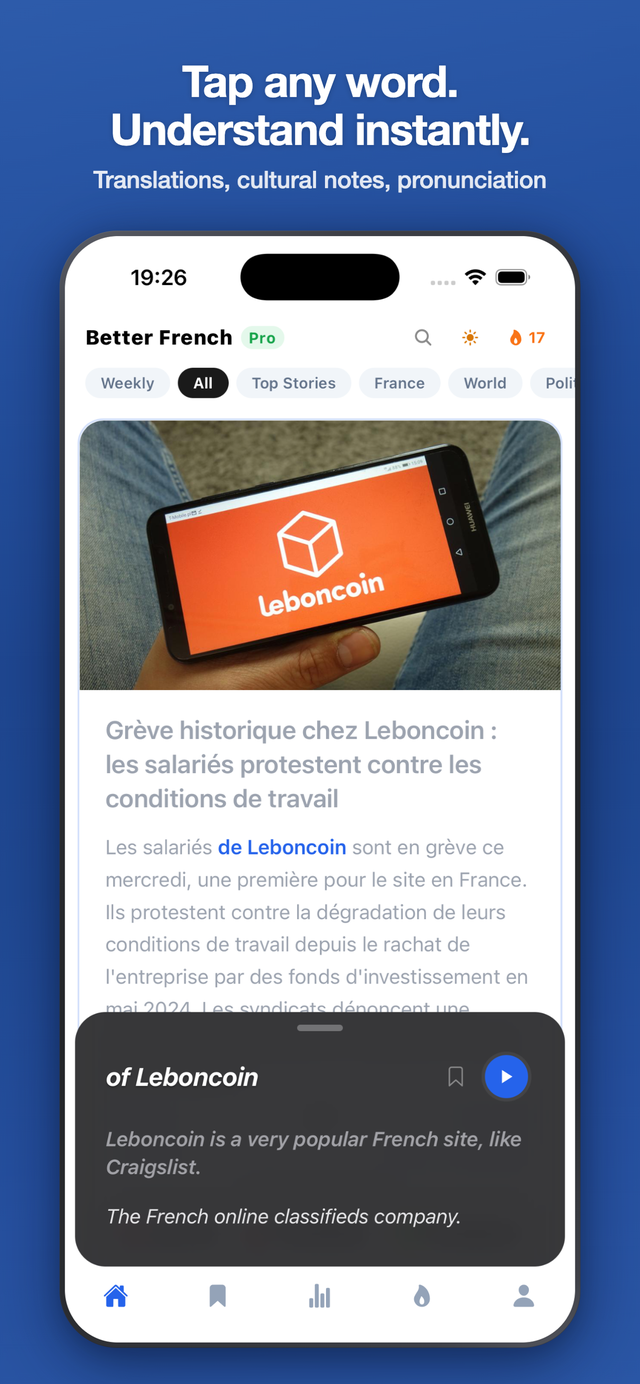
Inside a story, Better French Context closes the gap I described earlier. Tap any word or short phrase and you get the translation, the explanation, and the cultural note -- what it means, and what a French person hears when they read it. No dictionary, no second tab, no losing the thread of the sentence you were in the middle of. Audioplay lives in the same tooltip: tap the play icon and you hear that word or phrase spoken just under native speed. There is no narrator reading the whole article to you, on purpose. This is reading practice, and the quickest way to stop reading is to let a voice do it for you.
If you want to check yourself against English, Read in Your Language flips the whole article over and back with one tap -- English, German or Spanish -- which beats pasting a paragraph into a translator that flattens every idiom in it.
Then the part I care most about. Three games, built from the story you just read rather than from a generic word list:
- Quiz Me -- three questions on the article you just finished. They check what you actually understood, and they usually teach you something about France on the way. The difficulty moves with your streak, so it stops being easy once you stop being a beginner.
- VocaMatch -- match the vocabulary from that story to its meaning. Three lives, no clock, three difficulty bands. Nothing here is a speed test. Rushing a learner through vocabulary is how you end up recognizing a word forever and never using it.
- Breakdown -- say the story out loud, one phrase at a time, across three tiers. This is where reading quietly turns into being able to open your mouth about the thing you read.
There is also search and an archive, so you can follow one story across every source that covered it; nineteen sections if you would rather read about food and culture than politics; and a tap through to the original article any time you want to see how the journalist actually wrote the sentence.
I am biased, obviously. I built it because I needed it myself -- I was the person closing the Le Monde tab after one paragraph. The honest version is that everything in this guide works with a free newspaper and a notebook, and plenty of people have done it that way. What Better French removes is the friction that makes most of us quit in week two. Better French is a subscription and it starts with a free trial. It works out at under €5 a month, and the exact price for your country is shown in the app before you pay.
The 15-Minute Daily Routine
When I started reading French news consistently, I did not block out an hour. I blocked out fifteen minutes with my morning coffee. That was enough. Two years later, it is still enough.
The routine has three phases. They fit into a single session.
Phase 1: Review (2 minutes). Before reading anything new, review the five vocabulary words you noted yesterday. Say each one aloud, recall its meaning, try to remember the sentence you originally saw it in. This retrieval practice is what moves words from short-term recognition to long-term retention. If you cannot remember a word, put it on today's list again.
Phase 2: Read (10 minutes). Read one article. Not two, not five. One. Read it slowly on the first pass, trying to understand the main idea without looking anything up. Then read it again, this time looking up words that are critical to understanding the story. Do not look up every unknown word. Focus on words that appear more than once, words that seem essential to the meaning, and words you are genuinely curious about. Let the rest go.
Phase 3: Note (3 minutes). Write down no more than five new words from today's article. For each word, write the French term, its meaning in context (not just a dictionary definition), and the sentence you found it in. A vocabulary entry like "enjeu -- issue, what is at stake -- Le climat est l'enjeu principal de cette élection" is far more useful than just "enjeu = stake."
That is fifteen minutes. Do it every day -- with coffee, during lunch, on the metro, before bed -- and your reading will improve noticeably within two to three weeks. I noticed the shift after about three weeks. Articles that had felt opaque started making sense on the first read. Words I had looked up a week earlier appeared again and I recognized them instantly. It was not dramatic. It was gradual. But it was undeniable.
Five sessions of fifteen minutes spread across the week beats one 75-minute session on Sunday. Your brain needs daily repetition, not occasional marathons.
5 Techniques That Actually Work
Reading in a foreign language is not the same as reading in your native language. Your brain is processing at a different level. These five techniques are the ones that produce the most noticeable improvement -- they are what I actually did, not what a textbook says you should do.
1. Skim headlines first. Before reading a full article, scan the headline and any subheadings. This gives your brain a framework for what is coming, which dramatically improves comprehension. If the headline says Réforme des retraites: les syndicats appellent à une nouvelle journée de mobilisation, you already know the topic (pension reform), the actors (unions), and the action (calling for a protest day). Your comprehension of the body text jumps because you are not decoding the subject matter and the language simultaneously.
2. Use context before reaching for translations. When you hit an unknown word, do not look it up immediately. Try to guess its meaning from the surrounding sentence. What part of speech is it? Does it resemble a word you know? Does the sentence make sense if you substitute your guess? This mental effort strengthens the inference pathways that eventually make reading feel automatic. Even when your guess is wrong, the effort matters. Only look up the word after you have genuinely tried.
3. Read in chunks, not word by word. Beginner readers process one word at a time, which is slow and exhausting. Train yourself to read in phrases: le premier ministre is one unit, not three words. En raison de is one expression. Selon les autorités is a single chunk you will see hundreds of times. News is particularly good for this because it recycles common phrases (dans un communiqué, au cours de, mise en place) that quickly become recognizable units. The more you chunk, the faster and more naturally you read.
4. Read aloud once a week. Reading aloud forces your brain to connect written French with spoken French. It slows you down, which improves comprehension. It trains pronunciation. And it reveals patterns that silent reading misses -- the rhythm of French sentences, the liaison between words, how intonation marks the end of a clause. You do not need to do this daily. Once or twice a week with one article makes a noticeable difference in both your reading and your speaking.
5. Track your word lookups per article. Count how many times you look up a word in each article. In your first week, it might be fifteen. After a month, eight. After three months, four or five. This decline is one of the most reliable indicators of vocabulary growth, and watching the number drop is genuinely motivating. If you use Better French you do not have to keep the tally by hand: every unique word you tap counts toward a running total of words understood, sitting next to articles read and your streak.
How to Track Your Progress
Improvement in reading is gradual. Day to day, you will not feel it. Without some kind of record you might conclude you are not getting better -- even when you are. I almost quit after two weeks because it felt like nothing had changed. Then I looked at my notes and realized I was looking up half as many words as on the first day.
Counting is the obvious move and it is worth doing: articles finished, lookups per article. But a count only ever tells you a number went down. It does not tell you what you can read now that you could not read in March. For reading practice specifically, three checks have been worth more to me than any number.
Re-read something that beat you. Save the link to the first article that genuinely defeated you. Leave it alone for a month, then open it cold. No lookups, no help. This is the most honest test of reading progress there is, and it is the only one that ever made me feel the difference rather than infer it from a spreadsheet. Do it again a few months later with something harder. On a daily scale, Quiz Me is the small version of the same test: three questions on the article you just read, which is how you find out whether you understood it or only recognized it.
Judge the words you kept, not how many. A vocabulary list of two hundred words proves nothing. A list where you can still say where each word came from proves a great deal. This is why Saved Words in Better French keeps the story attached to the word: save vigilance orange off a weather piece and it stays tied to the sentence you met it in and the cultural note that arrived with it. A month later you are not revising a definition, you are revising a bit of France you read about, which is the reason it is still in your head. Do the same on paper if you prefer paper. The rule is that a word without its story is a word you are going to lose.
Follow one story for a week. Pick something with legs -- a strike, a trial, a budget fight -- and read whatever comes out about it for seven days. By day four the fourth article will be noticeably faster than the first, because the names and the vocabulary repeat. That acceleration is what growing fluency feels like from the inside, and it is completely invisible if you read one unrelated article a day. Better French has search and an archive so you can pull a single story across every source that covered it, but a bookmarks folder does the same job.
Keep a weekly log if you are the kind of person who keeps logs. Date, what you read, one line on how it felt. The log is not really data collection. Its value turns up in month three, when you read the entry from week one and barely recognize the person who wrote it.
Frequently Asked Questions
What level of French do I need to start reading news?
You can start at A2 with the right tools. You will not understand every word, and that is fine. Start with 1jour1actu or 20 Minutes. Or use Better French, where the day's stories are chosen from 40+ sources and rewritten at five levels, and Better French Context gives you the translation, the explanation and the cultural note for any word you tap. Understanding 60% of an article teaches you more practical French than understanding 100% of a textbook dialogue.
How much time should I spend reading French news each day?
Fifteen minutes is enough to see measurable improvement. One article, read carefully, with five new vocabulary words noted. Consistency matters more than duration. Tie it to an existing habit -- morning coffee, lunch break, commute -- and it becomes automatic within a week or two.
Should I look up every word I do not understand?
No. Try to guess meaning from context first. Only look up words that are essential to understanding the main idea, or words that keep appearing. Aim for five new words per session. Looking up every unknown word turns reading into a dictionary exercise and kills the flow that makes reading effective.
How do I know if my French reading is actually improving?
Counting helps -- articles finished, words looked up -- but the sharper test is to re-read an article that defeated you a month ago, cold. If it makes sense on the first pass now, that is progress no metric captures. The second signal is your saved vocabulary: if you can still say which story each word came from, it stuck. Quiz Me gives you the daily version, three questions on the article you just read.
Is it better to read French news or French novels?
Both help, but news has practical advantages for most learners. The vocabulary is immediately useful -- the same words in news appear in conversations, official mail, and daily life. News refreshes daily, so you never run out of material. Novels are great supplemental reading, but news should be the daily habit because it teaches you the French people actually use.
Get Better French
Fourteen stories a day, chosen out of around 800 and rewritten in clear French you can actually read. Tap any word for Better French Context, then play Quiz Me, VocaMatch and Breakdown, all built from the story you just read. Better French is a subscription and it starts with a free trial. It works out at under €5 a month, and the exact price for your country is shown in the app before you pay. Available on the App Store and Google Play.
Download the App