Why Learning French With Real News Beats Textbooks
French textbooks teach you classroom French. French news teaches you the language people actually use. Reading real news builds practical vocabulary, cultural fluency, and comprehension skills that transfer directly to conversations, emails, and life in France. You can start at A2 with the right tools, and a daily 15-minute habit produces better results than weekly textbook sessions. This guide explains why news works, how it compares to textbooks, and gives you five steps to get started today.
Most French learners follow the same path. Buy a textbook. Work through chapters on verb conjugations. Practice dialogues about ordering coffee and asking for directions. Take a test. Move to the next chapter. Repeat for months or years.
Then they try to follow a conversation about current events, open a newspaper, or turn on the radio -- and realize they understand almost nothing. The gap between textbook French and real French is enormous, and no amount of grammar drills closes it. This happens whether you are in a classroom in Paris or studying from home in Sao Paulo.
I experienced this firsthand. After months of textbook study, I tried reading a Le Monde article about pension reform. I knew every verb conjugation in the passé composé, but I had never seen the word cotisation -- a word that appears in French news almost every day. That was the day I stopped studying French and started reading it.
Reading real French news, consistently, with the right tools and approach, builds the vocabulary, cultural knowledge, and comprehension skills that textbooks cannot. This is not a theory. It is how millions of people have learned to read, write, and think in a second language -- by engaging with real content about real things happening in the real world. And it works from anywhere. French news is available globally, and reading it daily connects you to France no matter where you live.
Why Is News the Best French Teacher?
News does three things that textbooks cannot: it teaches real vocabulary, it covers current topics, and it immerses you in French culture. Together, these create a learning experience that is qualitatively different from anything a structured course can offer.
Real vocabulary in real context. News articles use the vocabulary of everyday French life. Words like pouvoir d'achat (purchasing power), manifestation (protest), cotisation (social contribution), and collectivité (local authority) appear in French news every single day. These are not obscure terms. They are the words French people use when they talk about their country, their economy, their politics, and their daily concerns. Textbooks rarely teach them because they do not fit neatly into a chapter on food vocabulary or past tense conjugation. But these are the words you actually need to understand French life.
Current topics that matter. When you read a textbook dialogue about a fictional character visiting a boulangerie, your brain processes it as an exercise. When you read a news article about a real boulangerie strike in Lyon, your brain processes it as information. That distinction matters because the brain is significantly better at retaining information it perceives as meaningful and relevant. News is inherently meaningful -- it is about things happening right now, to real people, in a real country. That relevance makes vocabulary stick in ways that textbook exercises cannot match.
Cultural immersion from anywhere in the world. Language and culture are inseparable. When you read French news, you are not just learning words -- you are learning what matters to French people, how they think about issues, what their institutions are, how their society works. You learn that la rentrée is not just "the return" but a national moment in September when everything restarts. You learn that labor strikes are a regular feature of French life, not a crisis. You learn that regional identity matters deeply. None of this comes from a grammar book. All of it comes from reading the news.
And this compounds. The more news you read, the more context you have for the next article. After two weeks of reading about French politics, you know who the key figures are, what the debates are about, and what vocabulary to expect. Each article gets easier because you are building domain knowledge alongside language knowledge. This is something textbooks, with their disconnected chapters on unrelated topics, fundamentally cannot offer.
How Does Textbook French Compare to Real French?
The difference between textbook French and the French you encounter in news, conversation, and daily life is not subtle. It is a different register, a different vocabulary set, and often a different way of constructing sentences entirely.
| Textbook French | Real French (News) |
|---|---|
| Je voudrais un café, s'il vous plaît | La hausse du prix du café inquiète les torréfacteurs |
| Il fait beau aujourd'hui | Météo France place 12 départements en vigilance orange |
| Nous allons au marché | Les marchés financiers réagissent à la décision de la BCE |
| Mon père travaille dans un bureau | Le télétravail recule, les entreprises rappellent leurs salariés |
| Le train arrive à 14 heures | SNCF: perturbations attendues sur le réseau TGV ce week-end |
| Elle aime le chocolat | La filière cacao face à une crise d'approvisionnement mondiale |
Look at the difference. Textbook French is simple, declarative, and personal. Real French news is dense, institutional, and packed with vocabulary that textbooks never cover -- vigilance orange, torréfacteurs, la BCE, filière, perturbations. These are not advanced or obscure words. They are common, everyday French. But you will not find them in Chapter 7 of any beginner textbook.
This does not mean textbooks are useless. They serve a purpose at the very beginning: teaching you verb forms, basic sentence structure, and foundational vocabulary. But there comes a point -- usually around A2 or B1 -- where the textbook approach stops producing meaningful gains. You keep learning grammar rules but cannot understand a real French sentence. You keep practicing dialogues but cannot follow a real conversation. That is the plateau, and news is how you break through it.
How Do You Start Learning French With News?
You do not need to be fluent. You do not need to understand every word. You need a method, the right sources, and about fifteen minutes a day. Here are five steps that work.
Step 1: Pick one source and stick with it. Do not try to read five different French newspapers from day one. Pick one accessible source -- France Info, 20 Minutes, or Le Parisien are good starting points -- and read it daily for at least two weeks. This lets you get familiar with that publication's writing style, recurring vocabulary, and structure. Once one source feels comfortable, add another. Spreading yourself too thin early on leads to overwhelm and abandonment.
Step 2: Start with headlines, not full articles. French news headlines are dense with information. A single headline like Grève des transports en Île-de-France: trois lignes de métro fermées mardi contains at least five useful vocabulary items. Spend your first few days just reading ten to fifteen headlines and trying to understand their meaning. This builds your news vocabulary foundation quickly without the commitment of reading full articles.
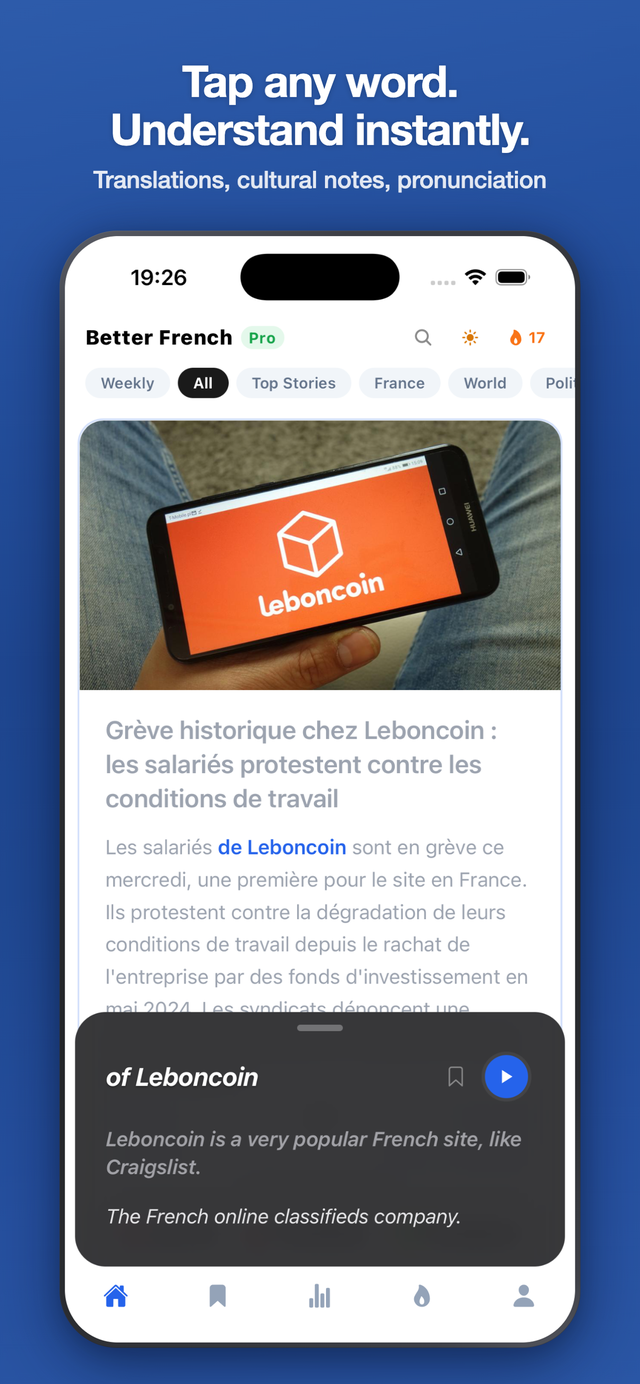
Step 3: Use a tool with built-in translation. Looking up words in a separate dictionary app destroys your reading flow. Every time you leave the article to check a word, you lose context and momentum. Tools that let you tap a word and see its meaning in place -- without leaving the page -- keep you reading. That is what Better French Context is for: tap a word or a short phrase and you get the translation, an explanation of how it is being used in that sentence, and the cultural note behind it, all without leaving the article. The difference in reading experience is significant: you stay immersed in the article instead of bouncing between apps.
Step 4: Keep a vocabulary notebook, but limit it. After each reading session, write down no more than five new words. Not every word you did not know -- just the five that seem most useful or that appeared multiple times. Review yesterday's five words before reading today's article. This constraint is important. If you try to learn every new word, you will learn none of them. Five words a day is 35 per week, 150 per month, nearly 2,000 per year. That is more than enough to dramatically improve your comprehension.
Step 5: Increase difficulty gradually. After two to three weeks with an accessible source, try a slightly more challenging one. If you started with 20 Minutes, move to France Info or Le Parisien. After a month there, try reading a Le Monde article. You will be surprised at how much more you understand. The vocabulary you built from easier sources transfers directly -- gouvernement, réforme, hausse, bilan appear in every French publication. The only difference is sentence complexity, and that is something your brain adapts to with exposure.
What Level Do You Need to Start?
This question stops most people from starting. They feel they need to reach some mythical level of readiness before engaging with real French content. You do not.
A2 (Elementary): You can start, with support. At A2, you know basic vocabulary and simple sentence structures. Raw French news will be too difficult. A real story rewritten at A2, with the meaning of every word one tap away and the references explained instead of assumed, is not. That is what Better French does at this level: you get the same story a C1 reader gets that morning, written so that you can actually get to the end of it. Start with headlines and short articles on familiar topics like weather, sports results, or local events.
B1 (Intermediate): You can read most general news articles with occasional translation help. At B1, you know enough grammar and vocabulary to follow the structure of a news article. You will still encounter unknown words, but you can often guess their meaning from context. This is the level where daily news reading produces the fastest gains, because each article reinforces vocabulary you partially know and introduces new words in understandable contexts.
B2 and above (Upper Intermediate to Advanced): You can read opinion pieces, editorials, and analytical articles. At this level, news reading is less about building basic vocabulary and more about refining your understanding of nuance, register, and style. You start noticing how Le Monde writes differently from Libération, how editorial choices reveal political leanings, and how idiomatic expressions carry meaning beyond their literal translation. This is where you stop learning French and start thinking in French.
There is no level at which you are not ready. There is only a question of how much support you need. At A2, you need a lot of support. At C1, you need almost none. The tools exist to bridge that gap at every level. What matters is that you start.
What Are the Best Tools for Learning French With News?
Before the tools, the honest problem. French news was not written for you. It was written for a French reader who already knows what a motion de censure does, which ministry is which, why the word laïcité starts an argument, and what happened in that story last week. Nothing gets explained, because for the reader it was written for, nothing needs explaining. The hard words are not glossed. The references are not footnoted. There is no easier version for the days you are tired. And when you reach the end there is nothing to check yourself against, so you never find out whether you understood the story or just recognized enough words to feel like you did. None of this is a failing of French journalism. The material was never built to teach anyone anything, and on its own it will not move your French. That is the gap a tool has to close, and most of them close one corner of it.
Your choice of tool determines whether reading French news feels productive or punishing. The wrong tool turns every article into a frustrating exercise in dictionary lookups. The right tool turns it into an immersive experience where you learn without realizing you are working.
Browser extensions like Google Translate can translate entire pages, but this defeats the purpose. If you read the English translation, you are not learning French. Page-level translation is for emergencies, not learning. Some extensions offer word-level hover translation, which is better, but they lack context -- they give you dictionary definitions, not explanations of how the word is being used in this specific sentence.
Dictionary apps like WordReference are excellent references but terrible reading companions. The process of selecting a word, switching to the dictionary app, finding the right definition among multiple options, and switching back to your article is slow and disruptive. If you need to do this more than three or four times per article, the experience becomes exhausting.
Slow news platforms like News in Slow French slow the delivery down and retell the week's stories in easier French. As a way into listening it works. The cost is what happens to the story on the way through. The words a French journalist would have used get swapped for words a learner already knows, and the references that make a French story French get smoothed off. You get comfortable with a version of the news that nobody in France is actually reading. It is also a subscription in its own right, at $22.90 a month for the single plan.
There is a distinction here worth being precise about, because everything turns on it. Simplifying a story and rewriting a story at your level are not the same operation. Simplifying swaps the hard words out and the story arrives hollow. Rewriting at your level keeps the event, the references and the words French people actually used, and changes only how much gets packed into each sentence. An A2 reader and a C1 reader open the same story about the same pension vote. One gets it in short, direct sentences. The other gets it in the long subordinate-clause prose Le Monde would use. Both come away holding words they will hear again this week, and that is the difference that shows up in your French rather than only in your reading time.
Better French is built on that second operation, and on the idea underneath it: you read what French people are reading, you understand France because of it, and your French improves because you finally have somewhere real to put it. Every morning it reads around 800 articles from more than 40 French sources -- France Info, Le Figaro, La Dépêche, Ouest-France, Libération and dozens more -- and picks the fourteen or so that a person learning French actually needs that day. The story your colleagues will bring up at lunch. The decision that changes something. The cultural moment that would otherwise go past you. The picking is not a technicality, it is half the product. Nobody needs a firehose of French. You need the fourteen stories France is talking about today, because those are the stories whose vocabulary comes back at you all week, at work, on the radio, at dinner. Those words are the shortest route to understanding what is being said around you.
Each of those stories is then rewritten at five levels. The version that opens on your phone is written for where you are, not for where a French journalist assumed you were. Same event, same names, same references, same vocabulary that matters. Different density. Which means you spend the whole article stretched rather than drowning, and being stretched is the condition under which French actually improves.
Inside the article, every word is live. Tap any word or short phrase and Better French Context gives you three things at once: the translation, an explanation of how the word is working in that sentence, and the cultural note behind it -- what the acronym stands for, what a French reader hears in that word that no dictionary will tell you. Audioplay sits in the same tooltip, so you can hear any word or phrase spoken in natural French, deliberately just under native speed. If a whole sentence refuses to come apart, Read in Your Language flips the article into English, German or Spanish and back into French again, so you can check what you thought it said instead of guessing.
Then you close the article and find out whether you actually understood it. Three games are built from the story you have just read, not from a generic word list. Quiz Me asks three questions, and gets harder as your streak gets longer. VocaMatch takes the vocabulary out of that story and gives you three lives and no timer, at whichever of its three bands matches your level. Breakdown teaches you to say the story out loud, one phrase at a time, in three tiers. This is the thing textbooks claim to do with end-of-chapter exercises and never manage, because the exercise was never about anything that happened.
The rest is the plumbing that makes a daily habit survive past week two. Nineteen sections, France and food and culture and sixteen more, so you read about what you already care about. Search and an archive, so you can follow one story across every source that covered it, over weeks. Saved Words, where every word you keep holds on to the story you met it in and the cultural note that came with it, which is the difference between remembering a word and remembering a flashcard. Straight to the Source, one tap through to the original article when you want it at full strength. And a running count of the words you have understood, the articles you have read and the days you have kept going.
The combination of real content with real support is what makes news-based learning work. You are engaging with the same French that French people read, but you have a safety net that catches you when you stumble. Over time, you use the safety net less and less. That is what fluency looks like -- not passing a test, but reading Le Monde and understanding it without help.
Better French is a subscription and it starts with a free trial. It works out at under €5 a month, and the exact price for your country is shown in the app before you pay. If you have been meaning to learn French through the news for a while but have never got past the first paragraph of a real article, this is the thing that closes that gap.
Frequently Asked Questions
Can you really learn French just by reading the news?
Reading French news is one of the most effective ways to build vocabulary, improve comprehension, and absorb cultural context. It works best as a core daily habit alongside speaking practice. The advantage over textbooks is that news uses real, current language -- the same vocabulary and structures you encounter in everyday French life.
What French level do I need to start reading news?
You can start at A2 with the right support. At A2, you need short pieces, a way to get the meaning of any word without leaving the article, and the cultural references explained rather than assumed. By B1, you can read most general news articles with occasional help. B2 and above can handle editorial and analytical pieces. The important thing is to start, not to wait until you feel ready.
How is learning French with news different from using a textbook?
Textbooks teach controlled, simplified French organized by grammar topic. News exposes you to real French as it is actually written and spoken -- with current vocabulary, idiomatic expressions, cultural references, and complex sentence structures. Textbooks prepare you for exams. News prepares you for France.
What is the best app for learning French with news?
Better French is built for exactly this. Every day it reads around 800 articles from more than 40 French sources and picks the fourteen or so that matter to someone learning French, then rewrites each story at five levels so you read the real news at your own level. Tap any word for Better French Context: the translation, the explanation, and the cultural note behind it. Three games built from the story you just read -- France Info, Le Figaro, La Dépêche, BFMTV, Ouest-France and dozens more -- check what you actually understood. Better French is a subscription and it starts with a free trial. It works out at under €5 a month, and the exact price for your country is shown in the app before you pay.
Get Better French
The stories France is talking about today, rewritten in clear French you can actually read. Tap any word for the translation, the explanation and the culture behind it, then let three games check what you understood. On the App Store and Google Play.
Download the App