Best French News Sources: 40+ Papers, TV, and Radio Explained
France has one of the richest media landscapes in the world. This guide covers every major category: national newspapers (Le Monde, Le Figaro, Libération, Les Echos, Le Parisien), TV and radio news (France Info, France 24, BFM TV, RFI, Europe 1), regional papers (Ouest-France, La Dépêche, Sud Ouest), and online-only outlets (Mediapart, HuffPost France, Brut). Each source is described with its political leaning, difficulty level for learners, and best use case. Better French reads around 800 articles a day from more than 40 French sources, picks the fourteen that matter to a French learner, and rewrites each one for five levels. Which sources we carry, and which of the ones below we do not, is set out near the end.
Understanding French news means understanding France. And understanding France means knowing its media landscape -- who reports what, from which perspective, for which audience, and at what level of complexity.
The good news: every source listed here is available online, from anywhere in the world. Whether you are studying French in Tokyo, commuting in Toronto, or reading from your apartment in Berlin, the full depth of French media is open to you. You do not need to live in France to read like someone who does.
France has an exceptionally rich and varied media ecosystem. National newspapers span the political spectrum from left to right. Regional papers cover local life with a depth that Anglophone countries often lack. Public broadcasters coexist with commercial channels. Digital-native outlets challenge traditional media with investigative reporting and new formats.
When I started reading French news, I made the mistake of going straight to Le Monde. I understood about one sentence in three. It took me weeks to realize that starting with France Info and 20 Minutes would have been far more productive -- and far less demoralizing. This guide is the map I wish I had: which source to read, when, and why.
The reason to read any of this is that it moves your French faster than a textbook does. Reading what French people are actually reading is how you pick up the words they actually use, in the order they actually use them, attached to the things they are actually arguing about. Learning French isn't enough on its own, and that is the whole point: the country is what unsticks the language.
Except French news wasn't built for French learners. It was written by French people for French people, which means the jargon arrives unexplained because everyone in the room already knows it, the political shorthand assumes twenty years of context you were not here for, nobody stops to gloss a word, and there is nothing at the end to tell you whether you understood any of it. That is not a flaw in French journalism. It is what a national press is. Every outlet below is excellent, and not one of them was made for you. That is why the difficulty rating on each one matters more than the description: it tells you what you can read today, and what will only demoralize you.
What Are the Major French National Newspapers?
France's national newspapers are the backbone of its media landscape. Each has a distinct editorial identity, political leaning, and writing style. For language learners, the differences in style matter as much as the content -- reading Le Monde develops a different vocabulary and register than reading Le Parisien.
Le Monde is the most respected French newspaper for a reason -- dense, thorough, and essential reading for anyone serious about French. Founded in 1944, it sets the standard for serious French journalism. Its writing is sophisticated, analytical, and often literary. Sentences are long, vocabulary is precise, and articles assume a well-informed readership. Politically, Le Monde leans center-left on social issues while maintaining a broadly centrist editorial line. For learners, it is a B2+ source -- rewarding to read at that level but frustrating below it. Le Monde's headlines alone are worth reading daily for vocabulary building.
Le Figaro is the oldest national daily in France, founded in 1826. It leans center-right and is considered the paper of the French establishment -- business leaders, professionals, and the traditional middle class. The writing is polished and formal but slightly more accessible than Le Monde. It covers politics, economics, and culture extensively. For learners, Le Figaro is a solid B2 source. Its cultural coverage is particularly good for building arts and lifestyle vocabulary.
Libération was founded in 1973 with ties to the post-1968 French left. It remains left-leaning with a distinctive, sometimes provocative editorial voice. The writing style is more creative and informal than Le Monde or Le Figaro -- headlines are often clever wordplay, and feature articles can be quite literary. For learners, Libération is interesting at the B2 level for its idiomatic language and cultural commentary, but the wordplay in headlines can be opaque to non-native speakers.
Les Echos is France's leading business and economics newspaper, and the single best source for building professional French vocabulary. If you work in finance, technology, or business, this is your paper. The writing is precise, data-driven, and relatively formal. Articles assume familiarity with economic concepts but explain them clearly. Politically, Les Echos is pro-business and economically liberal in the European sense. For learners, it is a B1+ source if you already know the subject matter, and a B2 source otherwise.
Le Parisien is the source I recommend most for B1 learners. It covers national and Paris-region news in an accessible, approachable style -- serious topics in plain language. Articles are shorter than Le Monde's, sentences are more direct, and the vocabulary is practical. Politically, Le Parisien is centrist with a populist streak. If you can only read one French newspaper at the intermediate level, make it this one.
La Croix is a daily newspaper with a Catholic editorial perspective. It covers national and international news with a particular focus on ethics, social justice, and humanitarianism. The writing is thoughtful and measured. For learners, La Croix is a B1-B2 source that provides a perspective often missing from other outlets -- useful for understanding the role of religion and values in French public life.
L'Humanité was historically the newspaper of the French Communist Party. Today it remains on the left of the political spectrum, covering labor issues, social movements, and inequality. For learners, it builds vocabulary around French labor relations, unions, and social policy -- topics that are central to French political life.
What Are the Main French TV and Radio News Sources?
Broadcast news in France is dominated by public service media alongside a competitive commercial landscape. Many of these outlets publish extensively online, making them accessible as reading material as well as audio and video sources.
France Info is the best starting point for any French learner, period. It is the flagship news brand of France's public broadcasting system, and its website publishes short, factual articles throughout the day, plus longer analysis pieces. The writing is clear, well-structured, and politically neutral by design. Its short articles work for A2 learners with support tools, while its analysis pieces challenge B2 readers. The radio feed is also excellent listening practice. And everything is free -- no paywall, available worldwide.
France 24 is a 24-hour international news channel that broadcasts in French, English, and Arabic. Because it targets a global audience, articles tend to explain French context that domestic outlets take for granted. The language is clear and relatively formal. For learners, France 24 is a B1 source that provides good coverage of international events from a French perspective.
BFM TV is France's most-watched 24-hour news channel. Its style is fast-paced and breaking-news oriented, similar to CNN. Online articles tend to be short and focused on developing stories. The language is straightforward but can be breathless during live events. For learners, BFM TV's online articles are accessible at the B1 level, though the quality of analysis is generally lower than France Info or Le Monde.
RFI (Radio France Internationale) broadcasts in French to a worldwide audience -- and its "Journal en français facile" (news in easy French) is a gift for learners. Specifically designed for non-native speakers, with slower speech and simpler vocabulary, it publishes transcripts alongside audio, making it ideal for combined reading and listening practice. If you are below B1, RFI should be one of your daily sources. Accessible from A2 upward and free everywhere.
Europe 1 is a major commercial radio station covering news, politics, culture, and sport. Its website publishes articles and interviews. The tone is more conversational than France Info, which makes it good practice for understanding less formal French. For learners, Europe 1 is a B1-B2 source.
RTL is France's most-listened-to commercial radio station. It covers general news with a mass-market approach. Articles are short and accessible. For learners, RTL's online content is a solid B1 source for everyday news vocabulary.
What About French Regional Newspapers?
Regional newspapers are a distinctive feature of the French media landscape. Unlike in many Anglophone countries where local news has declined, France's regional press remains robust and widely read. These papers cover local politics, culture, events, and daily life with a depth that national outlets do not match.
For language learners, regional papers offer a significant advantage: they cover concrete, everyday topics -- local festivals, market openings, road works, school events, weather -- using practical vocabulary that maps directly to daily life in France. If you live in France or plan to, your regional paper is arguably more useful than Le Monde for building the language you actually need.
Ouest-France is the most-read daily newspaper in France, not just among regional papers but overall. Based in Rennes, it covers Brittany, Normandy, and the Loire Valley. The writing is clear, grounded, and accessible. For learners, Ouest-France is an excellent B1 source that builds practical vocabulary about French daily life, regional culture, and local governance.
Sud Ouest covers the southwest of France, including Bordeaux, the Basque Country, and the Dordogne. It has a strong local identity and covers food, wine, rugby, and regional politics extensively. For learners interested in the southwest, it builds vocabulary specific to one of France's most culturally rich regions.
La Dépêche du Midi covers the south-central region around Toulouse. Like other regional papers, it balances national coverage with detailed local reporting. The writing is straightforward and practical.
Le Télégramme is the daily newspaper of Brittany, covering Breton culture, maritime issues, and local news. It has a loyal regional readership and a strong online presence.
La Voix du Nord covers the north of France, including Lille and the Hauts-de-France region. It has a strong focus on local industry, social issues, and cross-border news with Belgium.
Dernières Nouvelles d'Alsace (DNA) covers the Alsace region, with its unique cultural blend of French and Germanic influences. Articles sometimes reference local traditions and dialects that reflect the region's distinct identity.
Nice-Matin covers the French Riviera and surrounding area. Expect coverage of tourism, maritime issues, local festivals, and the particular lifestyle of the Côte d'Azur.
What Are the Best French Online-Only News Sources?
Digital-native outlets have carved out a significant space in French media, often doing the investigative work and innovative storytelling that legacy outlets struggle to sustain.
Mediapart is France's most important investigative news site and arguably the best journalism in the French language right now. Founded in 2008 by Edwy Plenel (formerly of Le Monde), it operates on a subscription model with no advertising. Mediapart has broken major stories, including financial scandals and political corruption cases. The writing is detailed, analytical, and often long-form. For learners, Mediapart is a C1 source -- the language is demanding. But being able to read Mediapart is a worthy goal. When you can follow a Mediapart investigation in French, you have arrived.
HuffPost France is the French edition of HuffPost, covering politics, society, and culture with a mix of news reporting and opinion. The writing style is more conversational and web-native than traditional outlets. For learners, it is a B1-B2 source with accessible language and topics that often overlap with international news.
Brut is a digital-first video media company that produces short, engaging video content about current events, social issues, and culture. Its written articles accompany videos and use simple, direct language designed for social media audiences. For learners, Brut is among the most accessible sources -- its language is informal, modern, and representative of how younger French people communicate.
Slate.fr is the French edition of Slate, publishing analysis and commentary on politics, culture, science, and technology. The writing is intelligent and engaging without being overly academic. For learners at B2, Slate.fr is a good source for building vocabulary around contemporary cultural and social topics.
Le Journal du Dimanche (JDD) is France's major Sunday newspaper, now published daily online. It covers politics and society with a centrist-to-center-right perspective. Its weekend feature articles are often longer and more reflective than daily news coverage.
Which Sources Does Better French Use?
Here I have to be precise, because the honest answer is more interesting than the marketing one. Better French is not a mirror of the French press. We read around 800 articles a day from more than 40 French sources, and we publish fourteen. The other 786 are not worse articles. They are articles that would not move your French and would not teach you anything about France, which for our purposes is the same failure twice.
The sources we read every morning: France Info, Le Figaro, Libération, 20 Minutes, France 24, RFI and Courrier International for general news; Mediapart, L'Express, Le Nouvel Obs and HuffPost France for reporting and analysis; BFMTV and BFM Paris for breaking news and Paris; the regional dailies Ouest-France, Sud Ouest and La Dépêche; Les Inrocks, Télérama, France Inter and France Culture for culture; Capital for money; L'Équipe for sport; Numerama, Frandroid, 01net, Clubic and Journal du Geek for technology; Futura Sciences, Sciences et Avenir, CNRS Le Journal and INSERM for science; and the government feeds, Service-Public.fr, Vie-publique.fr, INSEE, France Diplomatie and the ministries, which is how a rule change about your carte de séjour or your tax return reaches you before your neighbor mentions it.
Several outlets described above are not on that list, and it would be easy to leave that unsaid. Le Parisien, La Croix, Europe 1, RTL, La Voix du Nord, Nice-Matin, Le Télégramme, Brut, Slate.fr and the JDD are all worth your time, and none of them comes through Better French. They are in this guide because you asked what the best French news sources are, not because we resell them. Le Monde is its own case: it is a source we want and do not currently carry, because since May its feed has been handing us an error page where the article should be. Les Echos and La Tribune block us outright.
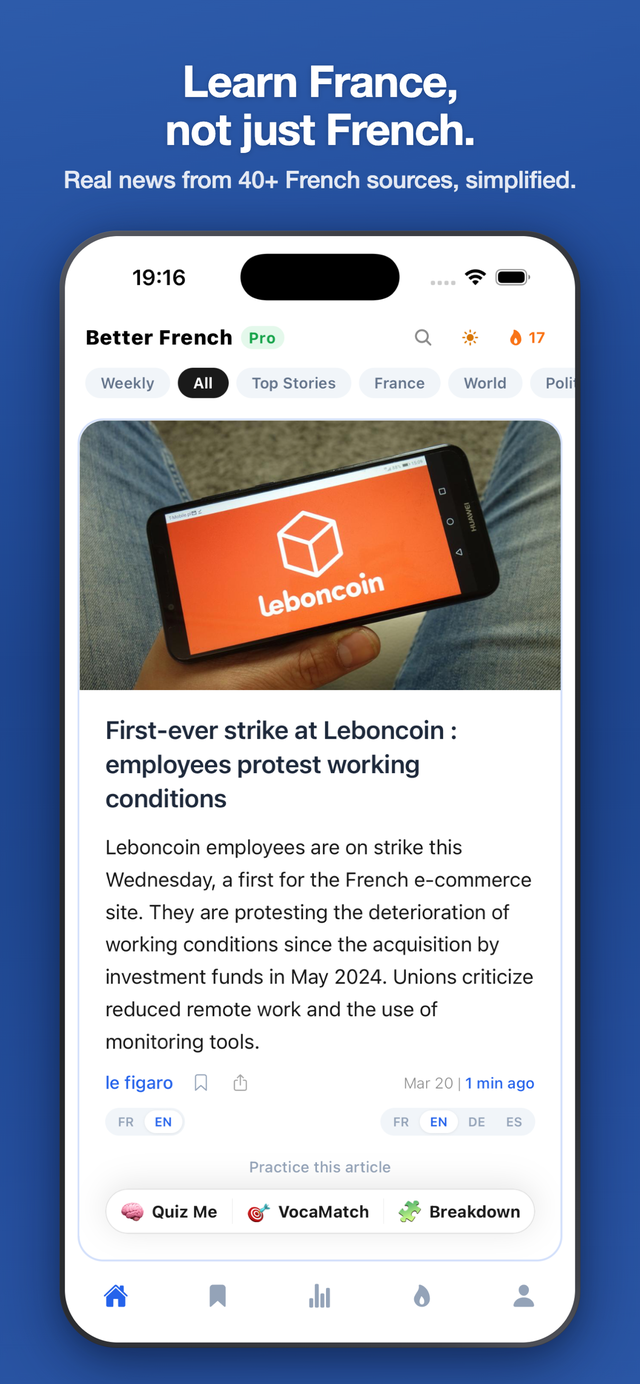
What happens to the fourteen that do get through is the actual product, and it is the part that has nothing to do with news. Each story is rewritten for five levels, so an A2 reader and a C1 reader open the same story on the same morning in language each of them can carry. Better French Context puts the translation, the explanation and the cultural note one tap away on any word or short phrase, which is the difference between looking a word up and understanding why a French person used that particular one. Then three games are built from the story you just read: Quiz Me, three questions that check what you understood and teach you something about France while they do it; VocaMatch, the vocabulary from that story, three lives, no timer; and Breakdown, which walks you through saying the story out loud, one phrase at a time. Audioplay is there whenever you want to hear a word or a phrase in natural French.
A few things follow from reading this way rather than browsing. You can flip an article into English and back, which settles the "did I actually understand that" question in about a second, and it works in English, French, German or Spanish. Every word you save keeps its story and its cultural note, so a word you met in a piece about pension reform stays attached to pension reform instead of becoming a naked flashcard three weeks later. Search runs across the archive, so when a story starts to matter to you, a strike, a trial, an election, you can follow it across sources and across weeks. Nineteen sections let you decide whether your French comes from politics or from food. And every article links straight through to the original, at the outlet that wrote it, whenever you want to see how the sentence looked before we touched it.
Breadth still matters, for two reasons. First, it exposes you to different writing styles, vocabulary sets, and perspectives. Reading only Le Figaro would give you an excellent but narrow view of French. Reading across 40+ sources gives you the full range of how French is actually written. Second, it makes the pool deep enough that fourteen can genuinely be the fourteen worth your morning, rather than whatever happened to publish before breakfast.
Which brings this guide back to where it started. On their own, many of these sources are too difficult for intermediate learners, and not because your French is bad. Nobody wrote them for you. Rewritten for your level, with every word tappable and a cultural note sitting where a French reader would already know the reference, they become the thing they should have been all along: daily reading you can actually finish, at a level that stretches you rather than stops you. You read what French people are reading, so you understand France, and your French improves because of it. That is the order it happens in, and it is the reason the country and the language cannot be separated.
How Do You Choose a Source Based on Your Level?
The right source depends on your current French level, your interests, and your goals.
A2 (Elementary) with support tools: Use Better French, where the day's stories are rewritten at your level rather than left at the source's. If reading directly, start with RFI's "français facile" content, 1jour1actu, or 20 Minutes headlines. Focus on understanding the main idea, not every word.
B1 (Intermediate): France Info, 20 Minutes, Le Parisien, and Ouest-France are your core sources. These use clear language, cover practical topics, and publish articles short enough to read in ten minutes. You should be able to follow the main argument of an article with occasional word lookups.
B2 (Upper Intermediate): Le Monde, Le Figaro, Libération, and Les Echos become readable. You can start engaging with opinion pieces and analytical articles, not just news reports. Your focus shifts from understanding vocabulary to understanding argument and nuance.
C1 (Advanced): Mediapart, Le Monde's long-form features, and specialized coverage (Le Monde Diplomatique for geopolitics, Alternatives Économiques for economics) become accessible and rewarding. At this level, you are reading for content, not for language practice -- and that is the goal.
| Source | Type | Leaning | Difficulty | Free Access |
|---|---|---|---|---|
| Le Monde | National daily | Center-left | B2-C1 | Limited |
| Le Figaro | National daily | Center-right | B2 | Limited |
| Libération | National daily | Left | B2 | Limited |
| Les Echos | Business daily | Pro-business | B1-B2 | Limited |
| Le Parisien | National daily | Centrist | B1 | Limited |
| La Croix | National daily | Catholic center | B1-B2 | Limited |
| France Info | Public broadcast | Neutral | A2-B1 | Full |
| France 24 | International TV | Neutral | B1 | Full |
| BFM TV | 24h news TV | Centrist | B1 | Full |
| RFI | International radio | Neutral | A2-B1 | Full |
| Europe 1 | Commercial radio | Center-right | B1-B2 | Full |
| 20 Minutes | Free daily | Centrist | A2-B1 | Full |
| Ouest-France | Regional daily | Center | B1 | Limited |
| Sud Ouest | Regional daily | Center | B1 | Limited |
| La Dépêche | Regional daily | Center-left | B1 | Limited |
| La Voix du Nord | Regional daily | Center | B1 | Limited |
| Nice-Matin | Regional daily | Center-right | B1 | Limited |
| Mediapart | Online investigative | Left | C1 | None |
| HuffPost France | Online | Center-left | B1-B2 | Full |
| Brut | Digital video | Progressive | A2-B1 | Full |
| Slate.fr | Online magazine | Center-left | B2 | Full |
A few notes on the table. "Limited" free access means the outlet operates a metered paywall -- you can read a certain number of articles per month for free before being asked to subscribe. "Full" means all content is freely available. "None" means Mediapart's content is entirely behind a paywall.
Paywalls are a real constraint on a reading habit, so plan around them. France Info, RFI, France 24, 20 Minutes and BFMTV publish everything free, which is why they carry so much of the daily load for learners. If you are going to pay for one paywalled outlet, pick the one whose subject matter you would read in your own language anyway. That is the one you will still be opening in March.
There is no single "best" French news source. The best source is the one that matches your level, interests you enough to read every day, and pushes your French slightly beyond its current limits. Start with one source. Read it daily for a month. Then branch out. Over time, you will develop your own reading habits across multiple outlets -- just as French people do.
Frequently Asked Questions
What is the best French news source for language learners?
It depends on your level. For beginners (A2), start with 20 Minutes or France Info, which use clear, accessible language. For intermediate learners (B1-B2), Le Parisien and Ouest-France offer substantive reporting in approachable prose. For advanced learners, Le Monde and Les Echos provide sophisticated writing. Better French works the other way round: rather than sending you to a source, it reads around 800 articles a day from more than 40 French sources, picks the fourteen that matter to a French learner, and rewrites each one for five levels, so the difficulty of the original stops deciding what you are allowed to read.
What are the main French national newspapers?
The major French national newspapers are Le Monde (center-left, newspaper of record), Le Figaro (center-right, oldest national daily), Libération (left-leaning), Les Echos (business and economics), Le Parisien (general interest), and La Croix (Catholic perspective). Each has a distinct editorial voice and political leaning that reflects France's diverse media landscape.
Is French news biased?
Like media everywhere, French news sources have editorial perspectives. Le Figaro leans center-right, Libération leans left, and Les Echos focuses on business interests. Le Monde and France Info aim for balanced reporting but have their own perspectives. Reading multiple sources gives you a more complete picture and, as a language learner, exposes you to different writing styles and vocabulary.
How many French news sources does Better French use?
Better French reads around 800 articles a day from more than 40 French sources, including Le Figaro, Libération, France Info, 20 Minutes, France 24, RFI, Courrier International, BFMTV, Mediapart, L'Express, Le Nouvel Obs and HuffPost France, the regional dailies Ouest-France, Sud Ouest and La Dépêche, plus culture, sport, technology, science and government feeds. Fourteen of those articles are published each day, chosen because they teach you something about France, and each one is rewritten for five levels with Better French Context on every word. Better French is not a mirror of the French press: several outlets described in this guide, including Le Parisien, Europe 1, Brut and Slate.fr, are not carried.
Get Better French
Fourteen French stories a day, picked out of around 800 and rewritten in clear French you can actually read, with Better French Context on every word and three games built from the story you just read. On the App Store and Google Play. Better French is a subscription and it starts with a free trial. It works out at under €5 a month, and the exact price for your country is shown in the app before you pay.
Download the App