French News in English -- And Why You Should Graduate Beyond It
France 24, The Local, RFI English, and Connexion are the best sources for French news in English. They are useful for staying informed about France, but they will not improve your French. To actually build language skills, you need to start reading in French -- and apps like Better French make that transition accessible by rewriting real French news for your level, with every word tappable for a translation, an explanation and the cultural note behind it.
If you are interested in what is happening in France but your French is not strong enough to read Le Monde, you are not alone. Millions of people around the world -- expats, French learners, international professionals, Francophiles -- want to follow French news but need it in English. And there are some excellent sources that provide exactly that.
But this article is not just a list of English-language French news sources. It is also an honest look at what you miss when you only read about France in English, and a practical guide to making the transition to reading in French -- even if that feels impossible right now.
Best Sources for French News in English
These are the most reliable and comprehensive English-language sources covering French news. Each has a different focus and editorial approach.
France 24 English is the flagship English-language news outlet for French and European affairs. It is a government-funded international news channel that produces original journalism in English, French, Arabic, and Spanish. Coverage spans politics, economy, culture, and international affairs, with a strong emphasis on French domestic policy and European Union matters. The reporting is professional and thorough, and the website is freely accessible worldwide. If you can only follow one English-language source for French news, this is it.
The Local France is an English-language news site specifically designed for expats and internationals living in France. It covers the practical side of life in France: immigration rules, tax changes, healthcare, housing, education, and regional news. The writing is clear and aimed at readers who need to understand French systems without having fluent French. It is particularly useful if you have recently moved to France or are planning to. Some content is behind a paywall.
RFI English (Radio France Internationale) produces news in English with a strong focus on Francophone Africa and French foreign policy. While it covers less French domestic news than France 24, it is valuable for understanding France's role in the wider world. RFI also offers audio content, making it useful for listening practice alongside reading. The perspective tends to be more global than the other sources listed here.
Connexion France is a monthly newspaper and website for English-speaking residents of France. It focuses on practical expat topics: property, healthcare, taxes, residency, and French law. The coverage is detailed and reliable, particularly for administrative and legal matters that directly affect internationals. The tone is informative rather than editorial, which makes it a trusted reference for navigating French bureaucracy in English.
Together, these four sources give you solid English-language coverage of French politics, culture, expat life, and international affairs. If your goal is simply to stay informed about France without reading in French, they will serve you well.
But there is a cost to this approach that is worth examining honestly.
The Problem With Only Reading English
English-language French news is a filter. It is a useful filter -- it makes France accessible to people who do not speak French. But it is a filter nonetheless, and like all filters, it removes things.
You miss the nuance of how French people discuss their own country. When Le Monde writes about pension reform, the language itself carries weight. The choice of words, the framing, the tone -- these communicate something that a translated or rewritten English version cannot fully capture. Reading about France in English gives you the facts. Reading in French gives you the texture.
You miss the cultural vocabulary. French political discourse is built on terms that do not translate cleanly: laïcité, la fracture sociale, le vivre-ensemble, les acquis sociaux. English-language outlets either translate these imprecisely or leave them untranslated with a brief gloss. In French news, these terms appear constantly and carry specific cultural weight. Not knowing them means not fully understanding the conversation.
You only see what English editors consider important. English-language French news outlets cover the stories they believe their English-speaking audience cares about. This creates a skewed picture. You get a lot of coverage about strikes, protests, and political drama because those stories are dramatic and easy to explain. You get less coverage about regional life, cultural events, literary debates, educational reform, and the quiet policy changes that actually affect daily life in France. The France you see through English-language media is not wrong, but it is incomplete.
Your French does not improve. This is the simplest and most important point. If your goal is to eventually understand French -- to follow conversations, read signs, comprehend official mail, watch the news -- reading about France in English does nothing to advance that goal. You learn about France, but you do not learn French. Every year you spend reading only English-language sources is a year your French stays at the same level.
None of this means you should stop reading France 24 or The Local. They are valuable resources. But if you are also trying to learn French, or if you live in France and want to reduce the language barrier, relying exclusively on English sources is a comfortable trap that keeps you dependent on translation indefinitely.
The Bridge: French News With Support
The gap between "I can read about France in English" and "I can read French news" feels enormous. But it is not a cliff you have to jump off. It is a bridge you can walk across, one step at a time.
The concept is straightforward: read real French news, but with tools that support your comprehension so you do not get stuck. Instead of reading an English article about what happened in France, you read the French article about what happened in France -- with instant translations, cultural explanations, and audio to help you through it.
This approach has two advantages over reading in English. First, you are actually learning French. Every word you look up, every sentence you decode, every article you finish builds your reading ability. Second, you get the unfiltered French perspective -- the actual language, framing, and cultural context that French people encounter when they read the same story.
The key is that the support tools need to be seamless enough that they do not disrupt the reading experience. If you have to copy words into a separate dictionary, the process becomes tedious and you stop doing it. The translation needs to be instant, contextual, and embedded directly in the article. The cultural context needs to appear right where you need it, not in a separate tab or footnote.
This is the bridge that makes the transition from English to French news practical rather than aspirational.
How to Make the Transition
If you currently read about France only in English and want to start reading in French, here is a practical, step-by-step approach that works even at an intermediate level.
Step 1: Start with headlines. French news headlines are short, use present tense, and often follow predictable patterns. Before you tackle full articles, spend a week just reading headlines on sites like France Info or 20 Minutes. Try to understand the main idea of each one. Use a translation tool for words you do not know. Headlines are low-commitment and build pattern recognition quickly.
Step 2: Read the English version first, then the French. When a major story breaks, read it on France 24 English to get the background. Then find the same story on a French outlet and read it in French. Because you already know what the article is about, you can focus on how the French version expresses it rather than struggling to figure out the basic facts. This priming technique reduces cognitive load significantly. Better French builds it into a single article: Read in Your Language turns the story into English when you need the facts, and back into French when you are ready to see how French people put them.
Step 3: Use an app with built-in translations. Once you are ready to read full French articles, use an app that lets you tap any word for an instant translation without leaving the page. This eliminates the friction that kills most people's reading habit. You stay in the flow of the article, tap what you do not know, and keep going. Better French is built specifically for this. Every story has already been rewritten in clear French you can actually read, so the article in front of you is real French news at a difficulty you can actually get through, and Better French Context gives you the translation, the explanation and the cultural note on any word or short phrase you tap.
Step 4: Read about topics you already follow. If you have been reading about French politics in English for months, you already have the background knowledge and much of the vocabulary. Reading the same topic area in French is significantly easier than starting with something unfamiliar. Use your existing knowledge as a scaffold.
Step 5: Set a modest daily target. One article per day. That is it. Do not try to replace your entire English news diet with French overnight. Read one French article per day with the translation and the cultural note one tap away. Over weeks and months, your comprehension will improve noticeably. As it does, you will naturally start reading more in French and less in English -- not because you forced yourself, but because you can.
The transition is not instant. It takes weeks of consistent daily reading before French articles start to feel less foreign. But the trajectory is clear: every article you read in French makes the next one slightly easier. The vocabulary builds. The sentence patterns become familiar. The cultural references start making sense. And at some point, you realize you are reading French news -- not because someone told you to, but because you want to know what is happening.
Tools That Bridge the Gap
The tool you use for this transition matters more than you might think. The wrong tool adds friction that kills the habit. The right tool makes reading French news feel natural and productive.
Google Translate (page-level) can translate an entire French article into English. This is useful in emergencies but does not help you learn French. You are just reading English with extra steps. The translations also lose nuance, especially with cultural references and idiomatic expressions.
Dictionary apps like WordReference are thorough but require constant switching between the article and the app. This breaks your reading flow and makes the experience tedious enough that most people stop after a few days.
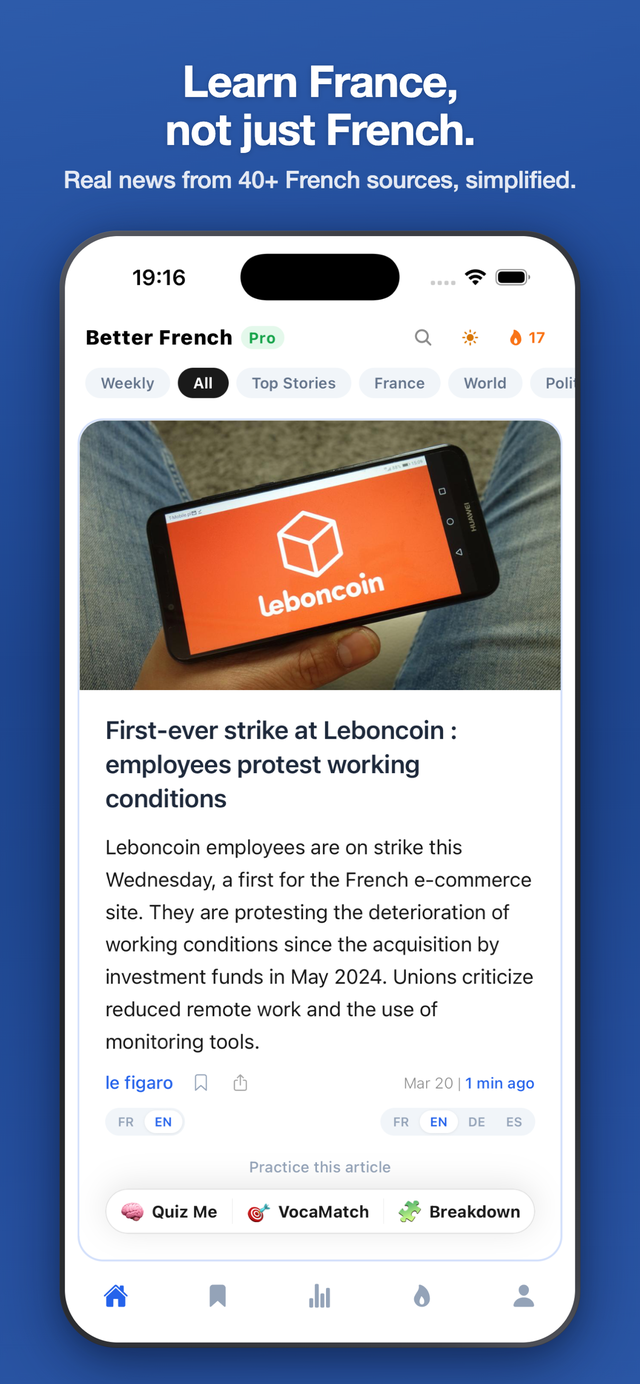
Better French is purpose-built for exactly this transition. Around 800 articles are read every day across 40-plus French sources -- the same outlets that France 24 and The Local cover in English, plus dozens more -- and 14 are picked because they matter to someone learning French. The picking is the point: this is not a feed of everything France published today. Each of those is then rewritten for five levels, so the story in front of you is the story French people are reading, at a level you can read without stalling. Better French Context turns any word or short phrase into a translation, an explanation, and the cultural note that English-language sources usually omit or simplify, and it will answer you in English, French, German or Spanish. Audioplay says any word or phrase back to you at just under native speed. Then there are three games built from that same story: Quiz Me, three questions on what you understood; VocaMatch, the vocabulary from the article, three lives and no timer; and Breakdown, which has you say the story out loud one phrase at a time.
The result is that reading French news with Better French feels like reading French news -- not like doing a language exercise. You are engaging with real stories from real sources, learning vocabulary that matters, and absorbing cultural context that makes you understand France at a deeper level than any English-language source can provide.
Better French is a subscription and it starts with a free trial. It works out at under €5 a month, and the exact price for your country is shown in the app before you pay. If you have been reading about France in English and are ready to start reading in French, this is the app that makes that transition practical.
English-language French news sources are valuable, and there is nothing wrong with reading them. But they are a starting point, not a destination. The real richness of understanding France -- the nuance, the vocabulary, the cultural depth -- lives in the French language itself. And with the right tools, accessing it is not as far away as it feels.
Frequently Asked Questions
What is the best source for French news in English?
France 24 English is the most comprehensive source for French news in English. It is a government-funded international news channel that covers French and European affairs in depth. The Local France and Connexion France are also strong choices, especially for expat-focused coverage of daily life, bureaucracy, and practical matters.
Can I learn French by reading news in English about France?
Reading French news in English will teach you about France but will not improve your French language skills. To actually build language skills, you need to read in French. Apps like Better French make this accessible by rewriting real French news for your level and letting you tap any word for Better French Context: the translation, the explanation, and the cultural note. That is how you read real French content at an intermediate level.
How do I transition from reading French news in English to reading in French?
Start by reading the English version of a story first for context, then read the same story in French. Use tools with built-in translations so you can tap unknown words without leaving the article. Begin with shorter, straightforward sources like 20 Minutes or France Info. Better French is designed specifically for this transition: every story is rewritten in clear French you can actually read, Read in Your Language flips it between French and English, and Better French Context explains any word you tap.
Is France 24 available in English?
Yes. France 24 broadcasts and publishes in English, French, Arabic, and Spanish. The English-language website and live TV stream cover French and international news, with a particular focus on European and African affairs. It is freely accessible worldwide at france24.com/en.
Get Better French
Stop reading about France in English. Read the same story in French, rewritten in clear French you can actually read, with Better French Context on every word. Available on the App Store and Google Play.
Download the App