The Language Barrier Nobody Warns You About When Moving to France
The language barrier in France is not just about speaking. It is about understanding -- following conversations, reading official mail, decoding cultural references, and knowing what is happening in the country you live in. Traditional language apps teach you vocabulary in isolation but do not prepare you for this. What works is daily exposure to real French content: news, conversations, and culture. Better French is built for exactly this. You read the stories French people are reading that day, rewritten in clear French you can actually read, so you understand the country around you -- and your French gets better because of it.
Everyone tells you that moving to France will be hard. They mention the bureaucracy. They warn you about the paperwork. They might even mention the cultural differences around scheduling and punctuality. What almost nobody warns you about is the specific, daily, grinding weight of the language barrier -- and how it affects parts of your life you did not expect.
This is not an article about how hard French is. French is learnable, and millions of people prove that every year. This is about the gap between the French you learn in a classroom or on an app and the French you actually need to live in France. That gap is wider than most people anticipate, and understanding it is the first step toward closing it.
It Is Not Just About Speaking
When most people think about the language barrier, they think about speaking. Ordering coffee. Asking for directions. Making small talk with the neighbor. And yes, speaking is a challenge. But for many expats, the bigger surprise is how much of the barrier is about understanding -- passive comprehension of the world around you.
Understanding the news. You turn on France 2 or BFM TV and the anchors are speaking at full speed about a remaniement ministériel or the 49.3. You catch a few words but lose the thread within seconds. Your French colleagues discuss it at lunch and you nod along, pretending to follow. This happens every single day, and it is isolating in a way that is hard to describe to someone who has not experienced it.
Reading your mail. A letter arrives from les impôts, the CPAM, or your mutuelle. It is dense, formal, and full of administrative vocabulary that no language course teaches. You spend thirty minutes with Google Translate trying to figure out if you owe money, need to respond, or can safely ignore it. This is not a one-time event. It happens monthly.
Following group conversations. One-on-one conversations in French are manageable because the other person adjusts their pace and vocabulary. Group conversations are a different world. People talk over each other, use slang, make cultural references, and speak at natural speed. You might understand individual words but miss the meaning entirely. After a while, you stop trying and check your phone instead.
Understanding cultural references. Someone mentions les Restos du Coeur and everyone nods solemnly. Someone else jokes about Bison Futé. A colleague says something is kafkaesque and the whole table laughs. These are not vocabulary problems -- they are cultural knowledge problems. You can know every word in the sentence and still not understand what is happening.
This cumulative experience -- of not fully understanding the country you live in -- is the real language barrier. It is not dramatic. It is not a single moment of failure. It is a slow, persistent fog that separates you from the life happening around you. And it is what most language learning tools completely fail to address.
Why Traditional Language Apps Do Not Help With This
If you are an expat in France, you have probably downloaded at least one language app. Possibly several. You have completed lessons, maintained streaks, and learned that le chat est sur la table. And yet you still cannot follow the evening news.
This is not a failure of effort. It is a design problem. Traditional language apps are built to teach you the language as an abstract system -- vocabulary, grammar rules, sentence construction. They do this through generated exercises: translate this sentence, fill in this blank, match these words. The content is invented for the purpose of teaching a linguistic concept.
What they do not do is teach you about the country where the language is spoken. Duolingo will teach you the word grève (strike), but it will not explain why France has more strikes than almost any other country, what the cultural significance of striking is in French labor relations, or how to read a news article about the latest one. Babbel will teach you to conjugate manifester, but it will not help you understand why there is a manifestation blocking your street every other Saturday.
The result is a strange disconnect. You know French words, but you do not understand France. You can pass a grammar quiz, but you cannot follow a dinner party conversation about pension reform. You have a vocabulary of 3,000 words, but not the 200 specific words that appear in every French news broadcast.
This is not to say these apps are useless. They serve an important function at the beginning of the journey. But for someone living in France, dealing with real administrative mail, trying to follow real conversations, and wanting to understand the country they chose to live in, abstract language exercises are not enough. You need real content from the real world.
What Actually Works: Immersion Through Real Content
Language acquisition research consistently shows that the most effective way to build comprehension is through extensive exposure to authentic content at or slightly above your current level. This is called "comprehensible input" -- material that is challenging enough to push your skills forward but accessible enough that you can follow the meaning.
For an expat in France, the most valuable authentic content is French news. Not because news is inherently special, but because it directly addresses the comprehension gaps that affect your daily life. When you can read and understand French news, several things happen at once:
- You understand conversations. Most casual conversation in France involves current events. When you have read about the same stories, you have the vocabulary and context to follow along -- and contribute.
- You understand your own situation. Policy changes, tax regulations, transport disruptions, weather events, local elections. These affect your life directly, and understanding them in French means you are not dependent on expat Facebook groups for secondhand translations.
- You absorb cultural context passively. Reading about la rentrée, the 14 juillet celebrations, or the annual prix littéraires teaches you how France works in a way that no textbook can replicate. Over time, cultural references stop being confusing and start being familiar.
- Your vocabulary becomes practical. The words you learn from news articles are the words that French people actually use. Not classroom French. Not tourist French. The French of daily life, politics, culture, and economy.
The challenge, of course, is that raw French news is difficult. An unassisted article from Le Monde can be impenetrable for an intermediate learner. The sentence structures are complex, the vocabulary is specialized, and the cultural references assume a level of background knowledge that most non-French readers do not have. This is where the right tools make the difference.
How to Start Understanding France (Not Just French)
If you are living in France and the language barrier is affecting your quality of life, here are practical steps to start closing the gap. These are not abstract tips -- they are specific actions that produce measurable results.
Read one French news article every day. Not five. Not an entire newspaper. One article, read thoroughly, with a tool that helps you understand the vocabulary and context. Fifteen minutes a day, consistently, will do more for your comprehension than a weekly two-hour class. Start with topics that directly affect your life: transport, weather, local politics, your industry.
Use tools that explain context, not just words. A dictionary tells you that 49.3 is a number. A cultural note tells you it is the constitutional mechanism that lets the French government pass a law without a parliamentary vote, and that invoking it is always politically explosive. The difference between these two experiences is the difference between knowing French and understanding France. Look for tools that provide cultural context alongside translations.
Listen to French audio while reading. Your ear needs to hear French at native speed to calibrate. But listening without any visual support is extremely difficult at the intermediate level. The combination of reading and listening -- seeing the text while hearing it spoken -- is one of the most effective ways to train both skills simultaneously. Audio helps most at the level of the individual word, though. The words that ambush you in a real conversation are almost always the ones you have only ever read. Hear a word spoken at the moment you look it up, slightly under native speed so you catch its actual shape, and you will recognize it the next time somebody says it at the boulangerie instead of decoding it three seconds too late.
Stop avoiding French situations. It is tempting to live entirely in English -- expat friends, English-language media, English-speaking doctors and accountants. This is comfortable, but it is also a trap. Every time you choose the English option, you lose an opportunity to build the skills you need. Start small: read one piece of French mail without translating it first. Watch one French show with French subtitles instead of English. Say yes to the dinner invitation where you will be the only non-native speaker.
Accept that discomfort is part of the process. You will misunderstand things. You will nod along when you should ask for clarification. You will miss jokes. This is normal, and it is temporary. Every expat who now speaks fluent French went through the same period of discomfort. The ones who pushed through it are the ones who got to the other side.
Better French: Built for Exactly This Problem
Start with the obvious objection. French news was never written for you. It was written for readers who already know what a rapporteur does, who Bison Futé is, and why a room goes quiet when somebody says a number instead of a name. There is no help with the vocabulary, nothing adjusts to where your French actually is, and nothing afterwards checks whether you understood a word of it. That missing half is the whole problem, and building it is the only reason Better French exists.
Better French was created for people in exactly this situation -- internationals living in France who need to understand the country, not just the language. The app's tagline is "Learn France, not just French," and that distinction matters.
Most of the work happens before you ever open the app. Every day we read around 800 articles from more than 40 French sources -- France Info, Le Figaro, La Dépêche, BFMTV, and dozens more -- and pick the fourteen or so stories that a person living in France genuinely needs to have heard of. Not the loudest headlines. The ones that explain the country you are standing in this week: the strike that will move, the reform that changes what you pay, the trial everyone at lunch has an opinion about. The picking is the product. Nobody who is already tired at the end of a French working day needs a firehose of 800 links.
Then every one of those stories is rewritten for five levels. That is the part worth pausing on if you have ever opened Le Monde and closed it again ninety seconds later. The A2 version of a story about pension reform and the C1 version carry the same facts and the same words French people are actually using about it, at a difficulty your reading can survive. It is not a children's version of France. It is France, at your level, and the level moves as you do.
Each article comes with tools that make it accessible without making it artificial:
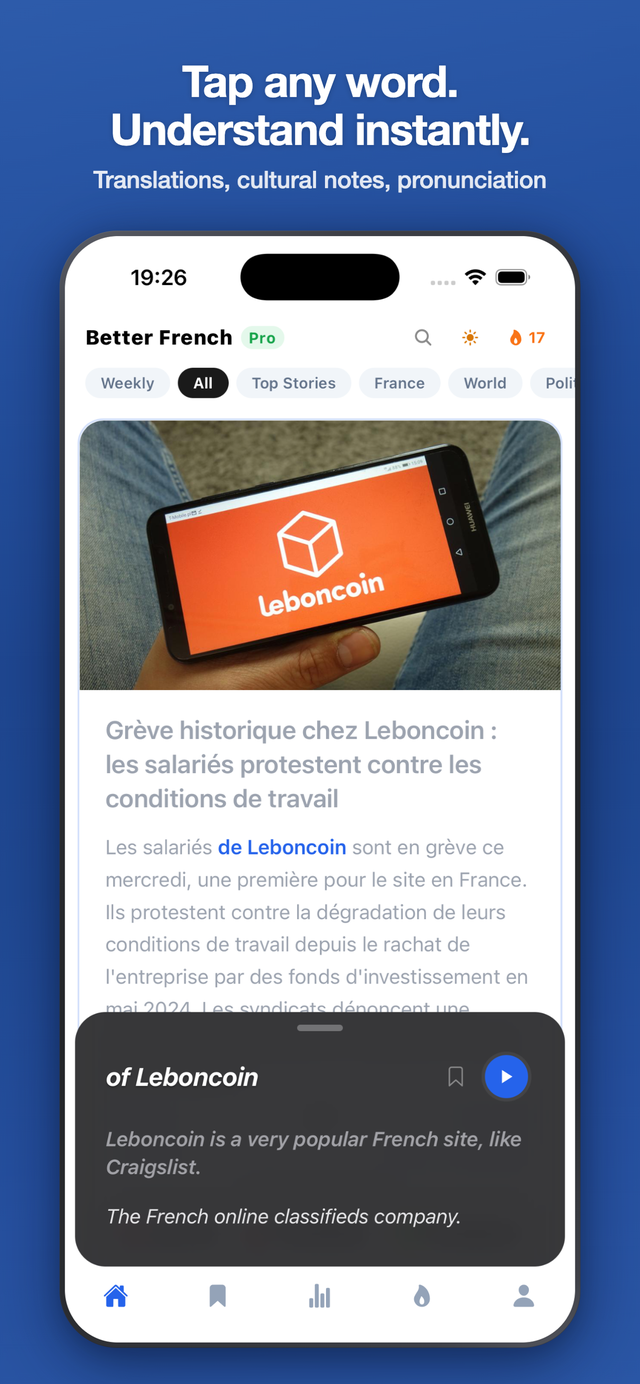
- Better French Context. Tap any word or short phrase and three things come back at once: the translation, an explanation of how it is being used here, and the cultural note sitting underneath it. No dictionary, no translator, no switching apps, no guessing. This is the tool that closes the gap between knowing the words in a sentence and knowing what was actually said.
- Saved Words. Every word you save keeps the story you met it in and the note that came with it. If you live in France, this is the one to pay attention to. Prélèvement, attestation, convocation, résiliation -- these words arrive in your letterbox, not in a lesson. A flashcard that has been stripped of its context teaches you nothing about the letter in your hand. Here the word keeps where you met it.
- Read in Your Language. Flip the whole article into English when you need solid ground under your feet, then flip it back to French. English, French, German and Spanish.
- Audioplay. Hear any word or phrase spoken in natural French, deliberately just under native speed so the shape of it registers. The play button lives on the word you tapped, not on the article -- this is for the vocabulary that keeps ambushing you, not for background listening.
- Search and the archive. The stories that affect your life do not finish in a day. A strike, a law, a reform, a trial: search the archive and follow one across sources and across weeks, and tap through to the original article whenever you want to see how a French outlet wrote it.
- Nineteen sections, and a plain-language title on everything. France, Politics, Food, Culture and fifteen more, so you can start where your actual week is rather than where the front page is. Each story carries a title in plain language, so you know what you are walking into before you commit to the French.
Then there are three games, and the point of all three is that they are built from the story you just finished rather than from a generic word list. Quiz Me asks three questions: they check what you actually understood, and they usually teach you something about France on the way out. The difficulty climbs as your streak does. VocaMatch takes the vocabulary from that same story and matches it against its meanings, across three difficulty bands. You get three lives and there is no clock -- nothing in the app is racing you. Breakdown is the one that transfers to the dinner table: you learn to say the story out loud, one phrase at a time, across three tiers. The phrases come from something that genuinely happened in France this week, which is why they survive contact with a real conversation in a way textbook sentences never do.
None of that is the argument, though. The argument is the order it happens in. You read what French people are reading, so you understand what is going on around you -- and your French improves because the fifteen minutes went into real French rather than into le chat est sur la table. Learning French, on its own, was never going to be enough. That was the missing piece all along.
Better French is a subscription and it starts with a free trial. It works out at under €5 a month, and the exact price for your country is shown in the app before you pay. What you are paying for is fifteen minutes a day that are not wasted: the story already chosen, already at your level, already carrying the note that explains the thing everyone else at the table grew up knowing.
The language barrier in France is real, and it is more complex than most people expect before they arrive. But it is not permanent. With consistent exposure to real French content, the right tools to support your comprehension, and the willingness to push through discomfort, the fog lifts. And when it does, living in France becomes something very different from surviving in France.
Frequently Asked Questions
Can you live in France without speaking French?
You can survive in major cities like Paris, Lyon, and Bordeaux with English, especially in international workplaces and tourist areas. But living comfortably -- understanding your mail, following local news, navigating administrative processes, and building relationships outside the expat bubble -- requires at least a functional level of French. Most expats find that the language barrier affects their quality of life more than they expected.
What is the biggest language challenge for expats in France?
Most expats expect the challenge to be speaking. In practice, the bigger challenge is understanding -- following conversations at normal speed, reading official documents, comprehending TV news, and picking up on cultural references that French people take for granted. These passive skills are harder to build with traditional language apps and require exposure to real French content.
How long does it take to overcome the language barrier in France?
It depends on your starting level and how actively you engage with the language. Expats who immerse themselves in real French content daily -- reading news, listening to radio, watching French TV -- typically see significant improvement within three to six months. Those who rely only on English at work and weekly language classes may struggle for years. Daily exposure to real content is the single biggest factor.
What is the best way to learn French while living in France?
Combine structured study with real-world immersion. Read the same stories French people are reading, rewritten in clear French you can actually read, with the translation and the cultural note one tap away. That is what Better French is for. Listen to French radio. Watch French TV with French subtitles. Attend local events. The key is engaging with real French content every day, not just studying textbook French in a classroom.
Is Better French a news app?
No. The news is the raw material, never the point. French news is written for people who already know France, which is exactly why it defeats learners. Better French reads around 800 French articles a day, picks the fourteen or so that matter to someone learning the language while living in the country, and rewrites each one for five levels. Every word is tappable for a translation, an explanation and a cultural note, and three games are built from the same story you just read. A news app hands you what French people read. Better French makes it readable, then checks that you learned something from it.
Understand France, Not Just French
Fourteen stories a day, chosen out of 800 and rewritten in clear French you can actually read. Every word tappable for the translation and the cultural note. Built for internationals who need to understand the country, not just the language.
Download the App