Better French vs Duolingo: Which Is Right for You?
Duolingo teaches you French words and grammar through gamified exercises. Better French is where you go when the exercises stop moving you. You read what French people are actually reading, so you understand the country, and your French improves because of it. Better French is not a news app: every day we go through around 800 French articles, pick the 14 that matter to a learner, rewrite each one for five levels, make every word tappable, and build three games out of the same story. Different tools for different stages. Most learners benefit from both.
If you are learning French, you have probably used Duolingo. It is the most downloaded language learning app in the world, and for good reason. But at some point, many learners hit the same wall: they can complete lessons and maintain a streak, yet they still struggle to read a real French article, follow a conversation, or understand what is happening in France.
That gap between textbook French and real French is exactly where Better French comes in. This comparison will help you decide which tool fits your current level, your goals, and the way you actually want to learn.
What Is Duolingo?
Duolingo is a free, gamified language learning app. It breaks languages down into short lessons -- typically five minutes or less -- built around translation exercises, fill-in-the-blank prompts, and listening drills. The experience is structured around a skill tree that guides you from basic vocabulary to more advanced grammar, one bite-sized exercise at a time.
Duolingo is exceptionally good at what it does. Its streak system keeps people coming back. The progression is clear. And for absolute beginners -- people who cannot yet distinguish bonjour from bonsoir -- it provides a structured, low-pressure on-ramp into French.
The app covers a wide range of languages and uses spaced repetition to reinforce vocabulary. It also offers Duolingo Super, the paid tier, which removes ads and adds extras like unlimited hearts and progress quizzes. Super is $12.99 a month, or about $8 a month if you pay for a year upfront, and there is a higher Max tier at $30 a month.
Where Duolingo stops, however, is at the boundary of the real world. The sentences you translate are generated for learning, not sourced from actual French speakers or writers. There is no cultural context. You will not learn why the French are debating pension reform, what la rentrée means culturally, or how to read a headline from Le Monde. Duolingo teaches the language in isolation from the country.
What Is Better French?
Better French is an app built around a different idea: Learn France, not just French.
That is not a demotion of the French. It is a claim about what makes French improve. Past a certain point, drills stop moving you, because what is holding you back is no longer a list of words you have never met. It is French used the way French people use it, about the things they are actually talking about. That is the whole bet: you read what French people are reading, so you understand the country, and your French gets better because of it.
Which is exactly why everybody tells you to read the French news. The France you are missing is almost all in there: the pension row, the strike that moved your train, the film your colleagues argued about at lunch, the word that came up three times on Monday and nowhere in your textbook. So read the French news. Everyone gives that advice.
Except French news was never built for French learners. It is written by natives for natives. The jargon arrives with no explanation, the references assume you grew up there, nobody helps you with the words, and when you reach the end there is nothing to test yourself against. That is why "just read Le Monde every morning" is advice that works for almost nobody. You open the article, you lose the thread by the second paragraph, and you go back to the lesson that at least ends with a green checkmark. Nothing about that is a discipline failure. The article simply was not written for you, and no amount of willpower fixes that.
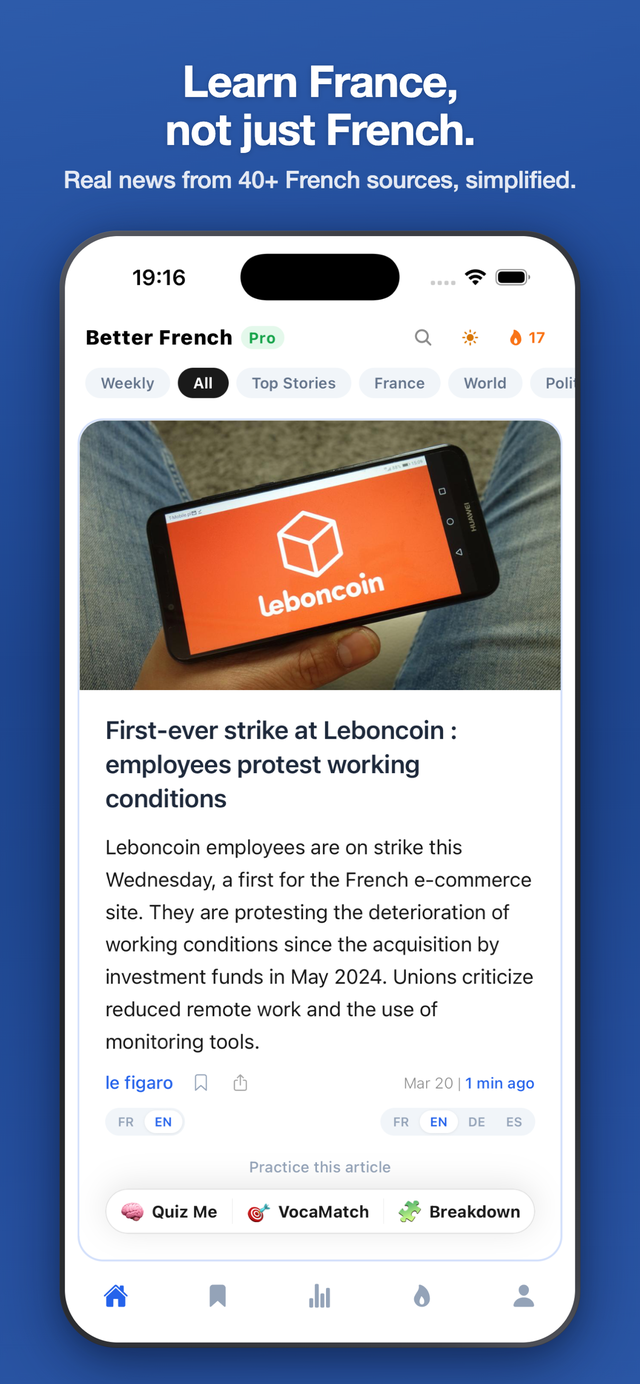
Better French exists for exactly that gap. Every day we read around 800 articles from more than 40 French outlets -- France Info, Le Figaro, La Dépêche, BFMTV, RFI, regional papers -- and pick the 14 or so that actually matter to somebody learning the language and the country. Then each of those stories is rewritten for five levels, so the version you open is pitched at the French you have today, not at a native who has been reading that paper for thirty years. The picking and the rewriting are the product. The news is the raw material.
Around the story sit the tools that get you through it:
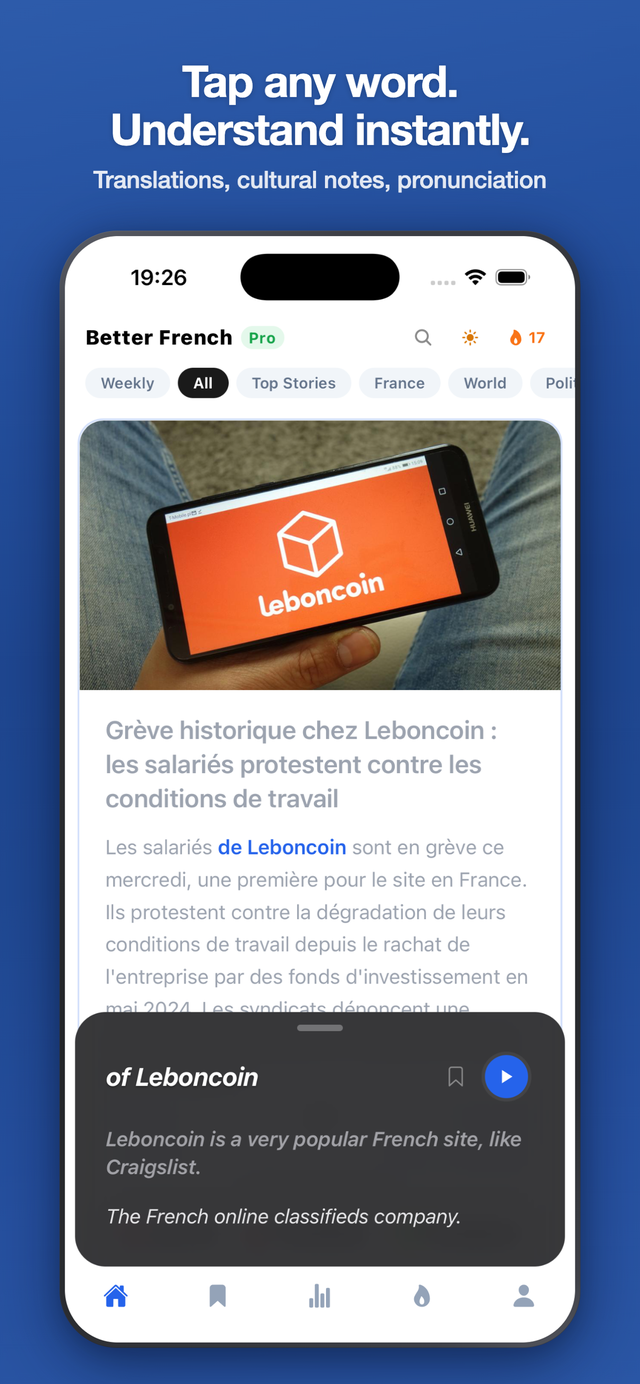
- Better French Context. Tap any word or short phrase and you get three things at once: the translation, a plain explanation of how the word is being used here, and the cultural note when the sentence is leaning on something a native would just know. One tap gives you the meaning. No dictionary, no translator, no guessing.
- Read in Your Language. Flip the whole article into English when you have lost the thread, then flip it back to French and try again. You can also read it in German or Spanish if that is the language you think in.
- Audioplay. Hear any word or phrase spoken in natural French, at a rate set deliberately just under native speed, so you learn what the word sounds like at the moment you learn what it means.
- Quiz Me. Three questions on the story you just read. They check what you understood and they usually teach you something about France on the way. The difficulty moves with your streak.
- VocaMatch. The vocabulary from that same story, matched against its meaning. Three lives, no clock, and three difficulty bands so it stays honest as you improve.
- Breakdown. Learning to say the story out loud, one phrase at a time, in three tiers. Reading is where most learners stall on speaking. This is the bridge.
- Saved Words. Every word you save keeps the story it came from and its cultural note. It is not a flashcard pile. The word remembers where you met it.
- Search and the archive. Follow a story you care about across sources and across weeks, instead of meeting it once and losing it.
There are nineteen sections -- France, Food, Culture and sixteen more -- so you can read about what you would have read about anyway. Every article links straight through to the original if you want to see how the source told it. Words understood, articles read and your streak are all tracked, so the progress is something you can see rather than something you hope is happening.
The result is that every session teaches you real words, in real context, about real events. When you sit down at a café in Lyon or Paris, you can follow the conversation, because you have been reading the same stories as everyone else at the table. And the French sticks, which is the part that matters: a word you met inside a story you cared about, with its cultural note attached, behaves nothing like a word you met in a list.
Better French is built for four kinds of learner: people who study every day and whose French still feels stuck, internationals already living in France for whom the jokes keep going past, people moving to France who would rather arrive already knowing the country, and candidates preparing for the DELF, TCF or TEF, which test reading real French rather than exercise French. All four want the same thing out of it. French that finally moves.
How Do They Compare?
Here is a side-by-side look at the key differences between Better French and Duolingo.
| Feature | Better French | Duolingo |
|---|---|---|
| Content type | Real news stories, picked and rewritten | Generated exercises |
| Where the stories come from | ~800 articles read daily from 40+ French outlets, 14 picked | None |
| Rewritten for your level | Five levels of every story | One path for everyone |
| Word help while reading | Better French Context: translation, explanation, cultural note | No |
| Cultural notes | Yes, on what a native would just know | No |
| Read it in your language | Flip to English, German or Spanish and back | No |
| Quizzes & games | Quiz Me, VocaMatch and Breakdown, built from the story you just read | Gamified exercises, skill tree |
| Audio | Audioplay: any word or phrase | Word and sentence audio |
| Streak | Yes, and only real work extends it: 10 words tapped, or one game finished | Yes, plus leaderboards and points |
| Saved vocabulary | Each word keeps its story and cultural note | Word lists |
| Real French content | Yes -- picked and rewritten daily | No -- all generated |
| Grammar instruction | Contextual (learn by reading) | Structured lessons |
| Best CEFR levels | A2 through C1 | A1 through B1 |
| Getting started | Free trial, no charge until it ends | Free with ads |
| Price | A subscription, priced for your country and shown in the app before you pay | $12.99/mo (Duolingo Super), about $8/mo billed yearly; Max $30/mo |
| Best for | Reading real French at your level, and the France behind it | Vocabulary basics, grammar drills |
Neither tool wins in every category. They are designed for different purposes, and the right choice depends on where you are right now.
Who Should Use Duolingo?
Duolingo is the right starting point if any of these describe you:
- You are a complete beginner. If you are starting from zero, Duolingo will get the basics into your head faster than almost anything else. The structured progression from "this is a cat" to "I would like to book a table" is exactly what beginners need.
- You want short, predictable sessions. Duolingo lessons take three to five minutes. If your schedule is unpredictable and you want something you can squeeze into a commute, it works well.
- You are motivated by streaks and gamification. The points, leaderboards, and streak mechanics genuinely help some people stay consistent. If that dopamine loop works for you, lean into it.
- You need to build basic vocabulary and grammar. The spaced repetition system is effective for memorizing core words and simple sentence structures. As a foundation, it is solid.
The limitation comes when you want to move beyond exercises. Duolingo can take you to roughly a B1 level -- you will recognize common vocabulary, understand basic grammar, and be able to form simple sentences. But you will likely struggle with real-world reading, listening to native speakers at normal speed, or understanding the cultural references that permeate everyday French.
Who Should Use Better French?
Better French is built for learners who want to bridge the gap between studying French and actually using it. You should consider it if:
- You have outgrown Duolingo. You have a solid vocabulary foundation and basic grammar, but you still cannot read a real French article without losing the thread. That is not a discipline problem. The article was written for a native. Better French gives you the same story, rewritten at your level, with every word tappable and something to test yourself against at the end.
- You live in France (or plan to). If you are an international living in France, understanding the news is not optional -- it is how you understand your own life. Pension reforms affect your retirement. Transport strikes affect your commute. Better French makes that accessible.
- You care about cultural context, not just words. Knowing that la rentrée means "back to school" is dictionary knowledge. Understanding that it is the single most important cultural moment of the French year -- when the entire country resets -- is cultural knowledge. Better French gives you both, and the second is what makes the first stay in your head.
- You want the words French people are actually using this week. Every story on Better French comes out of genuine French journalism, and Audioplay lets you hear any word or phrase from it in natural French, so the vocabulary arrives with its sound attached. The topics are the topics French people are actually discussing.
- You are at an A2 level or above. You do not need to be advanced. You need enough foundation that you can recognize basic sentence structures. Better French handles the rest: the story is rewritten in clear French you can actually read, Better French Context explains any word you tap, and Read in Your Language is there when a paragraph beats you.
Better French is not a replacement for structured grammar instruction. If you do not know what a past participle is or how French verbs conjugate, you will want a structured resource alongside it. But for reading real French at your level, for the cultural knowledge underneath it, for vocabulary that keeps the story it came from, and for saying any of it out loud, it is purpose-built.
Can You Use Both?
Yes, and many learners do exactly that. The two tools are not in competition -- they serve different parts of the learning process.
A practical routine might look like this:
- Morning: Five minutes on Duolingo to reinforce grammar and drill vocabulary. Keep the streak alive.
- Commute or lunch: Read one story on Better French at your level. Tap the words you do not know and let Better French Context explain them. Tap Audioplay on the ones you would not dare say out loud. Then take Quiz Me, three questions, and you are done.
- Evening: Play a VocaMatch level on that same story, or a Breakdown tier so you end up saying the story out loud instead of only recognizing it. Either one takes a couple of minutes and keeps your streak alive.
This combination gives you the systematic structure of Duolingo (grammar rules, spaced repetition, progressive difficulty) alongside the real-world application of Better French (authentic content, cultural literacy, natural vocabulary).
Think of it like learning to swim. Duolingo is the pool where you practice strokes in a controlled environment. Better French is the ocean -- real, unpredictable, and endlessly interesting. You need both environments to become a confident swimmer.
The Bottom Line
There is no single "best" tool for learning French. The right choice depends on your starting point and where you want to end up.
Choose Duolingo if you are starting from zero, you need structured grammar instruction, or you want a quick daily habit with clear progress markers. It is one of the best tools ever made for getting beginners started with a new language.
Choose Better French if you have a basic foundation and want to start using French for real. If you want to read what French people are actually reading, at a level you can handle, understand the references no textbook teaches, and build the kind of vocabulary that comes up in daily life, this is what Better French is built for. It is a subscription and it starts with a free trial. The price for your country is shown in the app before you pay.
Choose both if you want the most complete approach. Use Duolingo for the structure. Use Better French for the substance. Together, they cover the full spectrum from grammar drills to real-world fluency.
One final thought. Learning French is not enough on its own, and that is not a slogan, it is the reason so many people plateau. The language carries a country inside it, and the learners whose French keeps improving are the ones who let the country in. That is why Better French exists. Not to replace your language learning tools, but to give you the one thing they cannot: real French, about real France, at a level you can actually read today.
Frequently Asked Questions
Is Better French a Duolingo alternative?
Better French is not a direct replacement for Duolingo. Duolingo teaches vocabulary and grammar through exercises that were generated for teaching. Better French takes stories that actually happened in France this week, rewrites each one for five levels, and gives you Better French Context on every word plus three games built from the story you just read. Duolingo is best for building a foundation. Better French is best for the stage where the drills have stopped moving your French. Many learners use both.
Can I use Better French as a complete beginner?
Better French works best for learners at A2 level and above. If you are a complete beginner who cannot yet recognize basic French words and sentence patterns, starting with Duolingo or a beginner course is a better first step. Once you have that foundation -- even a modest one -- Better French becomes a powerful next step, because every story is rewritten for five levels and Better French Context explains any word you tap, giving you the translation, how the word is being used, and the cultural note behind it.
Does Better French use real French content?
Yes, and choosing it is most of the work. Every day we read around 800 articles from more than 40 French outlets, including France Info, Le Figaro, La Dépêche and regional newspapers, and pick the 14 or so that matter to somebody learning the language and the country. Each of those is then rewritten for five levels, so the story is real and current while the version you open is pitched at your French. Politics, culture, economy, sport and daily life, across nineteen sections.
How do Better French and Duolingo compare on cost?
Better French is a subscription and it starts with a free trial. It works out at under €5 a month, and the exact price for your country is shown in the app before you pay. Duolingo is free with ads; Duolingo Super is $12.99 a month, or about $8 a month if you pay for a year upfront, and Duolingo Max is $30 a month.
Isn't real French news too hard for a learner?
That is the honest objection, and it is why most people told to "just read Le Monde" give up inside a week. French news is written by natives for natives: the jargon arrives with no explanation, the references assume you grew up there, nothing helps you with the words, and there is nothing to test yourself against at the end. Better French is built for that exact problem. The story is rewritten for five levels, every word is tappable for a translation, an explanation and a cultural note, you can flip the whole article into English and back, and Quiz Me, VocaMatch and Breakdown give you a way to check what actually stuck.
Can I use Duolingo and Better French together?
Absolutely. Many learners use Duolingo for structured grammar and vocabulary drills in short daily sessions, then open Better French to read a real French story at their level and play Quiz Me, VocaMatch or Breakdown on it. The two tools complement each other because they address different parts of the same problem -- structure on one side, real French on the other.
Get Better French
The French stories that matter, rewritten in clear French you can actually read, every word tappable, three games built from the same story. Read what French people are reading, understand the country, and feel your French start moving again. Better French is a subscription and it starts with a free trial. It works out at under €5 a month, and the exact price for your country is shown in the app before you pay.
Download the App