If you are learning French through news, you have probably come across News in Slow French. It is one of the most well-known resources for French learners who want to follow current events while improving their comprehension. Better French takes a fundamentally different approach to the same goal.
This is not a hit piece. News in Slow French is a legitimate product that helps thousands of learners. But the two platforms solve the problem of "French news is too hard for me" in very different ways, and understanding those differences will help you choose the right tool for how you actually learn.
What Is News in Slow French?
News in Slow French is a weekly podcast that covers current events in French, spoken at a deliberately slower pace than native speech. It launched as part of the Linguistica 360 family of "News in Slow" language podcasts and has built a loyal following over many years.
The core idea is straightforward: real news is spoken too fast for most learners, so slowing it down makes it accessible. Each episode covers a handful of stories from the week, narrated by hosts who speak clearly and at reduced speed. Subscribers also get access to transcripts, grammar explanations, and vocabulary lists alongside the audio.
NISF has a single Full Access plan at $22.90 a month, which includes the podcast episodes, transcripts, quizzes, and other learning materials.
The strength of this approach is accessibility. If you find native French overwhelming, hearing the same content at a slower speed can be the bridge that makes it possible. For audio-focused learners, it fills a genuine gap.
What Is Better French?
Better French starts from a different diagnosis. Speed is not really what makes Le Monde hard on a Tuesday morning.
French news was written for French people. It assumes you already know who the ministers are, what the RN is, why a réforme des retraites can bring a country to a standstill. It drops acronyms without expanding them and references 1968 without explaining it. There is no help with the words, and when you reach the end there is nothing to test yourself against. Every learner has had the same evening: twenty minutes, three paragraphs, a translation tab open in another window, and no real idea whether any of it went in. French news is a wonderful way into France. It just was not built for anyone learning French.
So Better French does the work nobody had done. Every morning it reads around 800 articles from more than 40 French sources -- France Info, Le Figaro, BFMTV, RFI and dozens more -- and picks the fourteen or so stories that genuinely matter to someone learning France. Then each of those stories is rewritten for five levels. The picking and the rewriting are the product. What lands in your feed is the story France is actually discussing that day, told at the level you can actually read it.
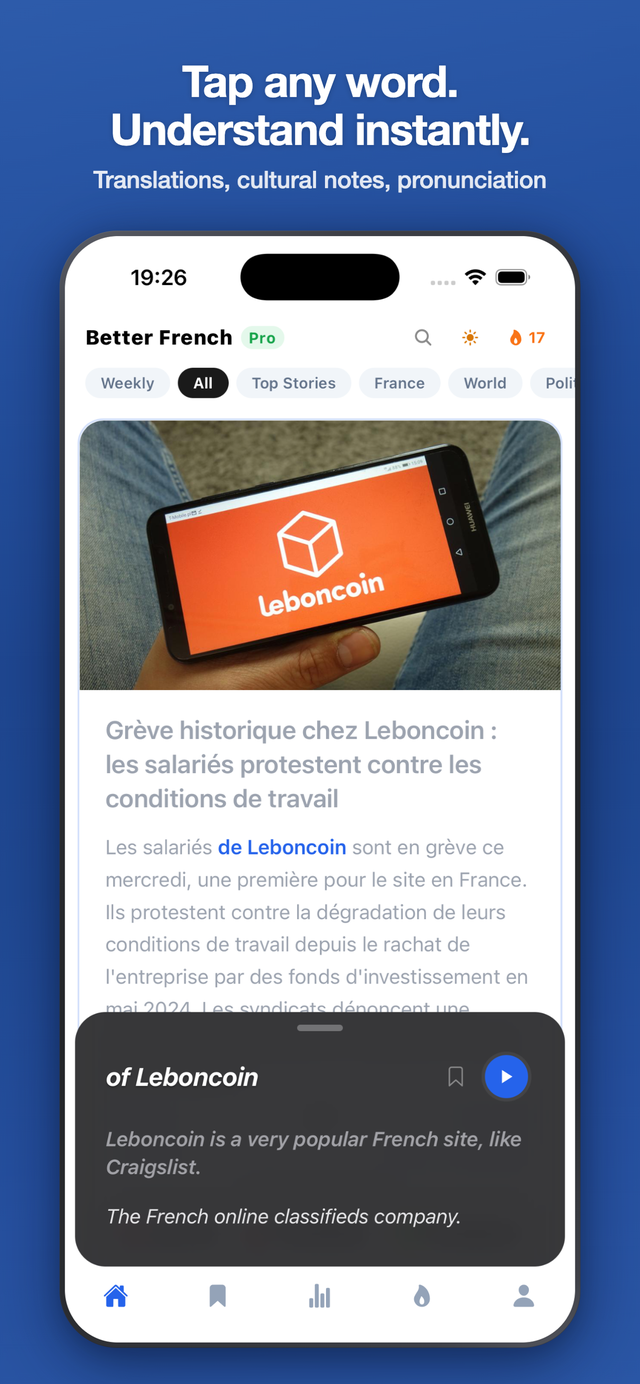
The reading is where it gets interesting. Tap any word or short phrase and you get three things at once: what it means, how it is being used in this sentence, and the cultural note that explains why a French reader would not blink at it. That is Better French Context, and it turns every article into a vocabulary lesson built around what you do not know, rather than a fixed word list chosen by someone else. Words you save keep their story and their cultural note attached, so a month later you still remember where you met them.
Three games are built from the story you just read. Quiz Me asks three questions, checking what you understood and teaching you something about France while it does it. VocaMatch takes the vocabulary from that article and gives you three lives to match it, with no clock running. Breakdown teaches you to say the story out loud, one phrase at a time, across three tiers. And Audioplay lets you hear any word or phrase in natural French, spoken just under native speed, so you learn what a word sounds like in a mouth rather than on a page.
There is more underneath the daily read. Nineteen sections, from France and Food to Culture, Tech and Sport. A searchable archive, so you can follow a story you care about across every source that covered it. A tap straight through to the original article when you want to see what the French version looked like. Progress and a streak that only moves when you have actually done something. And Read in Your Language, which flips the article to English and back, in English, French, German or Spanish, for the mornings when you just want to know what happened.
All of it points at one idea, which is also the tagline: learn France, not just French. Learning the language on its own is not enough. You can conjugate perfectly and still miss every joke at the dinner table, because the joke is about a politician you have never heard of. It runs the other way too, and this is the part that matters for your French: once you know who that politician is, the paragraph about them stops being a wall of vocabulary and starts being a sentence you can read. You read what French people are reading, you understand France, and your French improves because of it.
Feature Comparison
Here is a side-by-side look at how the two platforms compare across the features that matter most to learners.
| Feature | News in Slow French | Better French |
|---|---|---|
| Format | Audio podcast with transcripts | Reading, with three games built from the story |
| Content source | A few stories a week, written for learners | ~800 articles read daily from 40+ French sources, the 14 that matter chosen |
| How it is made readable | The speech is slowed down | The story is rewritten for five levels |
| Interactivity | Transcripts, grammar notes | Better French Context, quizzes, games |
| Translations | Vocabulary lists | Tap any word: meaning, use in the sentence, cultural note |
| Cultural notes | Occasional | Inside every translation |
| Games | Basic quizzes (paid tier) | Quiz Me (3 questions), VocaMatch (3 lives, no clock), Breakdown (3 tiers) |
| Audio | Slowed narration of the whole story (core feature) | Audioplay on any word or phrase, just under native speed. No whole-article narration |
| Follow a story over time | Weekly episodes | Search the archive across every source that covered it |
| Try before you pay | Limited samples | Free trial |
| Price | $22.90/mo, single plan | Subscription, your country's price shown in the app |
| Best for | Audio learners, beginners | Readers at any level, and anyone living in or moving to France |
The Key Difference: Slowing the Speech vs Rewriting the Story
This is the fundamental fork in the road, and it is worth thinking carefully about which side you fall on.
News in Slow French makes French easier by changing how the words are delivered. It reads the news to you more slowly. This works, and it works for a real reason. When native French sounds like one continuous noise, hearing the same sentence at reduced speed lets you find the seams: where a word ends, where a question starts, which syllable carries the weight. For a beginner that can be the difference between despair and a foothold, and nobody should sneer at it.
The limitation is that slowing the speech leaves the hard part untouched. The story is still an adult French story about an adult French subject, and the reason it defeats you at B1 is rarely the tempo. It is the four ministers you cannot place, the acronym nobody expanded, the sentence carrying three subordinate clauses, and the reference to 1968 that everyone in the room caught except you. Playing that at eighty per cent speed does not make any of it yours.
Better French works on the story instead of the tempo. Each of those fourteen daily stories is rewritten for five levels, so if you are A2 you get the A2 telling of the same news your neighbour is reading at C1. The sentences are ones you can hold in your head. The vocabulary sits close enough to your own that the new words stand out instead of drowning you. Nothing has been made childish and nothing important has been left out. The story is pitched at you, which happens to be the one condition under which reading has ever made anyone better at a language: a little above where you are, and understandable.
Then the help sits inside the text rather than in a PDF beside it. Tap the acronym and it is expanded. Tap the minister and you find out which government they belong to. Tap the word you half-recognise and you get the meaning, the register, and the note that explains why a French reader would smirk at it. That is Better French Context, and it is why the vocabulary sticks: the word arrives attached to a story you already cared about. Then Quiz Me, VocaMatch and Breakdown, all built from that same article, tell you what actually went in rather than letting you assume. This is the benefit slowing down was reaching for, delivered without pretending that real French is slow.
There is one thing NISF gives you that Better French does not, and it deserves saying plainly. NISF is audio first, so you can do it with your eyes shut on a bus. Better French wants your eyes. Audioplay will say any word or phrase to you in natural French, just under native speed, and Breakdown has you saying the story out loud one phrase at a time, but no narrator reads you the whole article. If your only French time of the day is a commute or a run, that should weigh on your decision.
The difference is not really speed at all. One reads you the newspaper slowly. The other sits next to you with the same newspaper, cuts it down to your level, and explains as you go. You can listen to the first one. You come away from the second one knowing what happened in France today, why the person next to you at work cares about it, and with a hundred words that now have somewhere to live.
Cost and Access
The two platforms sell access very differently, and it is worth laying out clearly.
News in Slow French has a single Full Access plan at $22.90 a month, which includes transcripts, grammar explanations, vocabulary lists, and quizzes. It is one of the most expensive options in the language learning space.
Better French is a subscription, and it starts with a free trial. There is deliberately no figure on this page: the price is set per country and shown to you in the app before you pay, so what you see is the number for where you live rather than a US price converted badly.
What you actually get differs just as much. NISF gives you one slowed recording of a handful of stories a week, written for learners. Better French gives you the fourteen stories that matter out of the day's real French news, read from 40+ outlets and rewritten in clear French you can actually read, with every word tappable for its meaning and its cultural note, three games built from the same article, and an archive you can search when you want to follow one story across every source that covered it.
None of which means price decides it. If NISF's slowed audio is the exact thing you need, $22.90 is money well spent. But if what you want is to open your phone in the morning, read the story France is arguing about at a level you can actually read, and come away with words that stay, that is a different product. The trial is there so you can find out which one you are before committing to either.
Which Should You Choose?
The right choice depends on how you learn, where you are in your French journey, and what you are trying to get out of it.
Choose News in Slow French if:
- You are a beginner and native-speed French is genuinely too fast for you to process, even with visual support. The slower pace may be the scaffolding you need right now.
- You learn primarily through audio. If your main study time is during commutes, walks, or workouts where you cannot look at a screen, a podcast format fits your routine better.
- You want grammar explanations. NISF includes explicit grammar breakdowns alongside the news content, which some learners find valuable.
Choose Better French if:
- You want the real story, at your level. Every article is rewritten for five levels, so an A2 reader and a C1 reader take on the same day's news and both finish it. You are not waiting until you are "ready" for real French, and you are not reading something written down for learners either.
- Your French is stuck and more grammar is not moving it. Better French reads 40+ sources across nineteen sections -- France, Food, Culture, Business, Tech, Sport and thirteen more -- and picks what matters. You learn the language through the country's actual conversations, which is usually what a plateau is missing.
- You are an expat or planning to move to France. Reading the same news that French people read is the fastest way to understand references, debates, and cultural context that come up in daily life.
- You want to do something with it, not just consume it. Better French Context on any word, three games from every story in Quiz Me, VocaMatch and Breakdown, Saved Words that keep the story and the cultural note attached to each word, and a streak that only moves when you have genuinely done something.
- You want to start today. The subscription opens with a free trial, so you can read today's real French news this evening and decide afterwards.
Or use both
The two are not mutually exclusive, and there is a decent case for running both. Listening and reading are different skills and training both moves your comprehension faster than either alone. NISF on the commute, Better French with your coffee. What the pair gives you that neither gives on its own is the same French coming at you through the ear and through the eye, attached to the same country.
Frequently Asked Questions
Is News in Slow French worth it?
News in Slow French is a solid resource for audio-focused learners, especially at beginner and intermediate levels. The slower pace makes spoken French more accessible, and at that stage it can be exactly the foothold you need. Two things weigh against it: at $22.90 a month it is one of the more expensive options in this space, and slowing the speech leaves the ministers, the acronyms and the references exactly as hard as they were. If you would rather read the day's real French news rewritten in clear French you can actually read, every word tappable for its meaning and its cultural note, Better French is the closer fit.
What is the best alternative to News in Slow French?
Better French is the closest alternative for learners who want the real French news rather than a slowed recording of it. It reads around 800 articles a day from 40+ French sources, picks the fourteen that matter to someone learning France, and rewrites each one for five levels. Tap any word for its translation, its explanation and its cultural note, then play Quiz Me, VocaMatch or Breakdown on the same story. It is a subscription and it starts with a free trial, and the price for your country is shown in the app before you pay.
Can I use Better French and News in Slow French together?
Yes, and many learners benefit from combining the two. Listening and reading are different skills. You could use News in Slow French for audio comprehension on your commute and Better French for reading, vocabulary and cultural understanding at your desk. The two complement each other well, because the same French reaches you through the ear and through the eye.
Does Better French have audio features?
Yes, though not in the way a podcast does. Audioplay lets you hear any word or phrase in natural French, spoken just under native speed. It lives in the word tooltip and inside Breakdown, where you learn to say the story out loud one phrase at a time. There is no narrator reading the whole article to you. If listening to a full story end to end is what you want, News in Slow French does that and Better French does not.
How much does Better French cost?
Better French is a subscription and it starts with a free trial, so you can read the day's real French news, tap words for Better French Context and play the games before you decide anything. The price is set per country and shown in the app before you pay, which is why there is no figure on this page.