Best French Learning Apps in 2026: An Honest Comparison
I have tested every app on this list. Duolingo is the best starting point for complete beginners. Better French (my app -- I am transparent about the bias) is built for A2+ learners whose French has stopped improving on drills, and who need to read what French people are actually reading. Babbel is strong for structured conversation. Pimsleur is unmatched for pronunciation. News in Slow French works for audio learners but costs $22.90 a month. No single app will make you fluent. Most successful learners combine two or three. This guide helps you pick the right ones.
I have tested every French learning app on this list. Some I use daily. Some I deleted after a week. A few surprised me. One of them I built myself.
That last part matters. I founded Better French, so I have an obvious bias. I am not going to pretend otherwise. But I also spent two years learning French in Paris before I built anything, which means I spent two years as a frustrated user of every tool on this list. I know what works because I needed it to work.
What I can promise is honesty. Every app here has genuine strengths. Duolingo kept me coming back for months when I was starting out. Pimsleur gave me pronunciation that my French colleagues actually complimented. News in Slow French helped during a period when real-speed French felt impossible. I built Better French because none of these solved a specific problem I had -- but that does not mean they are bad. It means we are built for different things.
Here is how to figure out which ones are right for you.
How to Choose: What Kind of Learner Are You?
Before you read through ten app reviews, answer three questions. They will save you time.
What is your current level? If you are starting from zero, you need structure: vocabulary drills, basic grammar, guided exercises. If you are intermediate, you need exposure to real French -- articles, videos, podcasts -- with support tools to help you through the hard parts.
How do you prefer to learn? Some people learn by reading. Others by listening. Others need to speak out loud before anything sticks. There is no wrong answer, but picking an app that matches your style matters more than picking the "best" one.
What do you want to do with your French? Survive a vacation? Understand your French partner's family? Read Le Monde? Pass the DELF? Each goal points to a different tool. An app that prepares you for real conversations is different from one that prepares you for reading French journalism.
With that framework in mind, here are the apps -- honestly.
Better French
Best for: Learners whose French stopped improving on drills (A2+)
I built Better French because I was living in Paris and could not follow what was happening around me. I could order coffee. I could navigate the metro. But when colleagues discussed pension reform, when my landlord sent a formal letter, when the news mentioned a new law -- I was lost. Duolingo had taught me "the cat is on the table." I needed to understand why France was on strike.
The obvious fix was to stop using apps and read the news like everyone else does. I tried that for about a month. It failed, and the reason it failed is the reason this app exists: French news is written by French journalists for French readers. It assumes you already know what a CSE is, what article 49.3 does, which ministry just changed hands. Nobody explains the vocabulary. Nobody slows down. And there is nothing at the end to tell you whether you understood it or just recognized enough words to feel like you had. Every other app on this list teaches you French. None of them can hand you what France is reading this morning, because the French press was never written for a learner.
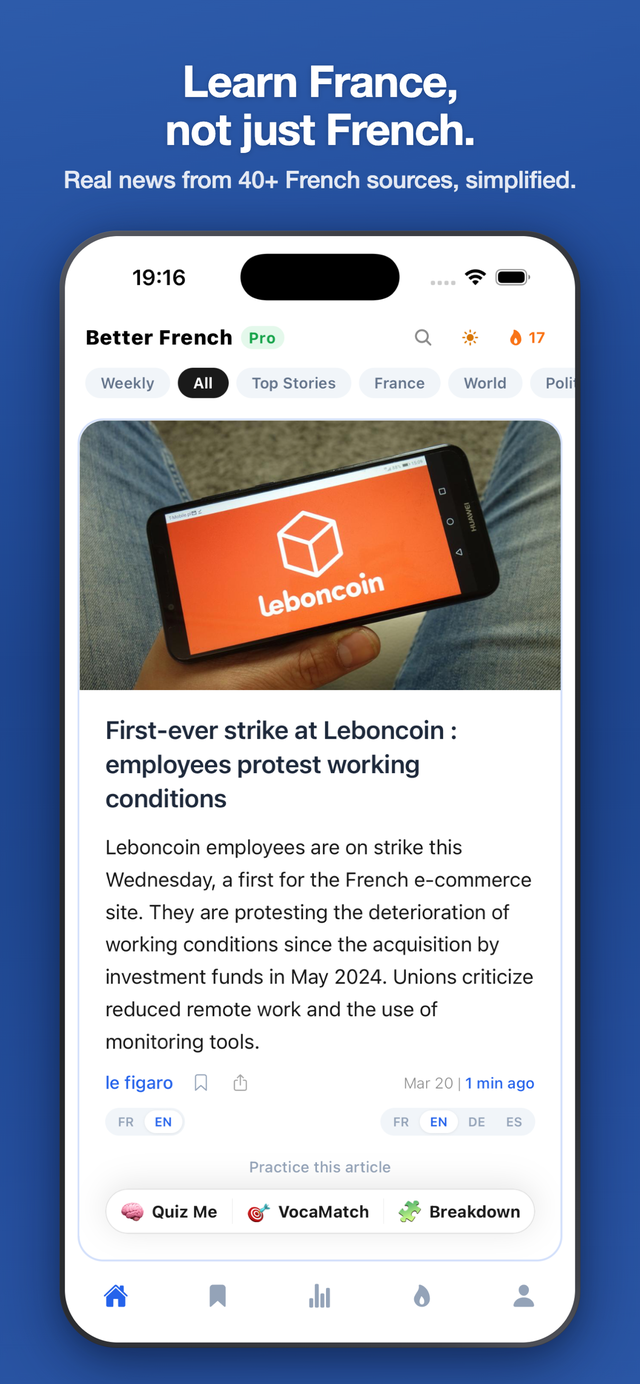
Closing that gap is the whole product. Every morning Better French reads around 800 articles from more than 40 French sources -- France Info, Le Figaro, La Dépêche, BFMTV, RFI and dozens more -- and picks the fourteen or so a learner actually needs to have read that day. Each of those is then rewritten at five levels. Not a summary, not baby French, and not a different story: the same news a native reads, in French you can get through, with the references and the register left in. That is the part that moves your French. You spend your reading time on real sentences pitched one notch above you, instead of drills pitched three notches below.
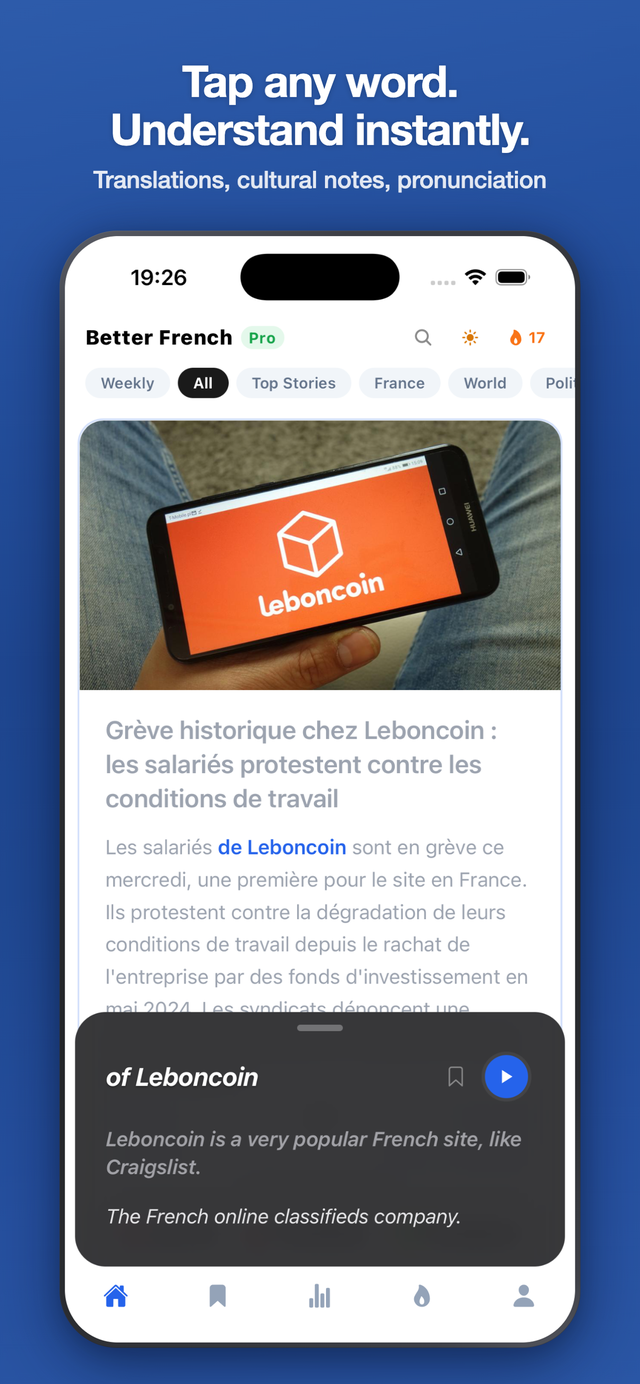
Then there is Better French Context. Tap any word or short phrase and you get three things instead of one: the translation, an explanation of what that word is doing in this particular sentence, and the cultural note. Tap la rentrée and you do not get "the return" -- you get the week the whole country goes back to work and school at once, and why French people build their year around it. Tap les gilets jaunes and you get the movement, not the two words. The translation teaches you the word. The note is what stops it falling straight back out of your head, and it is the part no other tap-to-translate on this list gives you.
The story you just read then becomes three games. Quiz Me is three questions that check what you understood, and usually teach you something about France on the way. VocaMatch drills the vocabulary from that same article: three lives, no clock, because recalling a word against a stopwatch is a different skill from knowing it. Breakdown teaches you to say the story out loud, one phrase at a time, across three tiers. Audioplay sits on any word or phrase you want to hear, spoken in natural French a fraction under native speed. There is no robot reading whole articles at you. What makes the three games work is that the vocabulary comes from something you cared about ten minutes ago, which is why it stays put when a flashcard deck does not.
There is more of it than a comparison table has room for: nineteen sections so you choose what you read, search and an archive so you can follow one story across sources and weeks, Saved Words where every word you keep arrives with the sentence and the cultural note it came from, a link straight through to the original article when you want the native version, a streak that only moves when you have actually done something, and Read in Your Language, which flips an article into English, German or Spanish and back for the days you need the gist first and the French second.
The philosophy is simple: language does not exist in a vacuum. When you read the same news French people read, you learn the language and the country at the same time, and it is the second half that finally unsticks the first.
What it does well: Picks the fourteen stories that matter out of roughly 800 read every morning, then rewrites each one at five levels, so what you read is real French pitched at you rather than at a native. Better French Context gives you translation, explanation and cultural note on any word or phrase. Three games built from the story you just read. Saved words keep their sentence and their note. It is the only tool here that takes what France read this morning and makes it readable at your level, instead of writing something easier and calling it French.
What it does not do: It is not for absolute beginners -- you need at least an A2 foundation. It does not teach grammar explicitly. It is reading-first, so if your primary goal is speaking practice, you will need to supplement.
Price: Better French is a subscription and it starts with a free trial. It works out at under €5 a month, and the exact price for your country is shown in the app before you pay.
Levels: A2 through C1.
Duolingo
Best for: Absolute beginners who need a structured start
Duolingo is excellent at one thing: getting you to open a language learning app every single day. The streak system is weirdly effective. The five-minute lessons fit into any schedule. The gamification -- XP, leaderboards, hearts -- gives you the small dopamine hits that keep you coming back. And the spaced repetition behind the scenes ensures words resurface just when you are about to forget them.
For complete beginners, this matters more than anything else. The biggest obstacle at A0 is not finding the perfect app. It is building a daily habit. Duolingo solves that problem better than any competitor.
Where Duolingo falls short is in connecting you to real French. The sentences are generated for learning exercises, not pulled from authentic sources. You will learn that "the woman eats bread" but not what French people actually talk about over that bread. There is no cultural context, no real-world content, and limited value beyond roughly B1 level. At some point, you outgrow it -- and that is fine. It did its job.
What it does well: Exceptional habit-building. Zero barrier to entry. Solid spaced repetition. Free tier is genuinely usable. Available on every platform.
What it does not do: Authentic content, cultural context, or advanced-level material. The gamification can become a distraction from actual learning -- you can spend twenty minutes managing hearts and streaks without learning much French.
Price: Free with ads. Duolingo Super: $12.99 a month, or about $8 a month billed yearly.
Levels: A0 through B1.
News in Slow French
Best for: Audio learners who want current events at a manageable pace
News in Slow French does exactly what the name says: it takes current news stories and narrates them in French at a reduced speed. If native-speed French still sounds like a wall of sound to you, this makes it possible to hear individual words and sentence structures. For audio-first learners -- people who study during commutes or workouts -- the format works.
Full Access, at $22.90 a month, gives you the podcast plus transcripts, vocabulary lists, grammar explanations, and quizzes. The content is produced specifically for learners, not sourced from real French publications.
The concern I have with slowed speech is dependency. When you eventually encounter real-speed French -- in conversation, on TV, in a French office -- the gap can feel jarring. Slowed French trains you to understand slowed French. Real French sounds different. That said, for beginners and lower intermediates who find native-speed content overwhelming, News in Slow French provides a genuine bridge.
What it does well: Clear, manageable audio for listening practice. Grammar explanations tied to real topics. Consistent publishing schedule. Well-established with a loyal audience.
What it does not do: Prepare you for real-speed French. Provide interactive reading tools. The price, $22.90 a month, is steep for what is primarily a podcast with extras.
Price: $22.90 a month.
Levels: A2 through B2.
Babbel
Best for: Structured conversational skills
Babbel takes a more traditional approach. Structured courses designed by linguists, organized around practical themes: ordering food, asking for directions, making small talk, handling a phone call. Lessons run 10 to 15 minutes -- longer and more substantial than Duolingo's bite-sized exercises, shorter than a classroom session.
Where Babbel distinguishes itself is conversation. The speech recognition feature lets you practice pronunciation, and the dialogues reflect how French people actually talk in daily situations. The grammar explanations are clear without being overwhelming. If your goal is to hold a real conversation -- at a restaurant, with a neighbor, at a shop -- Babbel teaches you the specific phrases and structures for those moments.
What it does well: Well-structured courses with clear progression. Practical, conversational focus. Good speech recognition. Clear grammar explanations.
What it does not do: Authentic content, cultural immersion, or real-world material. Limited free content -- you need a subscription to get real value. Can feel repetitive in longer sessions.
Price: Babbel prices by plan length and runs near-permanent promotions, so the monthly figure moves depending on when and where you look. The one-month plan is the most expensive way to buy it; six and twelve month commitments cost considerably less per month. Check the current price before you subscribe.
Levels: A1 through B2.
Pimsleur
Best for: Speaking and pronunciation
Pimsleur is the app that made my French colleagues say "your pronunciation is good" for the first time. The method has been around since the 1960s and it works by forcing you to speak from lesson one. Each 30-minute lesson introduces vocabulary and phrases, then prompts you to recall and produce them at increasing intervals. There is no visual crutch. You hear French, you process it, you speak it back.
This builds a kind of automatic recall that reading-based tools do not develop. If your priority is sounding good when you speak French -- producing the rhythm, the nasal vowels, the liaisons -- Pimsleur is uniquely good at that. The entirely audio format also makes it perfect for commuters.
What it does well: Forces active speaking from day one. Excellent for pronunciation and natural rhythm. Works entirely through audio. Proven methodology.
What it does not do: Teach you to read, write, or understand written French. No cultural context. Rigid lesson structure. Limited vocabulary per session. It is one of the more expensive subscriptions here.
Price: Monthly subscription, or a one-time purchase per level. Pimsleur discounts heavily and often, so the rate you see today is not necessarily the rate next week.
Levels: A0 through B1.
Lingvist
Best for: Vocabulary building with AI-powered flashcards
Lingvist does one thing and does it well: vocabulary acquisition. The app uses AI to figure out which words you know and which you need to learn, then presents French words in context -- within real sentences -- and uses spaced repetition to bring each word back at the optimal moment for retention. If you already know a word, it moves on. If you struggle, it returns more frequently.
The interface is minimalist. No games, no leaderboards, no mascots. You see a sentence with a blank, you type the missing word, you move on. For learners who want to build vocabulary efficiently without distractions, this stripped-down approach is refreshing. But it is best used as a supplement. Vocabulary alone will not teach you to read, speak, or understand French culture.
What it does well: Highly efficient vocabulary building. AI adapts to your knowledge gaps. Words in sentence context. Clean, distraction-free interface.
What it does not do: Grammar, reading, listening, cultural context, or anything beyond vocabulary. Can feel monotonous in longer sessions.
Price: Free tier (limited). Paid: €9.99/month, or €79.99 a year.
Levels: A1 through B2.
TV5Monde
Best for: Free authentic content from a trusted source
TV5Monde is the international French-language broadcaster, and their language learning platform is genuinely underrated. It provides exercises built around real TV clips, news segments, and cultural content. The material is sorted by CEFR level, and the exercises cover listening, reading, and vocabulary -- all for free.
The content is authentic in a way that most free tools are not. You are watching real French television, hearing real accents, and learning about real topics. There is a free mobile app as well, TV5MONDE EDU, on both iOS and Android, which carries the exercise library and will translate a word for you if you press and hold it. The trade-off is that the whole thing still feels institutional. The interface is not as polished as commercial apps, the progression is loose enough that you have to decide for yourself what to do next, and the help you get with a word is a translation rather than an explanation. But for the price -- zero -- the quality of the content is remarkable.
What it does well: Completely free. Authentic French media content. CEFR-sorted exercises. Trusted institutional source. Covers listening and reading.
What it does not do: Polish. It feels like an educational website that grew an app rather than an app in its own right. Progression is loose, so the sequencing is on you. Word help is a bare translation with no explanation or cultural context. Limited habit-building features.
Price: Free.
Levels: A1 through C1.
Kwiziq
Best for: Grammar drills and identifying weak spots
Kwiziq is for the learner who wants to master French grammar systematically. The platform uses an AI-powered assessment to identify your specific grammar gaps, then delivers targeted lessons and quizzes to fill them. It covers grammar points from A1 through C2, with clear explanations and plenty of practice exercises.
If grammar is the part of French that trips you up -- subjunctive, past tenses, pronoun placement, partitive articles -- Kwiziq will find exactly where you are weak and drill it until you are not. It is clinical, focused, and effective. It is also not going to teach you to read a news article or understand a conversation. Think of it as a specialist, not a generalist.
What it does well: AI-powered grammar gap analysis. Targeted practice. Covers A1 through C2 grammar. Clear explanations with examples.
What it does not do: Authentic content, conversation practice, cultural context, or vocabulary in real-world settings. Grammar drills can feel dry.
Price: Free tier (10 kwizzes a month). Premium is €26.99 a month month-to-month, less if you commit to a year.
Levels: A1 through C2.
Coffee Break French
Best for: Commuters and podcast lovers
Coffee Break French has been teaching French through audio lessons since 2008, and the quality holds up. The format is conversational: a teacher and a learner work through vocabulary, phrases, and grammar in episodes running 15 to 30 minutes. The tone is relaxed. The explanations are clear. The pacing suits people who want to absorb French during a commute, walk, or workout.
The free podcast alone provides substantial value. Hundreds of episodes, structured from beginner through advanced, available on every podcast platform. Premium courses add transcripts, bonus episodes, and exercises. As a complement to a reading-based or drill-based app, Coffee Break French fills the audio gap without costing anything.
What it does well: Free podcast with hundreds of episodes. Approachable, conversational teaching. Perfect for passive learning during dead time. Seasons progress from beginner to advanced.
What it does not do: Active practice. No reading or writing. No interactive features. Older episodes can feel dated. Premium required for full materials.
Price: Free podcast. Premium courses vary by season.
Levels: A0 through B2.
FluentU
Best for: Video-based learning with real content
FluentU uses authentic French videos -- movie clips, music videos, news segments, interviews -- and adds interactive subtitles. Click any word in the subtitles to see its definition, pronunciation, and usage in other videos. After watching, you complete quizzes and flashcard reviews based on the vocabulary.
The appeal is learning from how French actually sounds and looks in the real world. The videos are not scripted for learners. They are clips from French speakers with all the speed, slang, and personality that entails. The interactive tools make this accessible even when the content is above your comfort level. The drawback is the price -- at $29.99/month, it is among the most expensive tools on this list.
What it does well: Authentic video content. Interactive subtitles with instant definitions. Spaced repetition flashcards. Good variety of topics and difficulty levels.
What it does not do: Affordability. The video library can feel limited in certain topics. Requires reliable internet and a decent screen. No structured curriculum.
Price: $29.99/month month-to-month, or $11.99/month billed annually ($143.99 a year).
Levels: A2 through C1.
Quick Comparison
| App | Best For | Levels | Price |
|---|---|---|---|
| Better French | Reading real French at your level | A2-C1 | Subscription, free trial |
| Duolingo | Beginners, habit-building | A0-B1 | Free / $12.99/mo |
| News in Slow French | Audio learners, slow-paced listening | A2-B2 | $22.90/mo |
| Babbel | Structured conversation | A1-B2 | Varies by plan |
| Pimsleur | Speaking and pronunciation | A0-B1 | Subscription or per level |
| Lingvist | Vocabulary building | A1-B2 | Free / €9.99/mo |
| TV5Monde | Free authentic content | A1-C1 | Free |
| Kwiziq | Grammar drills | A1-C2 | Free / €26.99/mo |
| Coffee Break French | Free audio lessons | A0-B2 | Free / Paid premium |
| FluentU | Video-based learning | A2-C1 | $29.99/mo |
What I Actually Use
I use Better French every day. Obviously. I built it, I run it, and I genuinely believe reading real French news is the fastest way to improve once you have the basics down. But Better French is not the only app on my phone.
On the metro, when I want something mindless after a long day, I still open Duolingo. The five-minute sessions are oddly relaxing. I do not learn much new French from it anymore, but it keeps basic patterns sharp, and the streak is weirdly motivating. I am not proud of how much I care about that streak, but I would be lying if I said it did not keep me opening the app.
For pronunciation, I went through Pimsleur's first two levels when I arrived in Paris, and the investment paid off. My pronunciation is not perfect, but it is good enough that strangers do not immediately switch to English when I speak -- which, if you live in France, you know is the real test.
I listen to Coffee Break French occasionally when I am walking. The older seasons are too basic for me now, but the later seasons cover interesting ground, and the hosts are genuinely good at explaining grammar without making it feel like a lecture.
That is my stack: Better French for daily reading and cultural context, Duolingo for mindless maintenance, and podcasts for passive listening. Three apps, three purposes, maybe 30 minutes total on a typical day. The consistency matters more than the volume.
If I were starting over from zero today, I would begin with Duolingo and Pimsleur for the first three months, then switch to Better French and Coffee Break French once I could recognize basic sentence structures. That progression -- structured drills first, real content second -- is what I have seen work best.
Frequently Asked Questions
What is the best app to learn French in 2026?
There is no single best app. Duolingo is best for absolute beginners who need structure and habit-building. Better French is best for A2+ learners whose French has stalled on drills and who need to read what French people are actually reading. Babbel is strongest for conversational practice. Pimsleur is best for pronunciation. The right choice depends on your level, your learning style, and what you want to do with your French.
Can I learn French with just one app?
You can make real progress with one app, but most successful learners combine two or three tools that serve different purposes. A structured app for grammar basics plus a content-based app for real-world reading covers more ground than either alone. Think of it like exercise -- you would not only do push-ups and call yourself fit.
What is the cheapest way to learn French with an app?
Duolingo, Coffee Break French and TV5Monde all have genuinely usable free tiers, and you can build a real daily routine out of those three alone. Better French is a subscription and it starts with a free trial, with the price for your country shown in the app before you pay.
Which app is best for intermediate French learners?
Intermediate learners (B1-B2) often hit a plateau with beginner apps. Better French is built for that plateau: the stories France is reading today, rewritten at your level, with every word tappable for a translation, an explanation and a cultural note. FluentU and News in Slow French are good alternatives for intermediates who prefer video or audio formats.
Is Duolingo enough to become fluent in French?
No. Duolingo builds a solid foundation in vocabulary and basic grammar, roughly up to B1. But fluency requires exposure to real French content, cultural understanding, and practice with authentic materials. Think of Duolingo as the on-ramp, not the highway.
Is News in Slow French worth the price?
For audio-focused beginners, yes. The slowed speech genuinely helps train your ear. At $22.90 a month it is one of the most expensive options on this list. If you want interactive features and real content rather than slowed audio, several alternatives give you real French content and interactive tools instead.
Get Better French
Available on the App Store and Google Play. The stories France is reading today, rewritten in clear French you can actually read, with every word tappable for a translation, an explanation and the cultural note.
Download the App