Build Your French Vocabulary Through Daily News
News vocabulary sticks because it is learned in real context, repeated naturally across articles, and tied to topics you care about. Use the 5-word method: learn five new words from each article, review yesterday's five before reading today. The catch is that French news is written by French people for French people, so nothing in it tells you which five are worth keeping. Better French picks the stories that matter, rewrites each one for your level, and every word you save keeps the story it came from. Over time, your news vocabulary becomes your speaking vocabulary.
Most French vocabulary methods have the same problem: they teach you words in isolation. You memorize le chat and la maison on a flashcard, pass a test, and forget them within a week. The words never had a home in your memory because they were never attached to anything real.
I noticed this myself. I could memorize a word with a flashcard and forget it by Tuesday. But when I learned a word from a real article -- when I saw manifestation in a headline about a transport strike that affected my commute -- that word stuck permanently. Context is everything. This works whether you are reading from Paris or from your phone in Toronto.
Reading French news is the opposite of the flashcard approach. Every word you learn comes wrapped in context -- a sentence, a topic, a story about something that happened today. That context is what makes vocabulary stick. It is also what makes vocabulary useful, because the words you encounter in news are the words that French people actually use when they talk about the world around them.
This guide explains why news vocabulary is more durable than vocabulary learned from other sources, gives you a practical method for capturing and retaining new words, and includes the most common French news words you will encounter across all topics.
Why News Vocabulary Sticks Better
There are three reasons why vocabulary learned from news articles has higher retention than vocabulary learned from flashcards, textbooks, or vocabulary apps.
Context makes words memorable. When you learn the word grève from a flashcard, you know it means "strike." When you learn it from an article about transport workers shutting down the Paris metro, you know it means strike, you know what kind of situations produce strikes in France, and you know the words that typically surround it -- manifestation, syndicat, perturbation. That network of associations gives the word multiple entry points in your memory. Seeing syndicat in a future article will remind you of grève, and vice versa. Flashcards create isolated data points. News creates interconnected networks.
Natural repetition reinforces learning. French news has its own recurring vocabulary. Words like selon, gouvernement, hausse, and réforme appear in articles every single day, across every source. You do not need a spaced repetition algorithm to review these words -- the news does it for you. Each time you read a new article, you encounter the high-frequency words again in a slightly different context, which deepens your understanding of how they are used. After reading news daily for a month, you will know these words as well as you know common English words, simply from repeated natural exposure.
Emotional engagement improves retention. You remember things you care about. A flashcard with the word attentat is forgettable. An article about a real event that affects real people is not. News stories carry emotional weight -- surprise, concern, interest, frustration -- and that emotional response acts as a memory anchor. You may not remember vocabulary drill number 47, but you will remember the article about the pension reform protests that shut down half of Paris.
The Catch: French News Was Not Written For You
All of that is true, and it is also where most people quit in the second week. French news is written by French journalists for French readers. Nobody in that chain was thinking about someone learning the language, and it shows the moment you open an article.
Nothing glosses the words. A word turns up, alone, and you either know it or you open a dictionary in another tab, which is the moment reading stops being reading and becomes homework.
Nothing explains what the word is doing in that sentence. Mis en examen comes out of a translator as "placed under formal investigation." Accurate, and useless. It does not tell you that this is a specific step in French criminal procedure, that it is not the same as being charged in an English-speaking country, and that French readers know exactly how much weight to put on it. You can translate that phrase perfectly and still misread the story.
And nothing tells you which of the words are worth keeping. One article about a rail dispute can hand you forty words you do not know. Perhaps five of them will follow you around France for the rest of your life. The other thirty-five will not come up again this year. The article gives you no way whatsoever to tell them apart, and neither does your dictionary.
That third gap is the expensive one. The first two cost you patience. This one costs you the year. Spread your effort evenly across forty words instead of heavily across five, and you end the month with a notebook full of vocabulary you will never meet again.
Part of the answer is fixed and knowable in advance, because some words are simply always there, whatever the story is.
The Most Common French News Words
Certain words are the backbone of French journalism. Learning them accelerates your comprehension across every topic because they appear in nearly every article, regardless of subject. Here are the most important ones, organized by category.
| French | English | Category |
|---|---|---|
| selon | according to | Journalism |
| déclarer | to state / declare | Journalism |
| affirmer | to assert / claim | Journalism |
| préciser | to specify / clarify | Journalism |
| annoncer | to announce | Journalism |
| révéler | to reveal | Journalism |
| gouvernement | government | Politics |
| projet de loi | bill (proposed law) | Politics |
| député | member of parliament | Politics |
| Assemblée nationale | National Assembly | Politics |
| Sénat | Senate | Politics |
| réforme | reform | Politics |
| élection | election | Politics |
| maire | mayor | Politics |
| manifestation | protest / demonstration | Society |
| grève | strike | Society |
| syndicat | trade union | Society |
| rassemblement | gathering / rally | Society |
| entreprise | company / business | Economy |
| hausse | increase / rise | Economy |
| baisse | decrease / drop | Economy |
| pouvoir d'achat | purchasing power | Economy |
| chômage | unemployment | Economy |
| cotisation | contribution (social/tax) | Economy |
| croissance | growth | Economy |
| enquête | investigation / survey | Legal |
| mis en examen | charged (legally) | Legal |
| tribunal | court | Legal |
| condamner | to sentence / condemn | Legal |
| bilan | assessment / toll | General |
| enjeu | issue / stake | General |
| atteindre | to reach / achieve | General |
| dénoncer | to denounce / criticize | General |
| s'engager | to commit / pledge | General |
| mettre en place | to set up / implement | General |
| déplacement | trip / travel (official) | General |
| collectivité | local authority | General |
| intérieur | interior / domestic | General |
| étranger | foreign / abroad | General |
| désormais | from now on / henceforth | General |
You do not need to memorize this table. Use it as a reference. When you encounter one of these words in an article and cannot remember its meaning, come back here and check. After seeing each word three or four times in real articles, you will not need the table anymore.
The 5-Word Method
This is the simplest and most effective vocabulary method for news readers. It requires no apps, no flashcards, and no more than two minutes of extra effort per day.
Step 1: Read your daily article. Read one French news article, either on your own or using an app like Better French. Do not stop to look up every word. Focus on understanding the main idea and the key details.
Step 2: Pick five words. After reading, choose five words from the article that are new to you and seem useful. Not obscure technical terms. Not words you will never see again. Words that feel like they belong to the general vocabulary of the topic you were reading about. Write each word down with its meaning and the sentence where you found it.
Step 3: Review yesterday's five. Before reading today's article, look at yesterday's five words. Can you remember what they mean? Can you recall the context? This takes thirty seconds and is the single most important step in the process. It is the review that moves words from short-term recognition to long-term retention.
Step 4: Weekly review. Once a week, go through all the words you collected that week -- 35 in total if you read every day. Cross out any that you now know confidently. Circle any that are still fuzzy. The circled words become priority words for the following week -- pay extra attention when you encounter them in future articles.
The math is straightforward. Five words per day is 35 per week, 150 per month, and roughly 1,800 per year. In one year of daily news reading, you will have added 1,800 contextual, relevant, high-frequency words to your active vocabulary. That is enough to move from fighting your way through a news article to reading one without stopping.
There is a condition attached to that number, and nobody ever says it out loud: the five words have to be the right five. Five recurring words a day compound. Five words from a story that never comes up again are 1,800 pieces of trivia at the end of the year. Vocabulary only repeats itself if the subjects repeat themselves, which makes the stories you read from matter every bit as much as the method you use on them.
That is the problem we ended up building the whole product around. Every day we read around 800 articles from more than 40 French sources and choose the fourteen that actually matter to someone learning the language and living in France, or heading there. Not the fourteen with the loudest headlines. The fourteen a French colleague would assume you had already heard about. The effect on your vocabulary is direct: the words in those stories are the words that come back next week, and the week after, because the subjects come back. A random firehose of French articles gives you noise. Chosen stories give you repetition, and repetition is the only thing that has ever made a word stick.
How Better French Helps Build Vocabulary
Better French exists because of the three gaps described earlier. Learning French is not enough on its own; what unsticks people is understanding the country they are learning it for, and the fastest way in is the news French people are actually reading. So we picked the stories, rewrote them for five levels, and built the missing help around them. Here is how the app maps onto the four steps you just read.
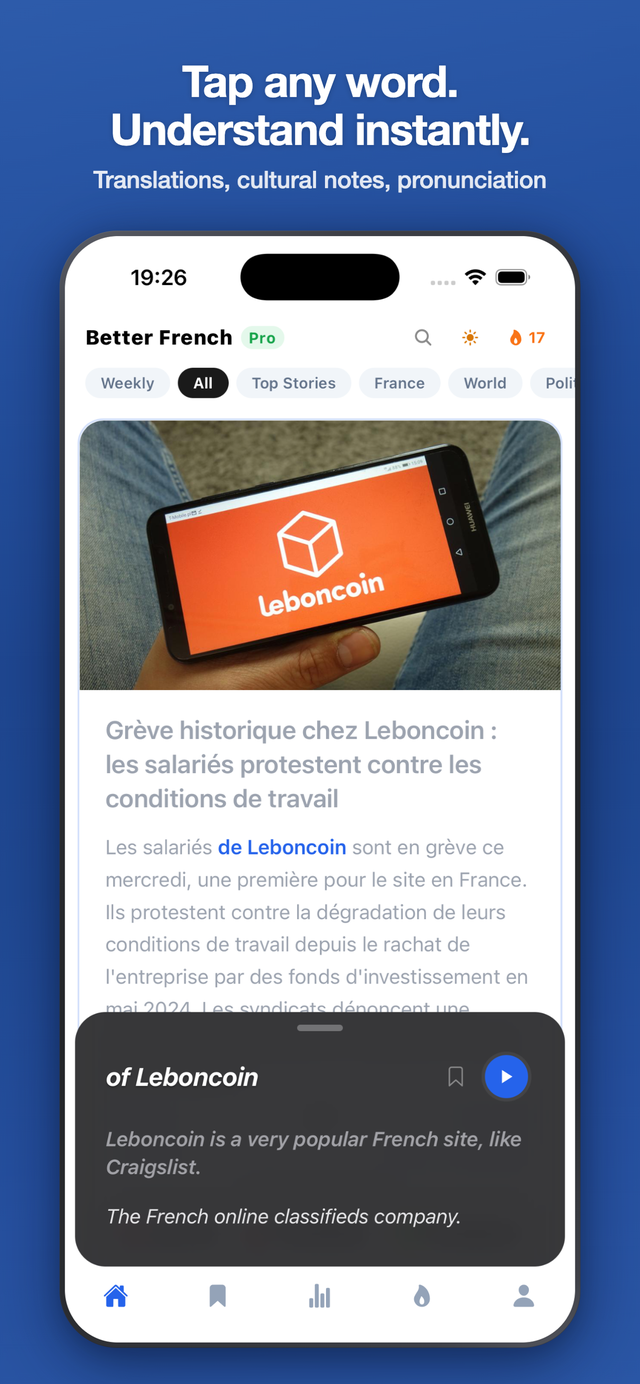
Step 1, the reading. Every story we choose is rewritten for five levels, so the article in front of you is the real news at a difficulty you can actually get through. Better French Context closes the first two gaps: tap any word or short phrase and you get the translation, an explanation of what it is doing in that sentence, and the cultural note when there is one worth giving. It opens in place, so the reading never stops. When a story mentions la rentrée, a dictionary says "the return." The note tells you it is the September restart when the entire country goes back to school and work in the same week, that it reorders the news, politics and half the conversations you will have that month, and that supermarkets build whole aisles around it. That is the layer a translation cannot reach. If a paragraph still defeats you, you can flip the article into your own language and back -- English, French, German or Spanish.
Step 2, picking your five. This is Saved Words, and it is the feature this whole article has been arguing for. Save a word and it does not turn into a flashcard. It keeps the sentence it came from, the story it came from, and its cultural note. Open it a week later and you are not staring at hausse on a blank card trying to reconstruct why you cared. You are back in the article about energy prices where you met it, with the context that made it memorable still attached. The failure at the top of this page -- the word memorized on Sunday and gone by Tuesday -- happens because the word had nothing attached to it. Saved Words is us refusing to detach it in the first place.
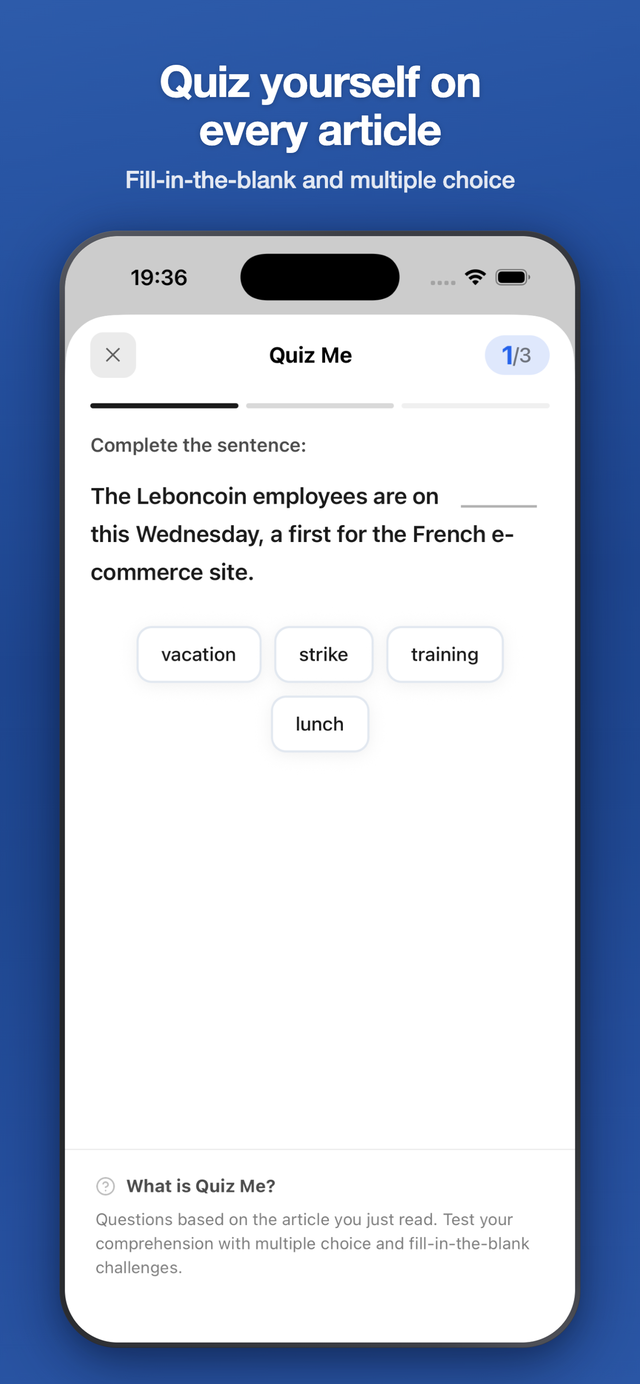
Step 3, reviewing yesterday's five. Three games are built from the story you just read, and each one does a different job. Quiz Me asks three questions and checks whether you followed the story, not just the words, and it gets harder as your streak grows. VocaMatch is the vocabulary itself: match the words from that article to their meanings, with three lives, so a careless tap costs you something. It is not timed, because nobody has ever learned vocabulary better with a clock running. It comes in three bands so the words are pitched at your level, and the meanings can be in English, French, German or Spanish. Breakdown takes the article's own phrases and gets you saying them out loud, one at a time, across three tiers -- the step that reading-based learning quietly skips, and the one that turns recognition into speech. Audioplay sits inside the word tooltip and inside Breakdown: tap the play icon on any word or phrase and hear it in unhurried French. There is no whole-article narration. This is a reading app, not a podcast.
Step 4, the weekly review. Search the archive for a word or a subject and you can follow one story across every source that covered it, over weeks. For vocabulary that is close to cheating: the same words, in the same subject, in five different journalists' sentences. Your saved words and saved articles are all still there with their context. And the streak keeps an honest score, because it does not move when you open the app or scroll the feed. It moves when you tap ten new words, or finish a quiz, a VocaMatch level or a Breakdown tier.
None of this replaces the reading. It removes the friction that makes people stop, and puts the reinforcement exactly where the method already asked for it.
From News Reader to French Speaker
There is a common concern that vocabulary learned from reading will remain "passive" -- you will recognize words on the page but not be able to use them in conversation. This concern is understandable but mostly unfounded, for a specific reason: the vocabulary you learn from news is the vocabulary of public life and current affairs, which is also the vocabulary of adult conversation.
When French people talk about what is happening in the world -- politics, the economy, social issues, cultural events -- they use the same words that appear in the news. If you can read an article about pension reform, you can follow a conversation about pension reform. If you know pouvoir d'achat from reading, you can use pouvoir d'achat when discussing the cost of living. The transfer from reading vocabulary to speaking vocabulary happens naturally because the contexts overlap.
The bridge between passive and active vocabulary is exposure and frequency. The more times you encounter a word in reading, the more readily available it becomes for speaking. Daily news reading provides exactly this high-frequency, high-repetition exposure. After seeing manifestation in thirty different articles, you will not hesitate to use it when describing a protest you walked past on your way to work.
To accelerate this transfer, try one additional exercise: after reading an article, summarize it out loud in French. Even a few sentences. This forces you to pull the words you just read from recognition into production. It is uncomfortable at first, but it is the fastest way to turn your reading vocabulary into your speaking vocabulary.
Frequently Asked Questions
How many French words do I need to know to read news?
Research suggests that knowing approximately 3,000 to 5,000 word families covers around 95 percent of a typical French news article. However, you do not need to reach that number before you start reading. With 1,000 to 2,000 words and a way to check any word in place, without leaving the article, you can follow most news articles and learn the remaining vocabulary in context as you go.
Is learning vocabulary from news better than using flashcards?
Learning vocabulary from news and flashcards serve different purposes, but contextual learning from news tends to produce deeper retention. When you learn a word from a news article, your brain stores it alongside the topic, the sentence, and the situation, which creates multiple retrieval paths. Flashcards are useful for initial memorization, but without context they often produce shallow knowledge where you recognize a word on a card but not in a real sentence.
What are the most important French words to learn first?
Focus on high-frequency words that appear across many topics: selon (according to), gouvernement (government), entreprise (company), hausse (increase), baisse (decrease), projet de loi (bill), enquête (investigation), and réforme (reform). These words appear in nearly every French news source and will immediately boost your comprehension across all article types.
How many new French words should I try to learn per day?
Five words per day is the optimal number for most learners. This is enough to make steady progress -- roughly 150 words per month and 1,800 per year -- without becoming overwhelming. What matters most is not just learning five new words but also reviewing yesterday's five words before your reading session. This spaced repetition cycle ensures that new vocabulary moves from short-term recognition to long-term retention. The unstated condition is that the five have to be the right five: words that recur across stories, not words from a subject that never comes up again.
Can I stop using flashcards if I learn vocabulary from the news?
You can, as long as the words you keep hold on to their context. Flashcards do not fail because of repetition, they fail because of detachment: the card hands you the word with everything that made it memorable stripped away. A word saved with its sentence, its story and its cultural note keeps the retrieval paths intact. That is why Better French saves every word with the article it came from and its cultural note rather than as a bare pair of words. If you prefer a card system, at minimum write the source sentence on the back.
Get Better French
The fourteen stories that matter each day, rewritten in clear French you can actually read. Tap any word for the translation, the explanation and the cultural note, then keep it with the story it came from. Better French is a subscription and it starts with a free trial. It works out at under €5 a month, and the exact price for your country is shown in the app before you pay. Available on the App Store and Google Play.
Download the App