French Immersion at Home: How to Surround Yourself With French
You do not need to move to France to immerse yourself in French. Build a daily routine that layers French into your morning (read the day's French news at your level on Better French, listen to France Info), your commute and work (French podcasts, French music), your evening (French TV with French subtitles, French YouTube), and your weekends (French films, cooking in French, cultural events). Start with one anchor habit and add more over time. Consistency beats intensity -- thirty minutes every day is worth more than five hours on Saturday.
You do not need to live in France to immerse yourself in French. Whether you are in a studio in Seoul, an apartment in Mexico City, or a house in suburban Chicago, you can build a French environment from your phone, your kitchen, and your commute.
Before I moved to Paris, I switched my phone to French. Half the time I could not find the settings I needed. But within a month, I stopped noticing it was in French at all. That was the moment I understood what immersion actually is: not geography, but exposure. How many hours per day your brain is processing French -- hearing it, reading it, thinking in it.
With the internet, streaming services, podcasts, and apps like Better French, you can create that exposure from anywhere in the world. You just have to be deliberate about it. This guide walks through how to build a French immersion routine around your existing daily life. No drastic changes. No quitting your job to move abroad. Just a structured approach to making French a part of every day.
What Immersion Really Means
Immersion is not a single activity. It is an environment. When you live in France, immersion happens automatically -- you hear French at the bakery, you read French on street signs, you watch French on television. The language is everywhere, and your brain is processing it constantly, even when you are not actively studying.
At home, you have to create that environment intentionally. The goal is not to spend three hours studying French grammar. The goal is to fill the spaces in your day with French content so that your brain gets the same quantity and variety of input that it would get in France. Some of that input will be active -- reading an article, doing a quiz, working through a lesson. Some will be passive -- listening to French radio while cooking, having a French podcast on during your commute. Both types matter. Active input builds skills deliberately. Passive input trains your ear and normalizes the sound of French so that it stops feeling foreign.
The most effective immersion routines combine both active and passive French across different times of day, using different types of content. Here is how to structure that.
Morning Routine in French
The morning is the best time for active French practice because your brain is fresh and your focus is sharp. This is when you should do the work that requires concentration: reading, vocabulary, comprehension exercises.
Read one French news article. This is the anchor habit that everything else builds on, and it is the only item on this whole list that works at full strength on day one. The film is still too fast. The radio is still a wall. A page of text sits still and waits for you, which is why reading is where an immersion routine starts rather than where it ends.
Except there is a catch, and it is the same catch as the film and the radio: French news is written for French people. Le Monde does not gloss its vocabulary. France Info does not slow down. Nobody stops to explain who the person in the headline is, what the acronym stands for, or why this is the fourth time this year that particular argument has come round. That is not a failing of French journalism. It just means the raw material needs work before a learner can use it, and doing that work yourself at seven in the morning, dictionary open, is not a habit anyone keeps for a month.
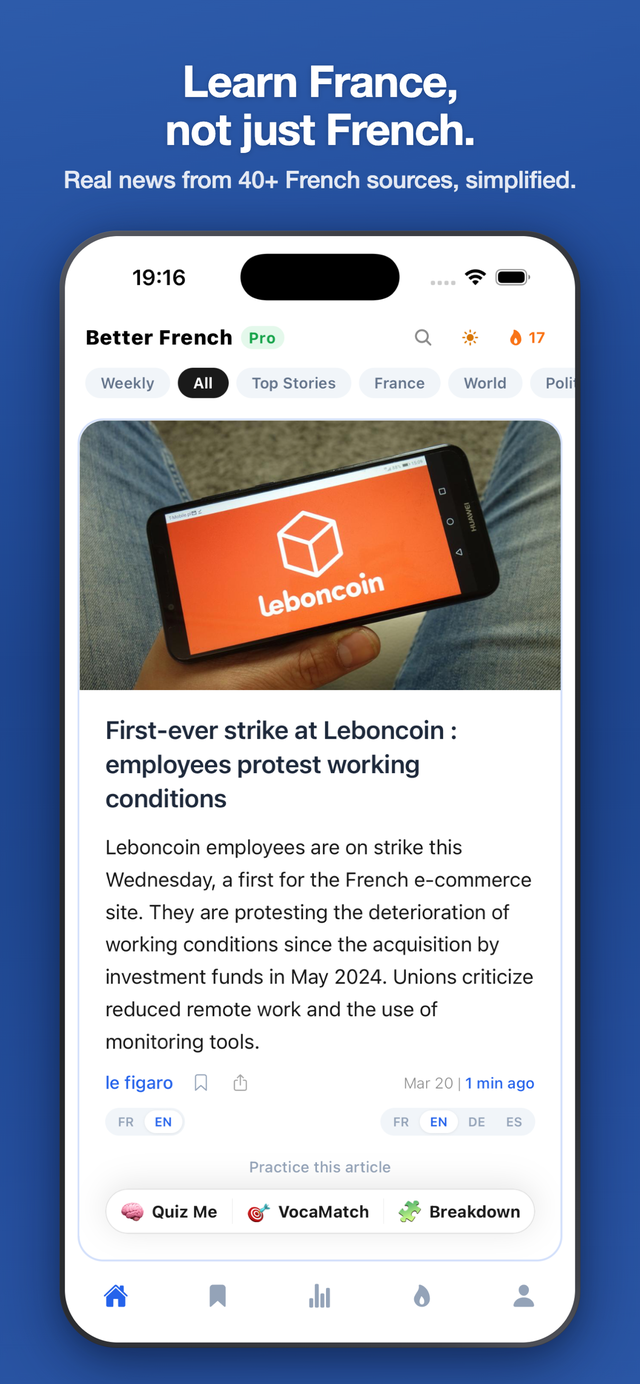
That is the work Better French does before you open it. Every day it reads around 800 articles from more than 40 French sources and picks the fourteen that are worth a learner's time. Each of those fourteen is then rewritten at five levels, so the same story exists as a version you can read at A1 and a version you can read at C1. You are not reading a textbook chapter about France. You are reading what France is reading today, at the level where you can actually follow it.
Then you read it, and the page helps. Tap any word or short phrase and Better French Context gives you three things at once: the translation, the explanation, and the cultural note underneath it, so the reference in paragraph three stops being a dead end. Audioplay lives in that same tooltip. Tap the play arrow and you hear the word or phrase spoken in natural French, pitched just under native speed. That is the bridge between this habit and the France Info habit below, because you are hearing the vocabulary properly said before you go hunting for it in a live broadcast. There is no voice reading the whole article to you. Words and phrases, on demand, when you want them.
And if the thread goes entirely, which it will, Read in Your Language flips the article to English and then back to French. That sounds like cheating. It is the difference between abandoning an input halfway and finishing it, and finishing it is the entire habit you are trying to build.
When you reach the end, the same story turns into three short things you can do with it. Quiz Me asks three questions, some about the French and some about what was actually going on. VocaMatch takes the vocabulary from that article and gives you three lives to match it up; nothing is timed, so you can sit and think. And Breakdown is the one that belongs in an immersion routine more than any of the others, because it takes the story phrase by phrase, across three tiers, and has you say it out loud. Ten minutes of reading followed by two minutes of your own voice speaking French, in a kitchen nowhere near Paris.
The whole thing takes ten to fifteen minutes, and you finish it knowing something that happened in France yesterday and holding six or seven words you did not have the day before. Those two are the same thing, which is the part most learners find out late. You read what French people are reading, so you understand the country, and your French improves because of it, faster than it does from another exercise on the conditional.
Listen to France Info while getting ready. France Info is the French public radio news station, and it broadcasts 24 hours a day. Put it on while you are showering, getting dressed, or making breakfast. You will not understand everything, and that is fine. The purpose is passive exposure -- training your ear to the rhythm, intonation, and sounds of spoken French. Over weeks and months, you will start catching words, then phrases, then whole sentences. France Info is freely available through their website, their app, or through any internet radio platform.
This morning combination -- one active reading session plus passive radio -- takes about 20 to 30 minutes total, most of which overlaps with things you are already doing. It is the minimum viable immersion routine, and on its own, it produces noticeable results within a month.
Work and Commute in French
The commute and work breaks are opportunities for passive French input that would otherwise be filled with English-language content or silence. Converting these dead spots into French exposure adds one to two hours of daily immersion without requiring any extra time in your schedule.
French podcasts for the commute. Podcasts are ideal for commuting because they require no visual attention. For intermediate learners, Journal en français facile by RFI is a daily ten-minute news broadcast in simplified French -- clear, well-paced, and designed for non-native speakers. For more advanced learners, Les Pieds sur terre by France Culture tells documentary-style stories about everyday life in France, and Le Monde's daily podcast covers the top news stories in standard journalistic French. Choose one that matches your level and listen to it every day during your commute.
French music throughout the day. Switch your background music to French artists. This is the easiest immersion habit because it requires zero effort -- you just change what is playing. French pop, chanson, rap, and electronic music are all thriving genres with world-class artists. Stromae, Angèle, Aya Nakamura, Edith Piaf, Jacques Brel, MC Solaar -- the range is enormous. You will absorb pronunciation, rhythm, and colloquial expressions without even trying. Create a French playlist and let it run during work, cooking, or cleaning.
French audiobooks. If your commute is longer than 30 minutes, audiobooks offer deeper immersion than podcasts. Start with books you have already read in English -- knowing the plot lets you follow the French without getting lost. Antoine de Saint-Exupéry's Le Petit Prince is the classic recommendation, and for good reason: the language is beautiful, clear, and accessible. From there, move to contemporary French novels or non-fiction on topics that interest you.
Evening Wind-Down in French
The evening is for enjoyable, low-effort French content. After a full day of work, you are not going to study grammar tables. But you can absolutely watch a great television series or browse YouTube in French. Choose content you would genuinely enjoy even if it were in English. Immersion only works if you actually do it, and you will only do it consistently if it feels like entertainment, not homework.
French TV series on Netflix and streaming platforms. Netflix, Amazon Prime, and Disney+ all have substantial French-language libraries. Lupin is the obvious starting point -- it is fast-paced, well-acted, and internationally popular for a reason. Dix pour cent (Call My Agent) is a comedy-drama about a Parisian talent agency that is widely considered one of the best French series of the past decade. Au service de la France (A Very Secret Service) is a sharp comedy set in 1960s French intelligence. Plan Cœur (The Hookup Plan) is a light romantic comedy.
Watch with French subtitles, not English. English subtitles train your brain to read English while ignoring the French audio -- this provides almost no language benefit. French subtitles connect what you hear with what you see on screen, reinforcing both listening and reading simultaneously. If a series is too difficult with French subtitles, choose an easier series rather than switching to English subtitles.
French YouTube channels. YouTube is an underused immersion resource. Channels like Cyprien (comedy sketches), Nota Bene (history), Le Monde's video explainers (current affairs), and Squeezie (gaming and entertainment) produce content that is engaging, colloquial, and current. The language is more informal than news or television, which exposes you to the French that people actually speak with their friends. Most YouTube videos also have auto-generated French subtitles, which are imperfect but helpful for following along.
The Weekend Deep Dive
Weekends are for immersion activities that require more time and attention than your weekday routine allows. These are the activities that make French feel like a part of your life rather than a task on your to-do list.
Watch a French film. French cinema is one of the richest in the world, and watching a full film in French is a two-hour immersion session that feels like entertainment. Start with films you have heard of: Intouchables, Amélie, La Haine, Les Misérables (2019). Then explore further -- French thrillers, comedies, dramas, and documentaries are all excellent. Watch with French subtitles. After the film, try to summarize the plot in French, even just a few sentences. This converts passive viewing into active language production.
Cook a French recipe in French. Find a recipe on Marmiton (the French equivalent of AllRecipes) and cook it. Reading a recipe in French builds practical vocabulary -- éplucher (to peel), faire revenir (to sauté), une cuillère à soupe (a tablespoon), à feu doux (on low heat). It is also a genuinely enjoyable activity that connects language learning with French culture in a tangible way. You end up with a meal and a set of new vocabulary words.
Visit French cultural events. Wherever you live, there are likely French cultural events nearby -- film festivals, Alliance Française meetups, French-language book clubs, or French restaurant events. Most major cities worldwide have an Alliance Française or a French cultural center. These provide real-world speaking practice and connect you with other French learners and speakers. Even if the conversation is partly in English, the French exposure adds up, and the social motivation keeps you engaged with the language.
Building Your Immersion Stack
Here is a practical overview of how to layer French into your day, with specific activities, resources, and difficulty levels for each time slot.
| Time of Day | Activity | Tool / Resource | Difficulty |
|---|---|---|---|
| Morning (15 min) | Read the day's story, then Quiz Me, VocaMatch or Breakdown | Better French. Fourteen stories picked from ~800 a day, each one rewritten for five levels, every word tappable | Any level, A1 to C1 |
| Morning (passive) | Listen to radio while getting ready | France Info | B1-C1 |
| Commute (10-30 min) | Listen to a podcast | Journal en français facile (RFI) | A2-B1 |
| Commute (10-30 min) | Listen to a podcast | Les Pieds sur terre (France Culture) | B2-C1 |
| Work (background) | French music playlist | Spotify / Apple Music | All levels |
| Evening (30-60 min) | Watch a French series | Netflix / Amazon Prime | B1-C1 |
| Evening (15 min) | Browse French YouTube | Cyprien, Nota Bene, Squeezie | B1-B2 |
| Weekend (2 hours) | Watch a French film | Netflix / MUBI / Canal+ | B1-C1 |
| Weekend (1 hour) | Cook a French recipe | Marmiton | A2-B2 |
| Weekend (varies) | Cultural event or meetup | Alliance Française, Meetup | All levels |
You do not need to do everything on this list. Pick two or three activities to start with and add more as they become habitual. The goal is to gradually increase the amount of French in your day until it feels normal rather than special.
If you are only picking one, pick the reading. Every other row on that table hands you French made for French people and asks you to keep up. The Better French row is the one where somebody has already done the picking and the rewriting, which is why it works on your first morning instead of your fiftieth. It is also what makes the other rows arrive sooner. The vocabulary you meet in the morning story is the vocabulary you start catching in the France Info bulletin, and then in Lupin, and then in the film. Reading with support is the door into an immersion routine, not a rival to it.
Consistency Beats Intensity
The most common mistake is starting too aggressively. You read three articles, listen to two hours of podcasts, and watch a film -- all on Monday. By Wednesday, you are exhausted and you skip everything. By Friday, the routine is dead.
Thirty minutes of French every single day for a year is 182 hours of exposure. That is enough to produce significant, measurable improvement in your reading, listening, and overall comprehension. Five hours on Saturday followed by nothing for the rest of the week gives you 260 hours per year on paper, but in practice, you will not sustain it. You will skip weekends, lose motivation, and end up with far less total exposure than the person who did thirty quiet minutes every day.
Start with one habit. Just one. Read one article on Better French each morning. Do it for two weeks until it feels automatic. Then add a second habit -- maybe French music during work or a podcast during your commute. Two weeks later, add a third. This gradual layering is how you build a sustainable immersion environment. Each habit is small enough to be easy, and together they create the constant French exposure that makes immersion work.
The person who reads one French news article every morning for a year will outperform the person who did a two-week immersion bootcamp and then stopped. Language learning is not a sprint. It is a daily practice, and the daily practice is what transforms your relationship with French from something you are studying into something you are living.
Frequently Asked Questions
Can I achieve French immersion without living in France?
Yes. Immersion is about the quantity and quality of your exposure to French, not your geographic location. By structuring your daily routine to include French news, podcasts, television, music, and reading, you can accumulate several hours of French exposure per day from anywhere in the world. Many successful French learners have reached advanced proficiency without ever living in a French-speaking country.
How many hours of French immersion per day do I need?
There is no minimum threshold, but one to two hours of daily exposure produces meaningful results within a few months. Some of that time should be active engagement -- reading or doing exercises -- while the rest can be passive exposure like listening to French radio or podcasts in the background. Even thirty minutes of focused French activity per day, combined with an hour of passive listening, adds up to significant immersion over time.
What is the best way to start a French immersion routine?
Start with one anchor habit and build from there. The easiest anchor is reading one French news article each morning, which takes about ten minutes. Once that feels natural, add a second habit such as listening to a French podcast during your commute or switching your evening television to a French series. Adding one new French habit every two weeks prevents burnout and ensures each habit becomes automatic before you layer on the next one.
Should I use French subtitles or English subtitles when watching French TV?
Use French subtitles. English subtitles train you to read English while hearing French, which provides minimal language benefit. French subtitles connect what you hear with what you read, reinforcing both listening and reading skills simultaneously. If a show is too difficult with French subtitles, choose an easier show rather than switching to English subtitles. Once you can follow a show with French subtitles, try watching without any subtitles at all.
Get Better French
The stories France is actually talking about, rewritten in clear French you can actually read, every word tappable, with three games built from the story you just read. Better French is a subscription and it starts with a free trial. It works out at under €5 a month, and the exact price for your country is shown in the app before you pay. On the App Store and Google Play.
Download the App