How I Went From Struggling With Le Monde to Reading It Over Coffee
Six months after moving to Paris, I could barely read a French news article. I tried harder textbooks, longer study sessions, more grammar drills. None of it worked. What worked was switching to real French content, reading every single day even when it felt pointless, and changing how I dealt with words I did not know. This is the story of what I did differently, and how it took me from closing Le Monde tabs in frustration to reading the news with my morning coffee.
Six months after moving to Paris, I opened a Le Monde article about pension reform. I understood maybe one sentence in five. The rest was a wall of words -- dense, formal, full of vocabulary I had never seen in any textbook. I closed the tab and went back to reading about France in English.
That was the low point.
I had been studying French. I could order food, make small talk, survive at the prefecture. But reading? Real reading, the kind where you actually follow an argument or understand why people are angry about a new law? I was nowhere close.
What followed was not a single breakthrough moment. It was a series of small changes, spread over months, that compounded into something that surprised me. Here is what I did differently, and how it changed everything.
The Shift That Started Everything
For my first year in France, I tried to improve my reading the way most people do. I worked through textbook exercises. I read graded readers designed for A2 learners. I highlighted grammar rules. I felt productive. I was not improving.
The problem was obvious in retrospect: I was practicing textbook French, so I got better at reading textbooks. Real French -- the kind in newspapers, in official letters, in the articles my colleagues shared at lunch -- was a completely different language. Different vocabulary, different sentence structures, different assumptions about what the reader already knows.
The first time I forced myself to read an actual French news article every day, even badly, progress accelerated in a way that months of textbook work had not produced. The articles were hard. I understood fragments. But those fragments were real. They were the same words and structures I would see tomorrow, and the day after, and the day after that.
The textbook taught me to read textbook French. Real articles taught me to read French.
That was the single most important shift I made. Everything else built on it.
I Read Every Day, Even When It Felt Pointless
I committed to reading one French article a day. Not three times a week when I felt motivated. Every day.
Most days, it felt pointless. I would read an article about a transport strike and understand maybe 60 percent. I would think: what is the point of reading something I barely understand? But I kept going, because I had tried everything else and nothing had worked.
After about three weeks, something shifted. Words I had seen in previous articles started appearing again -- and this time I recognized them. Sentence patterns that had confused me became familiar. Not because I had memorized them, but because my brain had absorbed them through repetition. I was not studying French. I was just reading it, badly, over and over, and somehow getting better.
Ten minutes was enough. I read with my morning coffee, before the day got busy. Some mornings I read more. Some mornings I barely finished one article. The amount did not matter as much as the fact that I showed up every single day. Consistency beats intensity. I have seen this proven over and over, in my own learning and in the learners who use Better French.
I Stopped Looking Up Every Word
This was the hardest habit to break. Early on, I would read a paragraph, encounter an unknown word, stop, open a dictionary, look it up, lose my place, find my place again, read three more words, hit another unknown word, and repeat. By the end of the article I had spent twenty minutes and retained nothing. I knew definitions but I had lost the meaning.
The turning point was a specific article about the Paris metro expansion. I decided to just read it straight through without stopping. I skipped words I did not know. I guessed from context. I reached the end and realized I understood the main story: they were extending Line 14, it was behind schedule, and commuters were frustrated. I did not know every word. But I understood what happened and why it mattered.
That was the moment I realized that understanding an article does not require understanding every word. It requires understanding enough words to follow the thread. The rest, your brain fills in. That is how native readers work too -- they skip, infer, move on. Nobody reads a newspaper with a dictionary next to them.
I started using a simple rule. If I understood roughly 80 percent of a paragraph, I moved on. If a word appeared three or four times across different articles and I still could not figure it out, then I looked it up. Otherwise, I let context do the work. My reading speed doubled in a week. My comprehension, counterintuitively, improved.
I Started With Topics I Already Knew
One of the best decisions I made was choosing articles about subjects where I already had background knowledge. Technology news. Business stories. International events I had already read about in English.
When you know the context, you do not need to understand every word. If you follow football and read an article about PSG losing to Marseille, you can infer what half the unfamiliar words mean because you understand the situation. Your background knowledge fills in the gaps that your vocabulary cannot.
I avoided French politics for the first two months. Not because it was not interesting, but because I had zero framework for it. I did not know the parties, the institutions, the debates. Every article assumed knowledge I did not have, and vocabulary was only part of the problem.
Starting with familiar topics gave me confidence and momentum. After two months of reading tech and business news in French, I had built enough general vocabulary and reading stamina to start branching out. By month four, I was reading political analysis. Not fluently. But I could follow the arguments. That would have been unthinkable on day one.
I Read Articles Twice
This sounds simple and slightly tedious. It works better than almost anything else I tried.
The first read is for the gist. What is this about? What happened? I read fast, do not stop for unknown words, and try to capture the main idea. Sometimes I get it wrong. That is fine.
The second read is for detail. Now that I know the topic, I go back and read more carefully. And every time -- every single time -- I am surprised by how much more I understand on the second pass. Words that were opaque suddenly make sense because now I have context. Sentences that felt tangled become clear.
I remember the article where this clicked for me. It was a piece about a new law regulating short-term rentals in Paris. First read: I understood it was about Airbnb and regulations, but the details were fuzzy. Second read: I followed the specific rules, the fines, the exceptions, the quotes from the housing minister. Same article, same words. But my brain had used the first pass to build a scaffold, and the second pass filled in the structure.
Two reads of one article is more valuable than one read of two articles. I still do this with complex pieces.
I Kept a Five-Word Journal
After every reading session, I wrote down five words. Not twenty. Not ten. Five.
For each word, I wrote the French, a short English meaning, and the sentence where I found it. The sentence mattered more than the definition. Manifestation in a textbook means "demonstration." Manifestation in the sentence "Les syndicats appellent a une manifestation mardi contre la reforme des retraites" means something much richer -- unions, strikes, pensions, French labor politics, Tuesday. One word, but the context gives it depth that a flashcard never will.
The five-word limit was the key. It forced me to choose. When you can only pick five, you instinctively pick the words that keep appearing, the ones that are clearly useful, the ones you almost understood but not quite. Those are exactly the words worth learning.
After a month, I had 150 entries. After three months, over 400. Every single one was connected to an article I actually read, about a topic I actually cared about. Retention was dramatically higher than any flashcard deck I had ever tried. I was building my own vocabulary, shaped by my own reading life, not by a textbook editor's idea of what I should know.
I do not keep the paper notebook any more, because Saved Words does the same job and does it better. A word you save does not go off to sit in a list on its own. It keeps the article it came from and the cultural note that came with it, so weeks later you open it and the whole story comes back with the word. That was the only part of my journal that ever made anything stick, and it is the part a flashcard deck throws away by design.
I Used Tools That Let Me Stay in the Article
One thing that frustrated me about existing tools was how they pulled me out of the reading experience. I would be in the middle of an article, hit an unknown word, switch to a dictionary app, search the word, read the definition, switch back, lose my place. The flow was constantly broken.
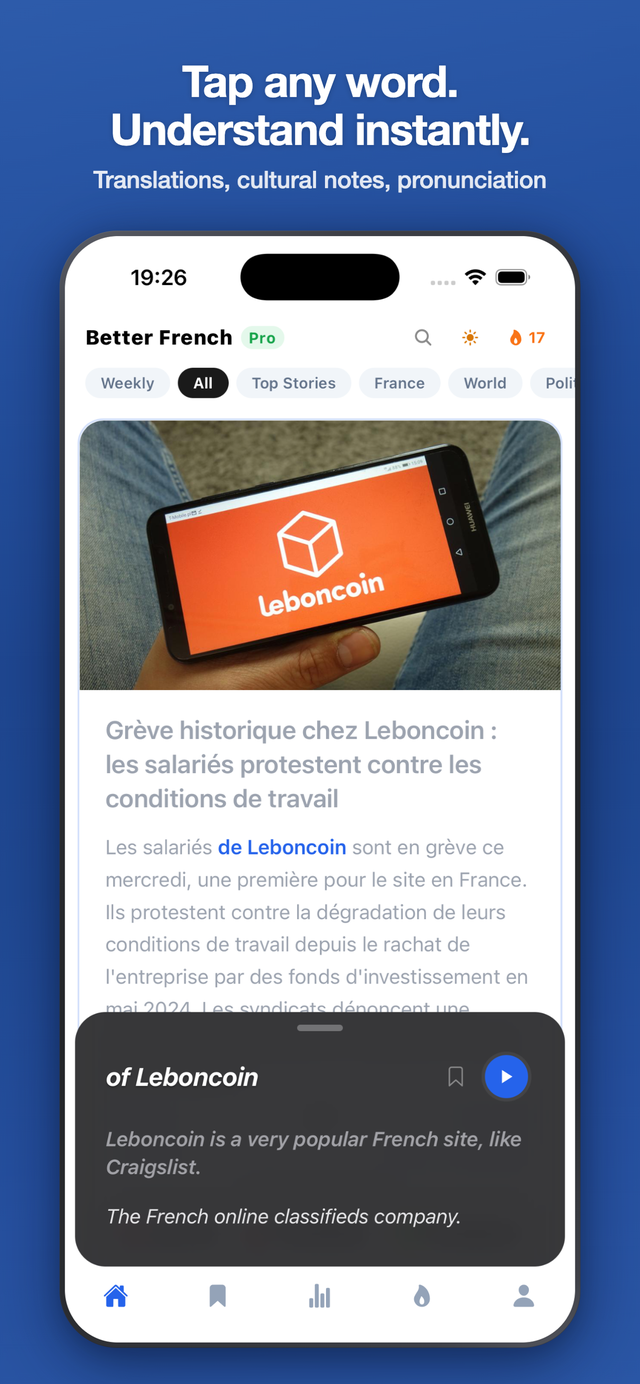
This is actually why I built Better French. I wanted a way to read real French news and get help without leaving the page. That is what Better French Context does: tap any word or short phrase and you get the translation, the explanation, and the cultural note that tells you why a French reader reacts to it the way they do. No app switching. No lost context. The reading flow stays intact.
I am being honest about this: I built the app because I needed it. The existing options either simplified French to the point where it was no longer real, or threw you into raw Le Monde with no support at all. I wanted something in between -- real content from real sources, but with a safety net for the moments when you are stuck.
"Something in between" turned out to mean two jobs, both done every morning before anyone opens the app. The first is picking. We read around 800 articles a day across more than forty French sources and choose the fourteen or so that are actually worth a learner's time -- the stories people here will be arguing about at lunch, not whatever ran hottest. The second is the rewrite. Every one of those stories is written again at five levels, so the article you open is already pitched at where your French actually is instead of where you wish it was.
I want to be precise about that second job, because I have just spent a paragraph complaining about apps that simplify French until it stops being French. Rewriting a story for a level is not the same as flattening it. Nothing is taken out. The strike is still about pensions, the minister is still named, the phrase the journalist chose because it was sarcastic is still sitting there, with a note explaining why it is sarcastic. What changes is sentence length and how much gets packed into each one. At A1 you get the story in short, direct sentences. At C1 you get it close to how Le Monde ran it. The France in the article never gets smaller. Only the sentence does.
Whatever tool you use, the principle is the same. The best reading tool is one that helps you without interrupting you. If checking a word requires leaving the article, switching apps, or losing your place, it will break your reading habit before it has a chance to form.
I Tested Myself After Every Article
Reading without checking your understanding is like running without a watch. You feel like you are working hard, but you do not know if you are getting faster.
After finishing an article, I would close it and try to summarize it in my head. What was the main point? What were the key facts? Could I explain it to someone? If yes, I understood it. If not, I went back for a second look.
This simple habit changed how I read. Knowing I would test myself afterward made me read more actively. I paid attention to the structure of arguments. I noticed which details mattered and which were filler. I was not just scanning words -- I was processing meaning.
Better French builds Quiz Me into every article for exactly this reason. Three questions after each piece. They are quick, they are focused on comprehension rather than memorization, and they close the feedback loop. You read, you test, you know where you stand. Over time, getting the questions right becomes the norm rather than the exception. That progression is one of the most satisfying parts of the whole process.
Two other games are built from the same story, and each catches something the questions cannot. VocaMatch pulls the vocabulary out of the article you just read and asks you to match it back up. Three lives, three difficulty bands, and no clock -- nobody has ever read better under a countdown, so there is not one. Breakdown is the one I underestimated. It hands the story back to you one phrase at a time and asks you to say it out loud, in three tiers from A1 to C1. Saying a French sentence yourself is a far harder test than recognising it on a page, and it is the quickest way I know to find the sentences you had only half followed.
How Long It Took
I will be honest about the timeline because most language advice skips this part.
After two weeks of daily reading, I noticed I was looking up fewer words. Not dramatically fewer. But the improvement was real.
After one month, I could follow most articles on topics I knew well. Tech news, international stories, business. I was still shaky on French domestic politics and anything about the legal system.
After three months, I could read most news articles. Not every word, not every nuance. But the main ideas, the key arguments, the tone. I started having opinions about what I read, which felt like a milestone. You cannot have an opinion about something you do not understand.
After six months, I read Le Monde with my morning coffee. I still encounter words I do not know. I still reread complex paragraphs. But reading French news stopped being an exercise and became something I just do, the way I read the news in English -- to find out what is happening, not to practice a skill.
That was the destination I did not know I was heading toward. Not fluency in some abstract sense, but normalcy. Reading French became normal. That changed everything else -- my confidence in conversations, my understanding of what was happening around me, my sense of actually belonging in the country where I live.
How to Track Your Progress
Improvement in reading is gradual. Day to day, you do not notice it. That is why tracking matters -- it gives you proof that you are moving forward during the weeks when it does not feel like it.
Three things worth tracking. First, articles per week. How many French articles did you read? This measures the habit, which is the most important thing. If you read three this week, aim for four next week.
Second, lookups per article. How many times did you need to check a word? Early on, you might look up ten or fifteen per article. After a few months, it drops to three or four. Watching that number fall is one of the clearest signals that your comprehension is growing.
Third, the summary test from earlier. Do not just run it, watch how the answer changes over the months. Going from "I got the general topic" to "I can tell you the argument, the key facts, and why it matters" is the clearest evidence you will get that something is moving.
Progress will not be linear. Some weeks you will fly through articles. Other weeks, a new topic or a dense editorial will humble you. That is normal. The trend over months is what matters.
Frequently Asked Questions
How long does it take to noticeably improve French reading comprehension?
If you read French daily for even ten to fifteen minutes, you will notice a difference within four to six weeks. You will look up fewer words, read faster, and catch yourself understanding sentences you would have skipped before. Moving from struggling with news articles to reading them comfortably took me about six months of consistent daily reading. The key word is daily. Three intense sessions per week will not produce the same results as ten quiet minutes every morning.
Can I improve my French reading comprehension without living in France?
Absolutely. Reading is the most location-independent language skill there is. You have access to the same French newspapers, the same news sites, and the same articles as someone sitting in a cafe in Paris. What matters is consistency and choosing material at the right level. I know learners studying French from London, Tokyo, and Sao Paulo who read better than some expats in France who default to English all day. Where you live does not determine how well you read. How often you read does.
Should I look up every word I do not understand when reading French?
No. This was the single biggest mistake I made early on. Looking up every word destroys your reading flow, trains your brain to depend on translation instead of inference, and turns reading into a chore. Try to understand the main idea from context first. Only look up a word if it is clearly blocking your comprehension of the whole paragraph and you cannot figure it out from the surrounding sentences. If you understand roughly 80 percent of a text, you are at the right level. The remaining 20 percent is where your brain learns to fill gaps, which is exactly how comprehension improves.
What is the best type of content for improving French reading skills?
Content that is real, slightly above your current level, and about topics you genuinely care about. For most intermediate learners, French news is ideal because it uses natural vocabulary, refreshes every day, and covers subjects you already have opinions on. Textbook exercises feel safe but they do not prepare you for how French actually looks in the wild. Better French bridges the gap by rewriting real French news for your level, so the story stays real and still fits what you can read today. Better French Context gives you the translation, the explanation and the cultural note on any word you tap, and Quiz Me checks afterwards that you followed the story, so you can read authentic content without drowning in it.
Get Better French
Read one article a day with instant translations and vocabulary tracking. Real French news, made accessible. Works at every level, from anywhere in the world. Available on the App Store and Google Play.
Download the App