B1 French: Breaking Through the Intermediate Plateau
The B1 plateau happens because early gains come from high-frequency vocabulary, while B1-to-B2 progress requires thousands of mid-frequency words that each move the needle less. The solution is massive input: read French news daily, listen to native-speed content, and focus on vocabulary depth over grammar rules. With consistent daily practice, most learners break through in six to twelve months. The catch is that French news was written for French people and not for learners, which is why "just read Le Monde every day" quietly defeats most people at B1. That is the gap Better French was built to close.
You have been learning French for a while now. You can order food, have simple conversations, understand the gist of news articles, and navigate daily life. You are solidly at B1. And then... nothing. Weeks pass, and you do not feel any better. You understand the same percentage of a news broadcast as you did two months ago. Complex articles still defeat you. Native speakers still lose you when they speak quickly or use slang.
Welcome to the intermediate plateau. It is real, it is frustrating, and nearly every language learner hits it.
I spent three months at B1 feeling like I was going nowhere. Every article felt equally hard. The same words tripped me up week after week. Then one morning, something shifted -- I read an entire article about pension reform without stopping. Not because my French got better overnight, but because the daily reading had been building connections I could not see. The plateau is not a wall. It is a phase, and the strategies for breaking through are well understood. They just require patience and a shift in how you approach learning.
Why Progress Slows at B1
Understanding why the plateau happens is the first step to overcoming it. Three factors converge at B1 to create the illusion -- and sometimes the reality -- of stagnation.
The vocabulary math changes. The most common 2,000 French words cover roughly 80% of everyday language. Getting from zero to understanding 80% of what you hear and read is dramatic and rewarding -- it takes you from complete beginner to functional communicator. But getting from 80% to 90% comprehension requires learning another 3,000 to 5,000 words. Each new word individually contributes less to your overall understanding. At A1, learning manger (to eat) unlocked hundreds of sentences. At B1, learning néanmoins (nevertheless) unlocks... a few transitions in formal writing. The return on each word feels smaller, even though the cumulative effect is significant.
Grammar becomes less visible. At A1 and A2, every new grammar concept -- past tense, future tense, object pronouns -- dramatically expanded what you could say and understand. At B1, the remaining grammar (subjunctive, conditional perfect, complex relative clauses) is important but less frequently needed. You can avoid the subjunctive in most conversations. You can get by without the plus-que-parfait. This means grammar study produces less obvious improvement, even when it is building important foundations for B2.
"Good enough" kills momentum. At A1, every interaction was a challenge -- whether you were in France, in a French class, or trying to read your first article. That urgency drove rapid learning. At B1, you can handle most situations comfortably. You manage daily life, basic professional interactions, and understand enough of the world around you. If you live in France, you can survive. If you are learning from abroad, you can get through conversations and understand most content. The survival pressure that powered early learning is gone, and with it goes some of the intensity that drove progress.
What B1 Learners Actually Need
The solution to the plateau is not more of the same. If textbook exercises, grammar drills, and basic conversation practice got you to B1, continuing with those same activities will not get you to B2. You need a fundamental shift in approach.
There is also something the plateau hides, and it took me an embarrassingly long time to see it. At A1 and A2 the missing ingredient really was more French: more words, more verbs, more tenses. Somewhere around B1 that stops being true. What you are short of is everything the language sits inside -- what people in France are talking about this week, the reference in the headline that everyone else caught, why a name or a number in a news bulletin makes a room go quiet. You can know every single word in a sentence about the 49.3 and still have no idea what was said. Extra vocabulary does not fix that, which is why more vocabulary stopped feeling like progress. Read what French people are reading and you start to understand the country, and your French improves because of it, because the words finally have something to hang on.
More input, much more input
The single most important change you can make at B1 is to dramatically increase your exposure to real French. Research in second language acquisition is clear: B1-to-B2 progress is driven primarily by extensive input -- reading and listening at volume. The vocabulary and grammar patterns you need to internalize are too numerous and too varied to learn through structured exercises. You need to encounter them hundreds of times in natural context.
Concretely, this means reading French for at least 20 to 30 minutes every day. Not textbook reading -- real content. News articles, magazine features, blog posts, novels. The more you read, the more mid-frequency vocabulary you absorb, and the more naturally complex grammar structures feel.
Vocabulary depth over breadth
At A2, learning new words was straightforward: one French word, one English meaning. At B1, vocabulary learning needs to go deeper. A word like mettre does not just mean "to put" -- it means "to put on" (clothes), "to set" (the table), "to take" (time), and participates in dozens of expressions (se mettre à, mettre en place, mettre au point). Understanding a word means understanding its range of uses, its collocations, and the contexts where it appears.
This depth comes from reading, not from flashcards. When you encounter mettre en place in a news article about government policy and then see mettre au point in a technology article, you build a rich, multidimensional understanding of the word that no vocabulary list can provide.
Tolerance for ambiguity
At B1, you need to get comfortable not understanding everything. When you read a Le Monde editorial and grasp 70% of it, that is a success, not a failure. The 30% you miss will gradually shrink as your vocabulary grows, but only if you keep reading through the uncertainty. Stopping every time something is unclear, or avoiding content that challenges you, keeps you stuck.
The Reading Strategy for B1-to-B2
Here is a concrete reading approach designed for B1 learners who want to break through to B2.
Read one substantive article per day. Not a brief from 20 Minutes (those are A2-B1 level). Choose something from Le Monde, Le Figaro, Libération, or a French magazine. The article should be long enough to challenge you -- 500 to 800 words minimum.
Read it twice. First pass: read for the main argument without stopping. You will miss things. That is fine. Second pass: read more carefully, looking up five to seven words that seem important or that you have seen before without fully understanding.
Note words in full sentences. Do not write davantage = more. Write davantage -- more / to a greater extent -- "Le gouvernement souhaite investir davantage dans l'éducation." The sentence gives you grammar, context, and usage in one package.
Vary your topics. Political articles teach you formal vocabulary and complex sentence structures. Sports articles teach you narrative and action vocabulary. Cultural articles teach you opinion language and descriptive vocabulary. Science articles teach you precise, technical French. Each topic area has its own vocabulary cluster, and breadth of reading builds breadth of understanding.
Now the warning that belongs with all of the above. French news was not written for you. Le Monde writes for readers who already know who the ministers are, what the acronyms stand for and what happened last week. There is no gloss on the jargon, no help with the words, nothing pitched at your level, and nothing at the end to tell you whether you understood the piece or only felt like you did. That is why "read Le Monde every day" works for about one learner in ten and quietly defeats the rest. It is not a discipline problem, and you did not fail the assignment.
Read the same stories with the level problem already solved. This is the thing we built Better French to do. Every morning it reads around 800 articles from more than 40 French sources and picks the fourteen or so a French learner should actually know about, the ones people here will be talking about by lunchtime. Each of those stories is then rewritten at five levels, so the version you open is the B1 telling of the news everyone else is reading: same story, pitched just above where you are. That gap, hard enough to stretch you and not so hard that you close the tab, is the one condition under which reading has ever improved anybody's language. Tap any word or short phrase and Better French Context gives you the translation, the explanation, and the cultural note that says why the thing matters in France. Audioplay says that word or phrase back to you at a shade under native speed. And if a sentence still refuses to come apart, you can flip the whole article into English, or German, or Spanish, and then back into French.
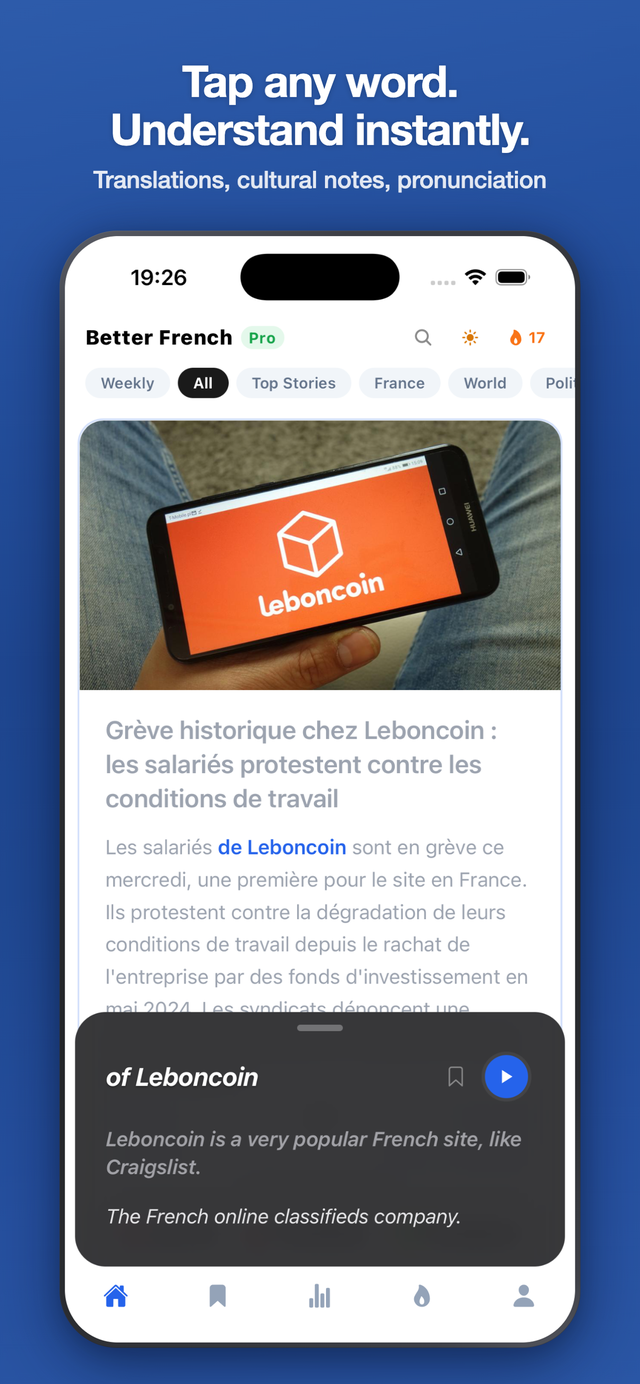
Reading still leaves the last hole open, the one from two paragraphs ago: nothing checks whether you understood. So every story comes with three short games built out of that same story rather than out of a generic word list. Quiz Me asks three questions, and the difficulty moves with your streak instead of staying where it was in January. VocaMatch takes the vocabulary from the article you just read: three lives, no clock, three difficulty bands, and B1-B2 is the one you want. Breakdown has you say the story out loud one phrase at a time, in three tiers, and the B1 tier is yours. None of them takes more than a few minutes. They are what turns "I read it" into "I know I read it," which at B1 is most of the difference between the people who move and the people who stall.
Beyond Reading: Other B1-to-B2 Strategies
Listen to native-speed French daily. Podcasts, radio, and television at natural speed train your ear to handle connected speech, liaisons, and the rhythm of real French. France Inter, France Culture, and news broadcasts are excellent. The goal is not to understand everything -- it is to train your brain to process French at the speed it actually happens.
Write regularly. Writing forces you to produce language actively, which reveals gaps in your knowledge that passive understanding hides. Start a French journal, write summaries of articles you read, or compose emails in French. The act of choosing words, constructing sentences, and editing your own text builds grammatical accuracy in a way that reading alone does not.
Study the subjunctive. This is the one grammar topic worth explicit study at B1. The subjunctive is used constantly in French -- in news, in formal writing, in everyday expressions -- and misunderstanding it blocks comprehension of complex sentences. Learning the common triggers (il faut que, bien que, pour que, avant que) and recognizing subjunctive forms will immediately improve your reading comprehension.
Track your progress over months, not days. The B1 plateau feels permanent because daily improvement is invisible. Keep a reading log: date, article read, number of lookups, and a one-line note on difficulty. Review it monthly. You will see the lookup count dropping and the difficulty tolerance rising, even when day-to-day progress feels flat.
If you would rather not keep that log by hand, Saved Words keeps it for you, and keeps more than a list. Every word you save holds on to the story you met it in and the cultural note that came with it, so three weeks later you are not looking at davantage = more on a bare flashcard, you are back inside the sentence about education spending where you first ran into it. That is the difference between a vocabulary list and a memory.
The streak is worth a word too, because it is deliberately hard to fake. It only moves when you have done something: ten new words tapped, or one game finished. Opening the app does not count, and neither does scrolling the feed. If you have been studying every day for a year without feeling any of it, a number you cannot earn by simply showing up is worth more than one you can.
How Long Will It Take?
Honestly: six to twelve months of consistent daily practice. That means 30 to 45 minutes of active learning (reading, listening, writing) plus incidental exposure (French radio in the background, conversations with French speakers). The timeline is shorter if you live in France and actively seek out challenging situations; longer if your only French exposure is a weekly tutoring session.
The plateau feels like standing still, but you are not. Every article you read -- even the ones you only half-understand -- is adding something. Every podcast where you catch a phrase you would have missed a month ago. Every conversation where you use a word you learned from the news. The progress is invisible day to day, but it is real. You just need to keep going long enough to see it.
Frequently Asked Questions
What is the intermediate plateau in French learning?
The intermediate plateau is a period -- typically at B1 level -- where progress feels stalled despite continued effort. You can handle everyday situations but complex content remains out of reach. It happens because early progress is driven by high-frequency vocabulary, while B1-to-B2 requires lower-frequency words that each contribute less visible improvement. It is normal and universal among language learners.
How long does it take to get from B1 to B2 in French?
With consistent daily practice (30-45 minutes of active learning plus regular exposure), most learners take six to twelve months. The range depends on how you spend that time. Extensive reading and listening to real French content accelerates the process. Living in France helps but is not sufficient on its own.
Why does progress slow down at B1 French?
Three factors combine. The most common 2,000 words cover 80% of everyday French, but reaching 90% comprehension requires 3,000-5,000 more words. B1 grammar is good enough for survival, reducing motivation to master advanced structures. And the urgency that drove early learning disappears once you can handle daily life.
What is the best way to break through the B1 plateau?
Extensive reading is the single most effective strategy. Read French news, magazines, or books daily for at least 20 minutes. Combine with active vocabulary work and regular listening to native-speed French. What matters most is dramatically increasing your input volume.
Should I focus on grammar or vocabulary at B1?
Vocabulary. At B1, your grammar is functional enough for most communication. What holds you back is not knowing enough mid-frequency words. Focus on learning words in context through reading. Grammar will improve naturally through repeated exposure. The exception is the subjunctive -- that is worth explicit study.
Can I reach B2 without living in France?
Absolutely. Many learners reach B2 without living in a French-speaking country. What matters is creating regular, sustained contact with real French content -- news, podcasts, films, and conversation partners. Deliberate practice matters more than geography.
How do I know if I am actually improving at B1?
Track concrete metrics: word lookups per article, comfort with longer texts, ability to follow spoken French at natural speed, and whether you can express nuanced opinions. Compare your abilities today to three months ago, not yesterday. A reading log makes progress visible.
Get Better French
The stories French people are reading, rewritten in clear French you can actually read, every word tappable for its translation, explanation and cultural note, with Quiz Me, VocaMatch and Breakdown built from the same story. On the App Store and Google Play. Better French is a subscription and it starts with a free trial. It works out at under €5 a month, and the exact price for your country is shown in the app before you pay.
Download the App