B2 to C1: Advanced French Through News
The jump from B2 to C1 is about precision, nuance, and register. News editorials, opinion columns, and longform journalism are the ideal training ground because they use the exact vocabulary, connectors, and argumentative structures that define C1 proficiency. Read diverse sources, write responses to what you read, and focus on the abstract and analytical vocabulary that separates "fluent" from "advanced." And accept early that the last gap at this level is not vocabulary at all. It is the shared context French writing assumes you already have.
At B2, you are functional in French. You read news articles without constant dictionary checks. You follow conversations on complex topics. You can express opinions and defend them. By most practical measures, your French works.
But there is a gap between "works" and "advanced." At B2, you understand Le Monde articles but miss the subtext of editorials. You follow political debates but struggle with the rhetorical flourishes. You can write clearly but not elegantly. C1 is where that gap closes -- where comprehension becomes effortless, expression becomes precise, and you stop feeling like a foreigner when you read or write French.
News is the ideal vehicle for this transition. Here is why, and how to use it.
What Changes Between B2 and C1
The B2-to-C1 transition is not about learning more grammar rules or memorizing more vocabulary lists. It is about three specific shifts in ability.
From understanding content to understanding intent. At B2, you understand what an article says. At C1, you understand what the author means -- the implicit arguments, the rhetorical strategies, the cultural references embedded in word choice. When a Le Monde editorial uses force est de constater que... (one must acknowledge that...), you recognize it not just as a phrase but as a rhetorical move -- the author is conceding a point before countering it.
From functional vocabulary to precise vocabulary. At B2, you know problème. At C1, you distinguish between problème, enjeu, difficulté, défi, and écueil -- and you know when each one is the right choice. This kind of lexical precision is what makes your French sound educated and natural rather than functional and translated.
From simple expression to structured argumentation. At B2, you can state an opinion. At C1, you can build an argument -- with connectors that signal contrast (néanmoins, en revanche, toutefois), concession (certes...mais, quoique), consequence (de ce fait, d'où), and nuance (il n'en demeure pas moins que). These structures are the backbone of editorials, academic writing, and professional French.
Why News Editorials Are the Best C1 Training
News reporting tells you what happened. Editorials tell you what it means and why it matters. That difference makes editorials the single best resource for B2-to-C1 development.
Editorials use formal register vocabulary that you need but rarely encounter in conversation. They employ complex sentence structures with multiple subordinate clauses. They build arguments using the exact connectors and discourse markers that define C1 writing. And they reference cultural, historical, and political knowledge that deepens your understanding of France.
Compare a news brief -- Le gouvernement a annoncé une réforme des retraites (The government announced a pension reform) -- with an editorial analysis: Force est de constater que cette réforme, si elle répond à un impératif budgétaire indéniable, fait fi des inégalités structurelles qu'elle prétend néanmoins atténuer. The second sentence is what C1 looks like -- and reading it repeatedly, across dozens of editorials, is how you internalize the patterns.
The Gap That Nobody Teaches You
Before the routine, the honest part. Read a Libération tribune at your level and pay attention to what actually stops you. Most of the time it is not a word.
It is the reference to 1968 dropped in without explanation, because every French reader has it. It is the acronym -- ZFE, PLF, CSE -- that nobody expands because nobody needs to. It is knowing which minister sat in which government, and which government fell over what. It is the sentence that is obviously a joke, where you can see the shape of the joke and still not see why it is funny.
French journalism is written for people who grew up inside French public life. It assumes a shared context and never stops to fill it in, because for its actual readers there is nothing to fill in. That assumption is invisible at A2, when the words are hard enough on their own. At C1 it is the only thing left standing between you and the page.
Which is the uncomfortable answer to why you can study for six years and still feel like a visitor inside a French newspaper. Learning French was never going to be enough by itself. Your tutor taught you French. The podcast taught you French. The app with the streak taught you French. None of them taught you France, and France is what the editorial is written in.
French news is the only place that context lives at full strength. It is also the one resource that was never built for you. Written for natives at native speed, jargon left unexplained, no help with the words, and nothing at the end to check whether you actually understood it. That is the problem worth solving, and it is the reason Better French exists. More on that further down, after the vocabulary.
A Daily Routine for B2-to-C1
This routine takes 45 to 60 minutes per day. It is more demanding than a B1 routine because C1 requires more active engagement with the language.
Read one editorial or opinion piece (20 minutes). Choose from Le Monde's editorials, Libération's opinion pages, or Le Point's analysis columns. Read it fully without stopping, then read it again, noting three to five words or expressions that are new or used in an unfamiliar way.
Write a 150-word response (15 minutes). Agree, disagree, or extend the argument. Use at least two connectors you are trying to internalize. This is the single most effective exercise for converting passive vocabulary into active production. You do not need a teacher to grade it -- the act of composing your thoughts in written French, using the vocabulary and structures you just read, builds the neural pathways for C1 expression.
Listen to a podcast or radio segment (15 minutes). France Culture's La Grande Table or Les Matinées feature intellectual discussion at native speed. France Inter's Le Téléphone sonne covers current events with call-in perspectives. The goal is not to understand every word -- it is to train your ear to process complex French in real time.
Review vocabulary (5 minutes). Review the words and expressions you noted from yesterday's editorial. Try to use each one in a sentence from memory before checking your notes.
The Vocabulary That Defines C1
Three categories of vocabulary separate B2 from C1. Focus your active learning on these.
Connectors and discourse markers
These are the structural words that organize arguments and signal logical relationships. At B2, you use mais, parce que, and donc. At C1, you use:
- Néanmoins / Toutefois / Cependant -- nevertheless (each with slightly different register)
- En revanche -- on the other hand
- D'ailleurs -- moreover / incidentally
- Or -- now / but (introduces a contrasting fact)
- De ce fait / Par conséquent -- as a result
- Certes...mais -- admittedly...but
- Quitte à -- even if it means
- Il n'en demeure pas moins que -- it remains the case that
Abstract and analytical vocabulary
The words used to discuss ideas, policies, and complex situations:
- Enjeu -- stake / issue / what is at play
- Démarche -- approach / process / initiative
- Dispositif -- system / mechanism / arrangement
- Bilan -- assessment / review / outcome
- Mise en oeuvre -- implementation
- Constater -- to observe / to note (more formal than remarquer)
- Susciter -- to provoke / to give rise to
- Relever de -- to fall under / to be a matter of
Register-specific expressions
Phrases that signal formal, educated French:
- Force est de constater que... -- one must acknowledge that...
- Il convient de rappeler que... -- it is worth recalling that...
- On ne saurait ignorer... -- one cannot ignore...
- Au-delà de la question de... -- beyond the question of...
- Faire fi de -- to disregard
Then stop reading other people's lists and start building your own. In Better French, every word you save keeps the sentence you met it in and the cultural note that came with it, so relever de comes back attached to the ruling it appeared in instead of sitting on a flashcard with no memory of where it came from. At this level that provenance is most of the learning.
Recommended Sources by Difficulty
Start with these (upper B2): Le Monde's Éditos, 20 Minutes' opinion sections, and France Info analysis pieces. These use formal language but stay accessible in structure.
Progress to these (B2-C1 bridge): Le Figaro's analysis, L'Obs longform features, and Mediapart investigations. More complex arguments, longer sentences, and denser vocabulary.
Target these (C1): Libération's Tribunes, Le Monde Diplomatique's essays, and Courrier International's translated analysis. These use the full range of formal French and assume cultural literacy.
What Better French Adds at This Level
By C1, most learning material has run out of things to show you. Courses are built around the levels where most learners sit, and that is several rungs below here. Better French starts from the other end: what French people are reading today, made usable at every level, with C1 at the top.
Every morning we read around 800 articles from more than forty French sources and pick the fourteen that matter to someone learning the country as well as the language. Several rungs of the ladder above sit in that pool: Le Figaro, Libération, Mediapart, L'Obs, L'Express, Courrier International, France Info and 20 Minutes, alongside L'Équipe, Télérama, Ouest-France, Les Inrocks, Numerama and the ministries' own feeds. The picking is the work. A firehose of French news would not help you. Fourteen chosen stories will. A few names on the ladder above are not in that pool, Le Monde Diplomatique and Le Point among them. Go and read those directly. Nothing here asks you to read only us.
Each of those stories is then rewritten at five levels, and this is the part that matters to you specifically. You do not want the story made easier. You want the hard version. The top of the five is the hard version: full register, real connectors, the argument left intact, nothing sanded off. It is not a simplification of anything. It is the C1 telling, and it happens to sit one tap from the A2 telling of the same story, which is its own quiet lesson in register whenever you feel like comparing the two.
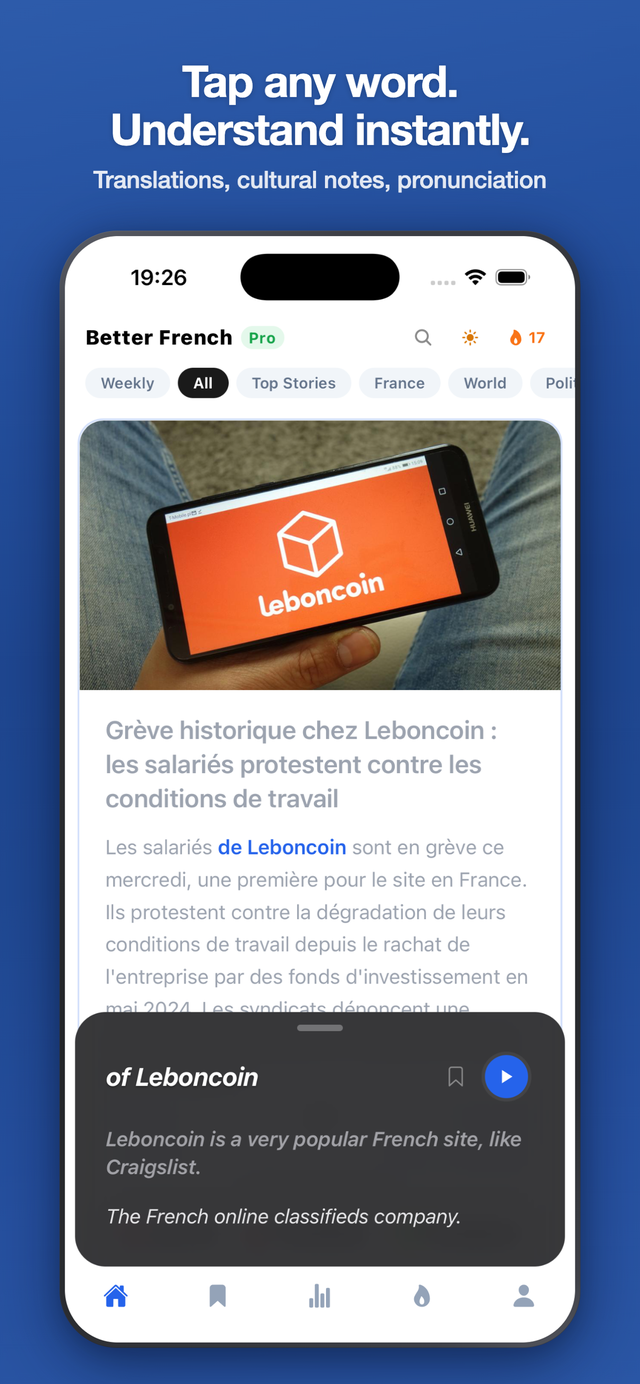
Better French Context earns its place at C1 for a different reason than it does at A2. A beginner taps because they do not know the word. You will tap because you know the word and can tell it is not doing its usual job: démarche in a policy sentence, acquis sociaux in a headline, an expression that is plainly idiomatic and plainly not literal. One tap gives you three things -- the translation, an explanation of how the word is working in that particular sentence, and the cultural note behind it. The cultural note is the one you actually need, and no dictionary carries it. Audioplay sits in the same tooltip, so you can hear the word or the phrase said at natural French rhythm, pitched just under native speed.
The three games are built from the story you just read, and two of them have a rung at your level. VocaMatch runs in three bands, and the top band, C1-C2, uses that day's vocabulary at the register this article has spent all these paragraphs describing. Three lives, no timer, so it stays a thinking exercise rather than a reflex test. Breakdown has three tiers, and the C1 tier takes the hardest phrasing in the piece and asks you to say it out loud, one phrase at a time. That is production, which is the bottleneck this whole article keeps pointing at, and it is the half that reading alone will never fix. Quiz Me is three questions on what you just read, and it gets harder as your streak grows.
Search and the archive is the feature advanced readers ask for and rarely get. You can follow one story across sources and across weeks: a pension reform, a court case, a bill moving through the Assemblée. Reading one article on a subject teaches you the vocabulary of that subject once. Reading twenty of them, as the story changes under you, is how that vocabulary stops being vocabulary.
And every story carries a link straight to the source. When you want the untouched original, take it. At C1 you often should, and pretending otherwise would be insulting.
The climb from B2 to C1 is slower than anything that came before it, and it is the most interesting part. You have stopped learning to communicate. You are learning to think in French, and thinking in a language means thinking about the things its speakers think about. Read what French people are reading, every day, and both halves arrive together: you understand France, and your French gets better because of it.
Frequently Asked Questions
What is the difference between B2 and C1 French?
B2 means you can understand the main ideas of complex texts and interact with native speakers without strain. C1 means you can understand demanding, longer texts and recognize implicit meaning. You express yourself fluently and spontaneously. The practical difference: at B2 you understand Le Monde articles with some effort. At C1 you understand editorials and literary references with ease.
How long does it take to go from B2 to C1 in French?
Most estimates suggest 200 to 400 hours of focused practice. With one hour per day of active reading, listening, and writing, that translates to roughly eight to sixteen months. Reading diverse French news sources daily is one of the most time-efficient ways to accumulate the necessary exposure hours.
Which French news sources are best for B2 to C1 learners?
Prioritize sources with complex analysis: Le Monde and Le Figaro for political coverage, Libération for opinion-driven writing, Mediapart for investigative journalism, and L'Obs or Le Point for longform analysis. Read editorials and opinion columns, not just news briefs -- the opinion register is where C1 vocabulary lives.
Should I still use translation tools at B2 level?
Yes, but selectively. At B2 you should be getting through most of an article without help. Save the help for what context will not give you on its own: abstract vocabulary, idiom, and culturally loaded references. That is what Better French Context is for -- one tap returns the translation, an explanation of how the word is working in that particular sentence, and the cultural note behind it. Read the piece all the way through first, then go back and tap the four or five things you could not resolve yourself.
What vocabulary should I focus on at B2 to C1?
Focus on connectors and discourse markers (néanmoins, en revanche, d'ailleurs), abstract and analytical vocabulary (enjeu, démarche, dispositif, bilan), and register-specific language (formal writing expressions and journalistic turns of phrase). These are the words that separate B2 comprehension from C1 fluency.
How important is writing practice for reaching C1?
Very important. C1 is defined partly by the ability to produce clear, detailed text on complex subjects. Writing forces you to actively use vocabulary and structures you might passively understand. Even 15 minutes of writing per day -- summaries, opinion responses, or analysis -- significantly accelerates the transition.
At C1, why not just read the original French news?
You should, and Better French links straight to the source of every story so you can. There are two things the original will not give you. The first is the shared context: when a column drops a reference to 1968 or an acronym like ZFE, it assumes you already have it, and Better French Context is where that gets explained. The second is anything to test yourself against, because reading on its own is passive. The C1-C2 band of VocaMatch and the C1 tier of Breakdown make you produce the language, and production is the half that actually moves you from B2 to C1. The stories themselves are rewritten at five levels, and the top level is the hard version rather than a simplified one.
Get Better French
Available on the App Store and Google Play. Fourteen stories a day, chosen for French learners and rewritten at five levels with C1 at the top. Tap any word for the translation, the explanation and the cultural note. Better French is a subscription and it starts with a free trial. It works out at under €5 a month, and the exact price for your country is shown in the app before you pay.
Download the App