How to Follow French Politics as a Foreigner
French politics has a unique structure: a powerful president, a prime minister who runs domestic policy, a two-round election system, and a tradition of street protests. This guide explains the institutions, the main parties, key political vocabulary, and the best news sources for following politics in France -- even if your French is still developing.
You are sitting at a dinner table in France and someone mentions la motion de censure. Someone else brings up les législatives. A heated debate erupts about la réforme des retraites. You smile, nod, and quietly eat your cheese. You have no idea what is happening.
You do not need to live in France to find French politics fascinating -- it is a window into how the country thinks. But if you do live here, understanding politics is not optional. French politics is not just a topic of conversation -- it is the topic. It dominates news, dinner tables, and workplace discussions. Not understanding it means missing a significant part of what is happening around you. Political decisions directly affect daily life: immigration policy, labor law, healthcare, housing regulations, and tax rules are all shaped by the political landscape.
French politics, while complex, follows patterns that become readable once you understand the basic structure. This guide gives you that foundation.
The French Political System: How It Works
France is a semi-presidential republic, which means power is divided between a president and a prime minister in a way that does not exist in purely presidential systems (like the United States) or purely parliamentary ones (like the United Kingdom).
The President (Président de la République) is the head of state, elected directly by citizens for a five-year term (quinquennat). The president sets the general direction of policy, commands the armed forces, conducts foreign affairs, and appoints the prime minister. The president has significant executive power -- more than most European heads of state -- including the ability to dissolve the Assemblée nationale and call new elections.
The Prime Minister (Premier ministre) is the head of government, responsible for domestic policy and the day-to-day running of the country. The prime minister leads the government (gouvernement), proposes laws, and manages the budget. Crucially, the prime minister must maintain the confidence of the Assemblée nationale -- if a majority of députés vote against the government (a motion de censure), the prime minister must resign.
The Parliament (Parlement) has two chambers. The Assemblée nationale (National Assembly) is the lower house with 577 seats. Députés are elected directly by citizens for five-year terms. This is the more powerful chamber -- it debates and votes on laws, controls the government, and can override the Sénat. The Sénat (Senate) is the upper house with 348 seats. Sénateurs are elected indirectly by local elected officials. The Sénat reviews legislation and can propose amendments, but the Assemblée nationale has the final word in case of disagreement.
How French Elections Work
Most French elections use a two-round system (scrutin uninominal à deux tours), which produces different dynamics than the single-round systems used in many English-speaking countries.
Presidential elections happen every five years. In the first round, all qualified candidates compete. A candidate who took more than 50% of the vote in that first round would be elected outright, but it has never once happened: every presidential election since 1965 has gone to a second round, held two weeks later between the top two candidates. The winner of that second round becomes president. This system means French voters often vote strategically -- supporting their preferred candidate in the first round and choosing "the lesser evil" in the second round.
Legislative elections (for the Assemblée nationale) follow a similar two-round system but with different rules. In the first round, a candidate can win outright with more than 50% of votes (and at least 25% of registered voters). Otherwise, all candidates with more than 12.5% of registered voters advance to the second round. This can lead to three-way runoffs (triangulaires), which create unpredictable results.
Municipal elections (élections municipales) elect mayors and city councils every six years. EU citizens can vote in these. Regional and departmental elections elect local assemblies that manage transport, schools, and social services.
The French Political Spectrum
French politics has traditionally been organized along a left-right axis, though this has fragmented significantly in recent years. Here is a simplified map of the main parties and where they sit.
The Left (La Gauche)
- La France Insoumise (LFI) -- the far-left party founded by Jean-Luc Mélenchon. Anti-capitalist, pro-redistribution, euroskeptic, and strongly opposed to neoliberal economic policy. LFI draws support from younger voters and urban areas.
- Parti Socialiste (PS) -- the traditional center-left party that governed under Mitterrand and Hollande. Pro-European, social democratic. Has struggled since 2017 but remains part of left-wing coalitions.
- Les Écologistes -- the green party, led by Marine Tondelier. It was called Europe Écologie Les Verts (EELV) until it renamed itself in October 2023, and the old initials still turn up in headlines and in anything written before then, so it is worth knowing both. Focused on climate, environmental policy, and social justice. Strongest in cities like Lyon, Grenoble, and Strasbourg.
- Parti Communiste Français (PCF) -- the French Communist Party. Small but historically significant. Often allies with LFI in left-wing coalitions.
When Emmanuel Macron dissolved the Assemblée nationale in June 2024, those four parties, together with Place Publique, agreed to field a single candidate per constituency under the banner of the Nouveau Front Populaire (NFP). It is an electoral alliance, not a merger: each party kept its own leadership, its own program, and its own quarrels. Read NFP as a coalition name you will meet in headlines rather than as a party.
The Center (Le Centre)
- Renaissance -- the party Emmanuel Macron founded in 2016 as En Marche and renamed Renaissance in 2022. Pro-European, economically liberal, socially progressive. Positioned as "neither left nor right," though critics argue it leans right on economic policy.
- MoDem -- a centrist party founded and led by François Bayrou, allied with Renaissance. Focused on European integration and balanced budgets.
- Horizons -- founded in 2021 by Édouard Philippe, Macron's first prime minister and the mayor of Le Havre. Usually described in the press as center-right: liberal-conservative, pro-European, more concerned with public debt than Renaissance is.
These three campaign together as Ensemble, the presidential coalition. You will see all four names in circulation, sometimes in the same article, which is one of the reasons the center is hard to follow from the outside.
The Right (La Droite)
- Les Républicains (LR) -- the traditional center-right party, descended from the Gaullist tradition. Pro-business, law-and-order, socially conservative. Governed under Chirac and Sarkozy. Led by Bruno Retailleau since May 2025. Has lost voters to both the center and the far right.
The Far Right (L'Extrême Droite)
- Rassemblement National (RN) -- formerly Front National. Anti-immigration, nationalist, euroskeptic. Jordan Bardella is the party president; Marine Le Pen leads its group in the Assemblée nationale. Has been a major force in French politics, consistently reaching the second round of presidential elections.
- Reconquête -- founded in 2021 around Éric Zemmour's presidential campaign, and placed on the far right by the French press. Campaigns mainly on immigration and national identity. It won no seats in the 2024 legislative elections.
- Union des droites pour la République (UDR) -- created in 2024 by Éric Ciotti, who was then the leader of Les Républicains and was expelled by his own party after he announced an alliance with the RN. Small in seats, but it is the reason you will keep reading about a divided right.
One word of caution about the labels themselves. Extrême gauche and extrême droite are the terms the French press uses, and the parties they are applied to generally reject them. When you read a French article, it is worth noticing whether a label is the journalist's own or a quote from an opponent. Telling those two apart is half of reading political coverage well, in any language.
Essential Political Vocabulary
French political news uses specific terms that you will encounter daily if you read the news. Here are the most important ones.
- Élection présidentielle -- presidential election
- Élections législatives -- legislative (parliamentary) elections
- Scrutin -- a vote or ballot
- Premier tour / Deuxième tour -- first round / second round
- Député -- a member of the Assemblée nationale
- Sénateur -- a member of the Sénat
- Projet de loi -- a bill proposed by the government
- Proposition de loi -- a bill proposed by a member of parliament
- Motion de censure -- a vote of no confidence against the government
- Dissolution -- when the president dissolves the Assemblée nationale and triggers new elections
- Cohabitation -- when the president and the parliamentary majority are from opposing parties
- Réforme -- reform (a word you will see almost daily in French news)
- Grève -- strike
- Manifestation (manif) -- protest or demonstration
- Syndicat -- trade union
- 49.3 -- a constitutional article that allows the government to pass a law without a parliamentary vote. Deeply controversial and frequently debated.
Why Protests Are Normal in France
If you live in France, you will encounter strikes and demonstrations. They are not a sign of crisis -- they are a fundamental part of how French democracy works.
The right to protest is constitutionally protected and culturally celebrated. French trade unions -- CGT, CFDT, FO, and others -- have a long tradition of organizing national strikes (journées de mobilisation) when they disagree with government policy. Major reforms almost always trigger street action. This is not unique to any government or political era -- it is how the system functions.
For foreigners, understanding this means not being alarmed when transport shuts down or when you hear news of demonstrations. Check service disruptions in advance (the RATP and SNCF apps show strike-day schedules), plan accordingly, and view it as a window into how French democracy expresses itself.
Best Sources for Following French Politics
Reading political news is one of the fastest ways to improve your French while understanding the country you live in. Here are the best sources, ordered by accessibility.
- France Info (francetvinfo.fr) -- clear, concise reporting with short articles. Good for getting the headline and key facts without dense analysis.
- 20 Minutes (20minutes.fr) -- brief, accessible articles. Covers politics in a straightforward way. Good for B1+ learners.
- Le Monde (lemonde.fr) -- France's newspaper of record. More complex language but essential for serious political coverage. Many articles are paywalled but the free content is substantial.
- Mediapart (mediapart.fr) -- investigative journalism, left-leaning. Known for breaking political scandals. Subscription required but respected for its independence.
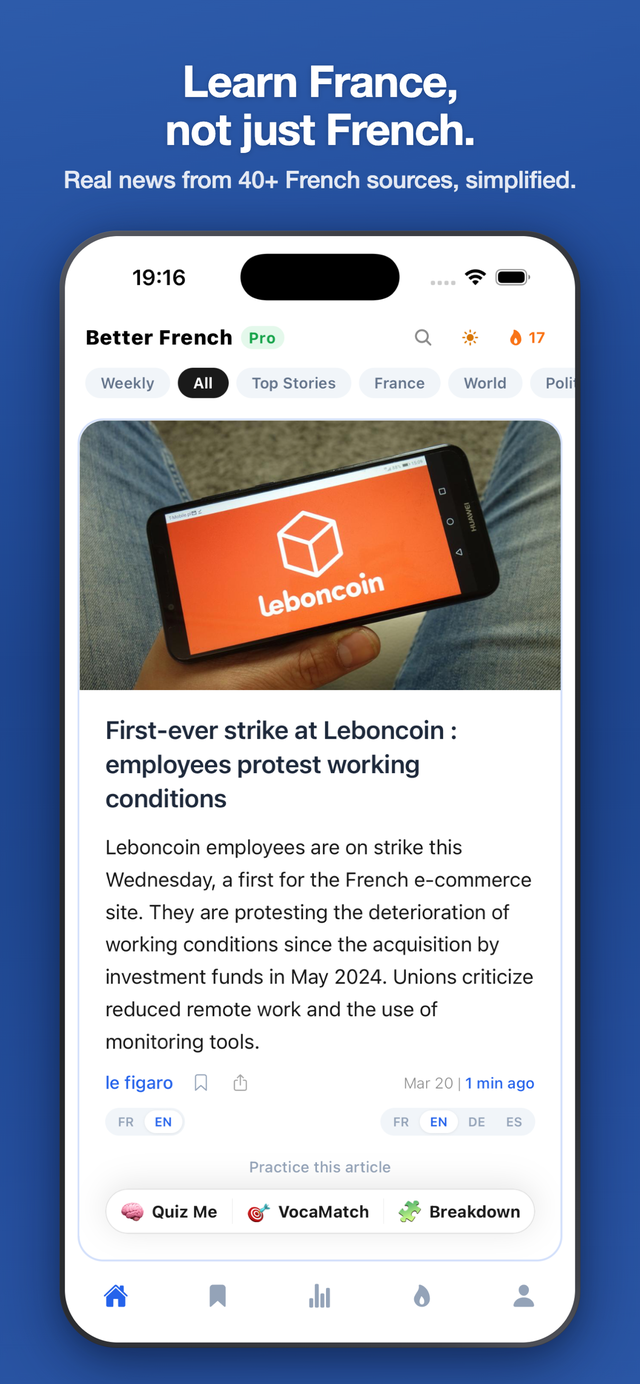
- Better French -- picks the French news stories worth a learner's time, from sources including France Info and 20 Minutes, and rewrites each one at five levels, with every word tappable for a translation and a cultural note. Reading political news this way is one of the most effective ways to build political understanding and language skills at the same time.
The most important thing is to start reading, even if you do not understand everything. French political vocabulary is a finite set -- the same terms recur in every article about every issue. Within a few weeks of regular reading, you will recognize projet de loi, motion de censure, and 49.3 without thinking. And that is when French politics stops being impenetrable and starts being genuinely interesting.
Frequently Asked Questions
What is the difference between the French president and the prime minister?
The president is the head of state, elected directly by the people for a five-year term. The president sets foreign policy, commands the military, and appoints the prime minister. The prime minister is the head of government, responsible for domestic policy and running the day-to-day administration. The prime minister must have the confidence of the Assemblée nationale. In periods of cohabitation -- when the president and the parliamentary majority are from different parties -- the prime minister holds more domestic power.
What are the main French political parties?
On the left: La France Insoumise (LFI, far-left), Parti Socialiste (PS, center-left), Les Écologistes (the green party, called EELV until 2023), and the Parti Communiste Français (PCF). In the center: Renaissance (Macron's party), MoDem, and Horizons (founded by Édouard Philippe in 2021). On the right: Les Républicains (LR, traditional right), led by Bruno Retailleau since 2025. On the far right: Rassemblement National (RN), Reconquête (Éric Zemmour), and the UDR (Éric Ciotti, 2024). These parties often form coalitions: the left ran the 2024 legislative elections as the Nouveau Front Populaire, and the center parties campaign as Ensemble.
How do French elections work?
Most French elections use a two-round system. In the first round, all candidates compete. If no one gets more than 50% of the vote, the top candidates advance to a second round two weeks later. The winner of the second round wins. Presidential elections happen every five years, and the president can dissolve the Assemblée nationale to trigger early legislative elections.
Can foreigners vote in French elections?
EU citizens living in France can vote in municipal elections and European Parliament elections, but not in presidential, legislative, or regional elections. Non-EU foreigners cannot vote in any French election, regardless of how long they have lived in France. However, understanding politics still matters -- government decisions directly affect your daily life, from immigration policy to housing regulations.
What does 'cohabitation' mean in French politics?
Cohabitation is a situation where the president and the prime minister come from opposing political parties. This happens when the president's party loses the legislative elections. During cohabitation, domestic power shifts significantly toward the prime minister while the president retains authority over foreign policy and defense. It has happened three times in the Fifth Republic.
What is the best way to follow French politics as a non-native speaker?
Start with accessible news sources: France Info, 20 Minutes, and Le Monde's simpler articles. Better French picks the French news stories worth a learner's time, from sources including France Info and 20 Minutes, and rewrites each one at five levels with every word tappable, so you can read political coverage and look up unfamiliar terms instantly. For deeper understanding, watch C dans l'air on France 5, broadcast Monday to Saturday, which explains political issues in an accessible format. Build your political vocabulary gradually -- focus on the most common terms first, and the rest will follow from context.
Why do French people protest so often?
Protest is a deeply embedded part of French political culture. It dates back to the French Revolution and is seen as a legitimate democratic tool -- not a last resort but a normal form of political expression. Unions regularly call national strikes and marches. Major reforms almost always trigger street protests. Understanding this is key to understanding France: protests are not signs of chaos but of an engaged citizenry exercising a constitutional right.
What is the Assemblée nationale and how does it differ from the Sénat?
The Assemblée nationale is the lower house with 577 députés elected directly by citizens. It is the more powerful chamber -- it can override the Sénat and can force the government to resign. The Sénat is the upper house with 348 sénateurs elected indirectly by local officials. It reviews and amends legislation but the Assemblée nationale always has the final say.
Get Better French
Read real French news with instant translations, cultural notes, quizzes, and audio. Available on the App Store and Google Play.
Download the App