My Daily French Routine (And Why It Works)
I spend 35 minutes every morning on French: 5 minutes reviewing yesterday's vocabulary, 15 minutes reading one article, 10 minutes listening to French radio, and 5 minutes writing a short summary. This routine took me from struggling with Le Monde headlines to reading full articles while my coffee gets cold. The structure works because it combines spaced repetition, varied practice, and habit stacking -- but honestly, the reason it works is that I do it every day.
I wake up at 7:15. By 7:50, I have read a French article, reviewed yesterday's vocabulary, and listened to five minutes of France Inter. That is my entire French routine. Thirty-five minutes, every single day, for the past two years.
It is not exciting. It is not innovative. But it took me from struggling to read Le Monde to reading it while my coffee gets cold.
Here is exactly what I do, and why each part matters.
My Morning, Step by Step
I make coffee first. Always. The coffee is not part of the routine, but it is what makes the routine happen. By the time I sit down with a full cup, my brain knows what comes next. That automatic feeling -- coffee means French -- took about three weeks to form. Now I do not think about it. I just do it.
First: vocabulary review (5 minutes). I open Better French and go back through yesterday's words in Saved Words. Usually five, sometimes three if they were hard ones. For each word, I try to recall the meaning before tapping to check. A saved word keeps the story it came from and its cultural note, so I am recalling a sentence I actually read, not a line on a card. Some mornings I get all of them. Some mornings I blank on a word I was sure I knew. Both are fine. This takes five minutes, rarely more.
I used to skip this step and go straight to reading. My vocabulary grew much slower. There is something about that small effort of trying to remember -- actively pulling a word from memory instead of just recognizing it -- that makes it stick. Researchers call this retrieval practice. I call it the difference between words I sort-of-know and words I actually use.
Then: one article (15 minutes). I pick one article. Usually whatever is at the top of the feed, unless the topic bores me. I read it through once without stopping, even if I miss words. Then I read it again more carefully, tapping words I do not know. I note about five new words -- the ones that seem useful or that I have seen before but never quite learned.
Fifteen minutes for one article might sound slow. It used to take me longer. At first I was stopping every other sentence to look something up. Now I read the first pass almost at normal speed, and the second pass is where I learn. The improvement was so gradual I did not notice it until I went back and reread an article from six months earlier and thought, "Wait, this is easy now."
I read the news because it is where France actually is that morning: the strike everyone is annoyed about, the law that just passed, the joke I would otherwise not get. Learning French was never the only thing I was missing. Not knowing what French people were talking about was.
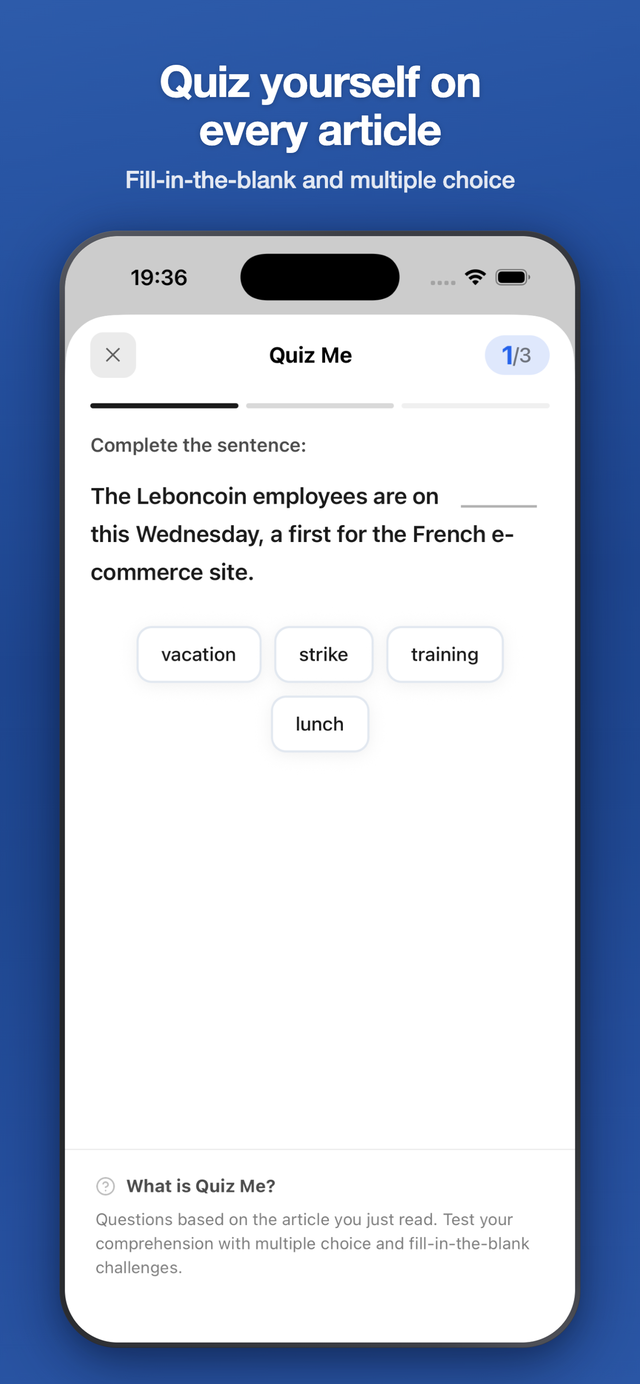
The catch is that French news was never written for people learning French. Nobody slows down, nobody explains the shorthand every French reader grew up with, and nothing at the end tells you whether you understood it. The story I open has already been chosen out of the day's eight hundred for someone learning the language and rewritten at my level, one of five, with every word in it tappable. Quiz Me then asks me three questions on that same story, which is how I find out whether I understood it or only felt like I did.
Next: listening (10 minutes). I put on France Inter while I get dressed. Most mornings it is background immersion -- I catch phrases, recognize topics, let the rhythm of spoken French wash over me. Some mornings, when I have the energy, I do focused listening with a podcast episode instead and try to follow the argument closely.
The background listening might sound lazy. But my ear has improved dramatically from it. French used to sound like one long, unbroken stream of sound. Now I hear where words start and stop. I catch verb tenses. I notice when a journalist is being sarcastic. That did not come from textbooks. It came from ten minutes of radio every morning while I put on my shoes.
Finally: write something (5 minutes). I write a three-sentence summary of the article I just read. In French. It is usually bad. Awkward constructions, wrong prepositions, verbs I am not sure I conjugated correctly. I do not fix it or look things up. I just write it and move on.
This felt pointless for the first two weeks. Then around week three, I noticed my sentences were getting slightly less terrible. By month two, I could write a coherent paragraph without agonizing over every word. Writing forces you to use vocabulary and grammar actively, not just passively recognize them. Five minutes of bad French writing every day did more for my fluency than any grammar textbook.
And that is it. By 7:50, I am done. The rest of my day happens in whatever language it happens in, but those 35 minutes are non-negotiable.
Why This Specific Routine Works
I built this routine through trial and error, not by reading research papers. But it turns out the things I stumbled into align pretty well with what linguists and cognitive scientists already know.
Vocabulary review first thing works because of how memory consolidates. Spaced repetition -- reviewing material at increasing intervals -- is one of the most replicated findings in memory science. When I review yesterday's five words this morning, and then again in a few days, and then again next week, each review strengthens the memory trace. Reviewing them all in one long session would feel productive but produce weaker retention.
Mixing reading, listening, and writing in one session works because of interleaving. Alternating between different skills in the same session builds more flexible knowledge than practicing one skill at a time. My brain connects the written word I read to the spoken word I hear to the sentence I write. Those connections are what make vocabulary actually usable, not just recognizable.
Attaching the routine to coffee works because of habit stacking. Linking a new behavior to an existing one removes the need for willpower. I do not decide to study French each morning. I pour coffee, and the routine follows. This became automatic faster than I expected. Three weeks, maybe four. Now skipping French after coffee would feel stranger than doing it.
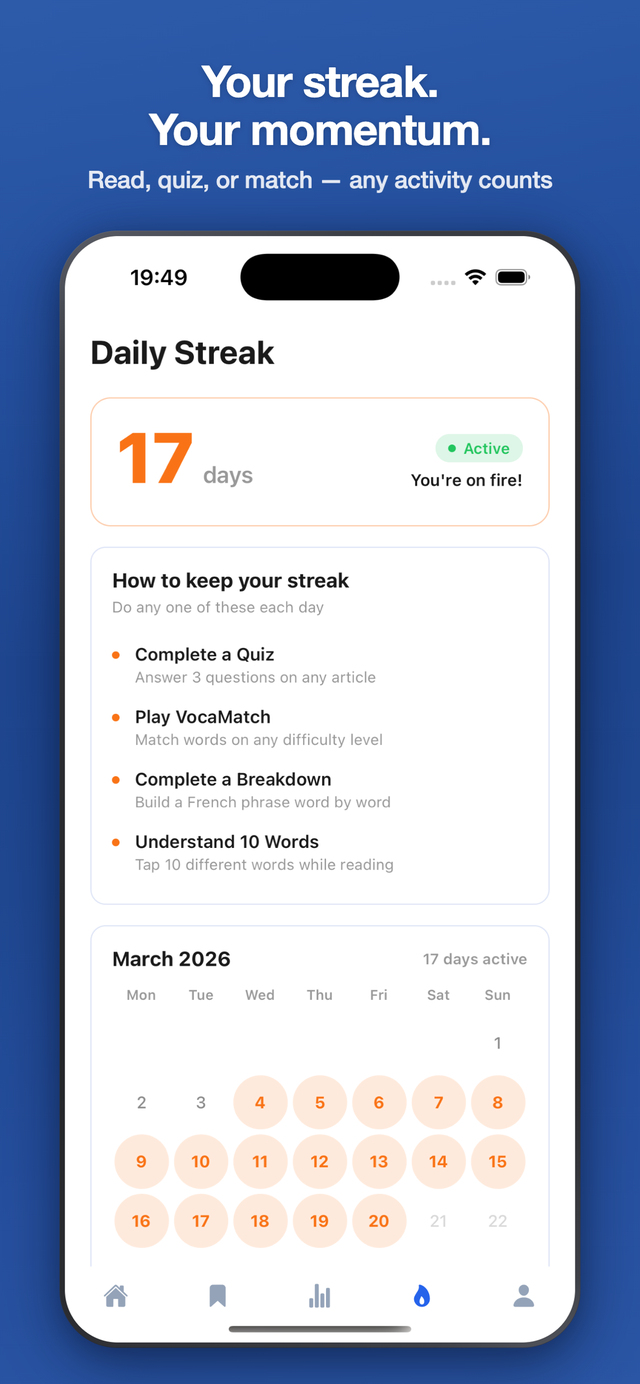
And the streak is one I cannot fake. It only moves when I have actually done something: ten new words tapped, or one game finished. Opening the app and scrolling does not count. A number that flatters you is worse than no number at all.
Adapting This to Your Level
My routine is built for someone around B1-B2, which is where I have been for most of the past two years. But the structure works at any level. You just adjust the difficulty of the material, not the routine itself.
If you are at A2, swap Le Monde for 1jour1actu -- it is a news site written for French kids, and the vocabulary is simpler without being childish. For listening, try InnerFrench or slowed-down news podcasts instead of France Inter. For writing, one sentence is enough. A single sentence in French, every day, adds up faster than you think.
If you are at B2 or above, replace the news article with an editorial or opinion piece. Editorials use more complex sentence structures and nuanced vocabulary. For listening, try France Culture debates or long-form interviews. For writing, write a paragraph responding to the article's argument -- agree, disagree, complicate it.
Whether you are studying from your apartment in Berlin or commuting in Tokyo or sitting in a café in Lyon, the routine is the same. Thirty-five minutes. Four activities. Every day. Your material changes as you improve. The structure does not.
What I Do on Bad Days
Some mornings I have zero motivation. The coffee is not helping. My brain wants nothing to do with French or anything that requires effort. I used to skip entirely on those days. Then I noticed that skipping one day made it easier to skip the next, and suddenly I had lost a week.
Now, on bad days, I do five minutes of vocabulary review and nothing else. I open the app, review my words, close the app. Done.
The point is not to have a productive session. The point is to never break the chain entirely. A five-minute session keeps the habit alive. And about half the time, once I have started, I think, "Well, I am already here, I might as well read one article." Starting is always the hardest part.
I also stopped beating myself up about bad sessions. Some mornings I read an article and retain nothing. Some mornings my writing is embarrassingly bad. That is fine. The routine is not about any single day. It is about what happens over months. One bad Tuesday does not undo six good weeks.
What I Wish I Had Known Earlier
Grammar study is overrated as a daily practice. I used to spend half my study time on grammar exercises. Now I spend almost none. Daily reading teaches grammar through pattern recognition -- you absorb how French sentences work by reading thousands of them. I still look up a specific grammar point when something confuses me, but I do not drill conjugation tables anymore.
Consistency beats intensity every time. One article per day, every day, is worth more than ten articles on Monday and nothing until Friday. Language learning compounds like interest. Small daily deposits grow into something substantial. Weekend marathons do not compound because your brain forgets most of it by Wednesday.
Tracking progress weekly keeps you sane. Daily progress is invisible. You cannot tell the difference between your French yesterday and your French today. But if you note how many articles you read and how many words you looked up each week, you will see the numbers shift over a month. I look up fewer words now than I did six months ago. That is how I know the routine works -- not because I feel fluent, but because the data says I am improving.
Frequently Asked Questions
How many minutes per day do I need to improve my French?
Thirty to forty-five minutes is the sweet spot, but fifteen focused minutes daily still produces real results -- about 30 articles and 150 new words per month. Consistency matters more than duration. Thirty minutes every day beats three hours on the weekend because spaced repetition is how memory actually works.
Should I study French in the morning or evening?
Whatever time you will actually show up for, every single day. I chose mornings because my brain is fresh and nothing has derailed my plans yet. Research shows slight advantages for both morning and evening, but the difference is tiny compared to the difference between studying consistently and studying whenever you get around to it.
What should I read for my daily French practice?
Real French content, not textbooks. News articles work well because they refresh daily, cover varied topics, and use vocabulary you actually encounter in real life. At A2, try 1jour1actu. At B1 and above, real news sites. The important thing is that it interests you -- boredom kills routines faster than difficulty.
Is it better to use flashcards or read more to build vocabulary?
Both, but lean toward reading. Reading gives you vocabulary in context -- not just what a word means, but how it behaves in a sentence. Flashcards are useful for reinforcing words you have already encountered. My approach: read one article, note five words, review them the next morning. Reading provides depth, review provides retention.
What do I do on days when I have zero motivation?
Five minutes of vocabulary review, then stop. The goal is not productivity -- it is not breaking the chain. Skipping entirely is far more damaging to a habit than doing a reduced session. And about half the time, starting with five minutes leads to doing more, because starting is the hardest part.
Build Your Daily French Habit
One story a day, chosen out of the French news for learners and rewritten at your level, with Better French Context on every word: the translation, the explanation and the cultural note. Better French is a subscription and it starts with a free trial. It works out at under €5 a month, and the exact price for your country is shown in the app before you pay. Available on the App Store and Google Play.
Download the App