French False Friends: 50 Words That Will Trick You
French and English share thousands of similar-looking words, but hundreds of them mean completely different things. Actuellement means currently, not actually. Blessé means injured, not blessed. Librairie is a bookshop, not a library. These false friends (faux amis) cause constant misunderstandings. This guide lists the 50 most common ones, grouped by how often you will encounter them, with correct meanings and example sentences.
You are reading a French article and see actuellement. Your brain instantly translates it as "actually." But the sentence does not quite make sense. That is because actuellement means "currently" -- not "actually." You just fell for a faux ami, and you are in good company. Every English speaker learning French does it dozens of times.
I once told a French colleague I was excité about a project. The silence that followed taught me more about faux amis than any textbook. In French, excité has a sexual connotation. I meant enthusiastic. The word I wanted was enthousiaste. That moment is seared into my memory, and I have never made that mistake again. That is how false friends work -- you learn them by embarrassment, one at a time.
Faux amis (false friends) are words that look alike in French and English but have different meanings. They exist because the two languages share Latin and Norman French roots, but the meanings diverged over centuries. There are hundreds of them, and they are everywhere -- in news articles, conversations, official documents, and daily life. Here are the 50 that trip up English speakers most.
The Top 20: You Will See These Daily
These false friends are so common that you will encounter them within your first week of reading French news.
- Actuellement -- means currently, not "actually." (Actually = en fait)
- Assister (à) -- means to attend, not "to assist." (To assist = aider)
- Blessé -- means injured, not "blessed." (Blessed = béni)
- Bras -- means arm, not "bra." (Bra = soutien-gorge)
- Coin -- means corner, not "coin." (Coin = pièce de monnaie)
- Décevoir -- means to disappoint, not "to deceive." (To deceive = tromper)
- Demander -- means to ask, not "to demand." (To demand = exiger)
- Envie -- means desire / craving, not "envy." (Envy = jalousie)
- Éventuellement -- means possibly, not "eventually." (Eventually = finalement)
- Figure -- means face, not "figure." (Figure/shape = silhouette / chiffre)
- Formidable -- means wonderful / tremendous, not "fearsome." (Fearsome = redoutable)
- Librairie -- means bookshop, not "library." (Library = bibliothèque)
- Location -- means rental, not "location." (Location = emplacement / lieu)
- Monnaie -- means change / currency, not "money." (Money = argent)
- Occasion -- means opportunity / secondhand, not "occasion." (Occasion/event = événement)
- Regarder -- means to look at / watch, not "to regard." (To regard = considérer)
- Résumé -- means summary, not "resume/CV." (Resume = CV / curriculum vitae)
- Sensible -- means sensitive, not "sensible." (Sensible = raisonnable / sensé)
- Sympathique -- means nice / likeable, not "sympathetic." (Sympathetic = compatissant)
- Travail -- means work, not "travel." (Travel = voyage)
The Next 15: Common in News and Formal French
These appear regularly in news articles, official documents, and professional contexts.
- Avertissement -- means warning, not "advertisement." (Advertisement = publicité)
- Caméra -- means movie/video camera, not "camera." (Photo camera = appareil photo)
- Chair -- means flesh, not "chair." (Chair = chaise)
- Conducteur -- means driver, not "conductor." (Orchestra conductor = chef d'orchestre)
- Conférence -- means lecture / talk, not "conference." (Conference = congrès / colloque)
- Délai -- means deadline / time limit, not "delay." (Delay = retard)
- Entrée -- means starter course, not "main course." (In American English, "entree" means the main dish, but in French it means the first course.)
- Expérience -- means experiment (as well as "experience"). Context determines which meaning applies.
- Ignorer -- means to not know / be unaware of, not "to ignore." (To ignore = ne pas tenir compte de)
- Journée -- means day (duration), not "journey." (Journey = voyage / trajet)
- Phrase -- means sentence, not "phrase." (Phrase = expression / locution)
- Réaliser -- means to achieve / carry out (as well as "to realize"). In news, it almost always means "to accomplish."
- Rester -- means to stay / remain, not "to rest." (To rest = se reposer)
- Supporter -- means to endure / put up with, not "to support." (To support = soutenir)
- Tissu -- means fabric / tissue (biological), not "tissue paper." (Tissue paper = papier de soie; the paper tissue you blow your nose into = mouchoir en papier)
The Final 15: Subtle Traps
These false friends are particularly sneaky because they are partially correct or misleading in specific contexts.
- Attendre -- means to wait, not "to attend." (To attend = assister à)
- Biscuit -- means cookie / cracker, not the American "biscuit." (The American biscuit has no French equivalent. The nearest thing is a scone.)
- Bride -- means bridle (horse), not "bride." (Bride = mariée)
- Cave -- means cellar, the cool room where the wine lives, not "cave." (Cave = grotte / caverne)
- Chance -- means luck, not "chance." (Chance/opportunity = occasion / possibilité)
- Collège -- means middle school (ages 11-15), not "college." (College/university = université / fac)
- Comédien -- means actor, in any register including tragedy, not "comedian." (Comedian = humoriste / comique)
- Complet -- means full (hotel full, parking lot full), not "complete." (Complete = terminé)
- Habit -- means formal clothing / outfit, not "habit." (Habit = habitude)
- Histoire -- means story as well as "history." Context determines which meaning applies.
- Magazine -- means TV show / program as well as "magazine." A print magazine is usually revue or magazine.
- Patron -- means boss, not "patron." (Patron/customer = client)
- Prune -- means plum, not "prune." (Prune = pruneau)
- Raisin -- means grape, not "raisin." (Raisin = raisin sec. Same trap as prune: French names the fresh fruit, English named the dried one.)
- Sale -- means dirty, not "sale." (Sale = soldes / vente)
How to Master False Friends
Memorizing a list helps with awareness, but real mastery comes from encountering these words in context -- repeatedly, over time. Here is the most effective approach.
Read French news daily. False friends appear constantly in journalism. Every time you read actuellement in a news article and correctly understand it as "currently," that neural pathway gets stronger. After seeing it in context twenty or thirty times, the false association with "actually" fades permanently.
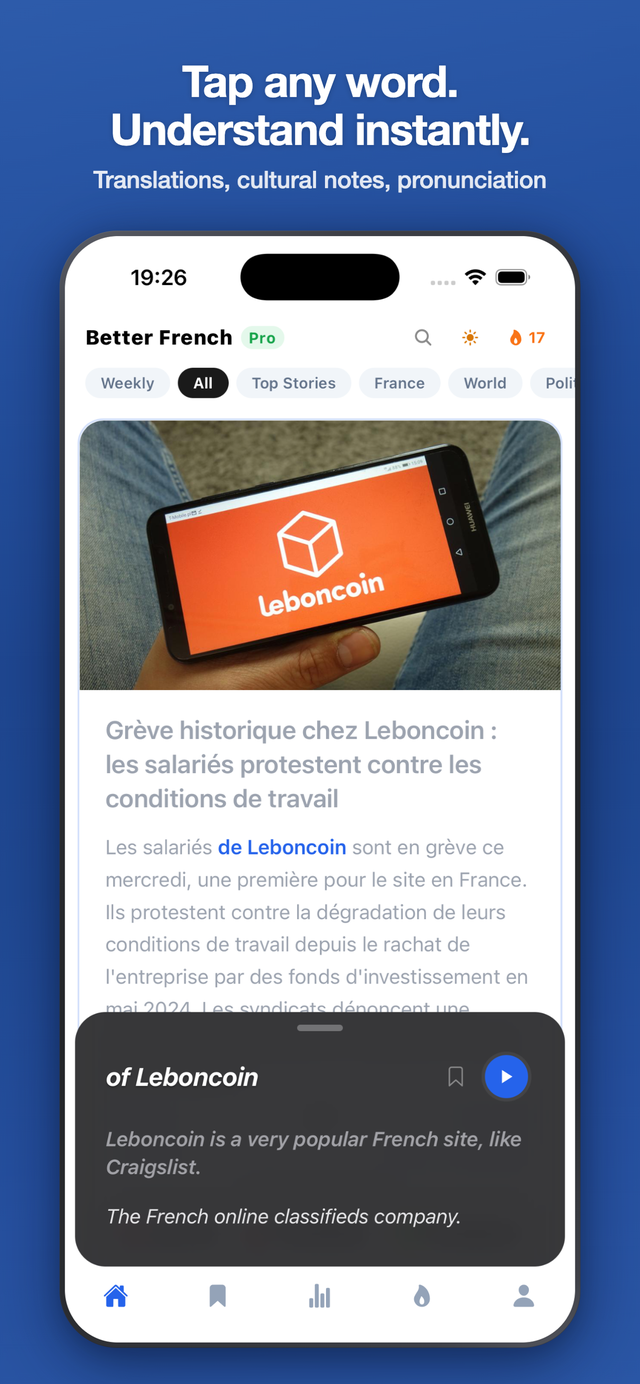
Use Better French Context as a safety net. When you read a sentence and something does not quite make sense, the problem is often a false friend. Tapping the suspicious word in Better French instantly reveals the correct meaning, so you can catch and correct the mistake in real time.
Pay attention to context clues. False friends are easiest to catch when the English meaning does not fit the sentence. If an article says Le président a déçu les électeurs, "the president deceived the voters" makes some sense -- but the tone of the article is about disappointment, not deception. That mismatch is your signal to check the word.
False friends are a finite set. There are a few hundred that matter, and you will encounter the most common fifty within your first month of reading French regularly. After that, they stop being traps and start being vocabulary you simply know.
Frequently Asked Questions
What are false friends (faux amis) in French?
False friends are French words that look or sound similar to English words but have different meanings. They exist because both languages share Latin and Norman French roots, but meanings diverged over centuries. For example, "actuellement" means currently, not actually.
What are the most common French false friends?
The most frequent include: actuellement (currently), assister (to attend), blessé (injured), demander (to ask), décevoir (to disappoint), librairie (bookshop), monnaie (change/currency), sensible (sensitive), and sympathique (nice/likeable).
How can I avoid being tricked by false friends?
Read extensively in context. When you see "actuellement" in ten different news articles, you internalize the correct meaning. Tap-to-translate tools help catch mistakes in real time. Pay attention when the English-looking meaning does not fit the sentence.
Are there French words that are partial false friends?
Yes, and they are arguably more dangerous. "Histoire" means both "history" and "story." "Formidable" means "wonderful," not "fearsome." "Réaliser" can mean "to realize" but usually means "to achieve." These partial overlaps create subtle misunderstandings.
Why do French and English have so many similar-looking words?
The Norman Conquest of 1066 brought thousands of French words into English. Both languages also borrowed heavily from Latin during the Renaissance. A well-known count of the Shorter Oxford English Dictionary (Finkenstaedt and Wolff, 1973) put French, including Anglo-Norman, at about 28% of the entries, with Latin supplying another 28%. Most of those are true cognates, but hundreds diverged in meaning.
Do false friends appear often in French news?
Constantly. "Actuellement," "assister à," "réaliser," "supporter," "avertissement," and "décevoir" appear in French news daily. This is an advantage -- reading news regularly is one of the fastest ways to learn correct meanings through repeated exposure.
See False Friends in Context -- in Real Articles
When you read French news with Better French, tap any word to see its real meaning, usage notes, and common traps. Build vocabulary that sticks.
Download the App