Why You Can Read French But Can't Understand It Spoken (And How to Fix It)
Written and spoken French are almost different languages. Liaisons merge words, elisions drop vowels, and native speakers compress sentences in ways textbooks never show you. On top of that, your brain is running every French word through an English translation before it reaches meaning -- a relay race that is too slow for real conversation speed. The fix combines two things: training your ear to decode connected speech, and building direct French-to-meaning pathways through massive reading and listening. Your reading skills are your biggest asset here. Use them -- and use them on what French people are actually reading, because half of understanding a spoken sentence is already knowing what it is about.
The first time I watched the 20h on France 2, I understood exactly three words: bonjour, France, and merci. I had been studying French for a year. I could read Le Monde articles -- slowly, with a dictionary open, but I could get through them. Hearing the same language spoken at full speed was a completely different experience. It sounded like one long, elegant blur.
I remember sitting in my apartment in Paris thinking: this cannot be the same language I have been studying. On the page, French is orderly. Clear. Polite, even. Spoken at native speed, it sounds like someone fed the written version through a blender and hit puree.
If you have ever felt this way -- whether you are studying French from your living room in Tokyo, practicing on your commute in London, or sitting in a café in Lyon pretending to follow a conversation -- you are not alone. The gap between reading French and understanding it spoken is one of the most universal frustrations in language learning. And it has a specific, fixable explanation.
Why Reading and Listening Feel Like Different Languages
Written French was standardized centuries ago. Pronunciation kept evolving. The result is a writing system that preserves letters, endings, and word boundaries that disappeared from speech long ago. When you read, you see each word clearly separated on the page. When you listen, those same words have been compressed, linked, and reshaped into something your eyes would not recognize.
Three things make spoken French particularly hard to parse.
Liaisons erase word boundaries. A liaison happens when a normally silent final consonant wakes up because the next word starts with a vowel. Les amis is not "lay ami" -- it is "lez-ami," with the s suddenly alive and glued to the next word. Vous avez becomes "vooz-avay." Un petit enfant compresses into "un p'tit-tonfon." You cannot tell where one word ends and the next begins. Your brain, trained on neatly separated written words, has no idea what just happened.
Elisions swallow entire syllables. Casual French drops vowels aggressively. Je ne sais pas becomes chais pas. Il y a becomes ya. Tu as becomes t'as. Je suis becomes chuis. These are not slang. This is standard spoken French, used by everyone from university professors to baristas. But if your brain is searching for the four-word phrase your textbook taught you, the two-syllable version will fly right past.
The rhythm is alien to English ears. French is syllable-timed -- every syllable gets roughly the same weight and duration. English is stress-timed, with heavy beats on important syllables and weak, swallowed beats in between. This difference makes French sound flat and impossibly fast to English speakers. There are no stress cues to grab onto, no emphasized words to anchor your understanding. It all flows at the same steady pace.
Put these three things together and you get a language that looks familiar on paper but sounds unrecognizable at full speed. The good news: once you understand what your ear is struggling with, you can train it to catch up.
The Translation Trap
There is a second problem, and it has nothing to do with sounds. It happens between your ears.
When you hear a French sentence, your brain runs a relay race: hear the French word, translate it to English, understand the meaning, move to the next word, translate, understand, next word. This loop worked fine when you were a beginner and your teacher spoke slowly. In a real conversation at native speed, it is a disaster. By the time you have translated the first half of the sentence, the speaker is three sentences ahead.
I noticed this happening to me during my first month in Paris. Someone would ask me a question and I would stand there for five seconds, not because I did not know the words, but because my brain was busy translating them one by one, like passing items down a conveyor belt. By the time the meaning assembled itself in English, the moment had passed.
Native speakers do not translate. When a French person hears maison, the image of a house appears directly. No English detour. You already do this with a handful of words -- bonjour, merci, oui. You do not think "hello" first. You just understand. The goal is to extend that direct processing to thousands of words.
How? There is no trick. The answer is volume. The more French you read and hear, the more words your brain rewires from the slow translation pathway to the fast direct pathway. Every time you encounter gouvernement in a news article and understand it without consciously thinking "government," that direct connection gets stronger. After fifty encounters, your brain stops bothering with the English detour. After a hundred, the word just means what it means.
This is why people who read French news daily often report listening breakthroughs they did not expect. They were not even practicing listening. But all that reading built such a deep reservoir of vocabulary and context that their brains started processing spoken French faster -- not because their ears improved, but because the translation bottleneck dissolved.
The Reading-Listening Bridge
Here is what nobody told me when I started: your reading skills are your biggest asset for improving your listening. Not a separate skill. An asset.
When you read an article and then hear it spoken, your brain does something powerful. It connects the written words you already know to their spoken forms. Suddenly, aujourd'hui is not just seven letters on a page -- it is that specific cluster of sounds you keep hearing on the news. The word manifestation, which you can read perfectly, now has a sound attached to it. Your brain builds a bridge between the visual and auditory versions of the same word.
This is why reading along while listening is one of the most effective comprehension exercises that exists. You are not just practicing listening. You are teaching your brain to map sounds onto words it already knows. Every time you do this, the mapping gets faster and more automatic.
The catch is everything the exercise needs before it works. A text you can actually read, not one you decode with a dictionary open in another tab. A subject you already have some grip on, so your brain has something to predict with. And the sound of those words, at a speed you can follow. Assembling all three yourself is more work than the exercise.
Almost everyone reaches for French news at this point, and the instinct is right. News is where the vocabulary you keep half-hearing actually lives: the names, the running stories, the words that come up at work and at dinner. Except French news was never written for French learners. Le Monde is written for a reader who already knows who the ministers are, what a motion de censure is, and why the acronym in the headline matters this week. Jargon arrives with no explanation. Nothing helps you with the words. Nothing checks whether you understood. So you read three paragraphs, look up four words, lose the thread and close the tab. The material is exactly right. The packaging is wrong.
Closing that gap is the reason Better French exists. Every day it reads around 800 articles from more than forty French sources and picks the fourteen that matter to someone learning the language and the country. Not a firehose. A choice. Each of those stories is then rewritten at five levels, so you read the real story at the level you are actually at rather than the level you wish you were at. Tap any word or short phrase and Better French Context gives you the translation, the explanation and the cultural note underneath it, which is usually the part you were missing. Three games are then built from that same story, so the words you just met come back at you the same day. You read what French people are reading, so you understand France, and your French improves because of it. Knowing the story is what makes the sounds land.
This technique works regardless of where you are. You do not need to be in France. You do not need a conversation partner. You need a story you can read, the sound of its words, and fifteen minutes.
Where the Sound Comes From
One thing to be straight about, because it changes how you use it: Better French does not narrate whole articles. There is no play button that reads the piece to you end to end. Audioplay works on the unit that actually trains your ear, which is the word and the phrase.
Tap a word you have just read and you hear it in natural French, spoken a shade under native speed. That is the mapping happening at the moment your brain is holding the written word in front of it, the sound and the shape arriving together. Ten words in one story does more for your ear than five minutes of radio in the background.
Then there is Breakdown, which I did not expect to become the thing I use most. It gives the story you have just read back to you one phrase at a time, and you rebuild each phrase and say it out loud. You can hear the phrase whole, and you can hear any single word inside it. Three tiers, A1 through C1, and it puts you in yours. It is shadowing, except what you are shadowing is a sentence you understood four minutes ago, and that is the entire difference. Shadowing the radio, you chase sounds. Shadowing a phrase from a story you have just read, you attach sound to meaning that is already there.
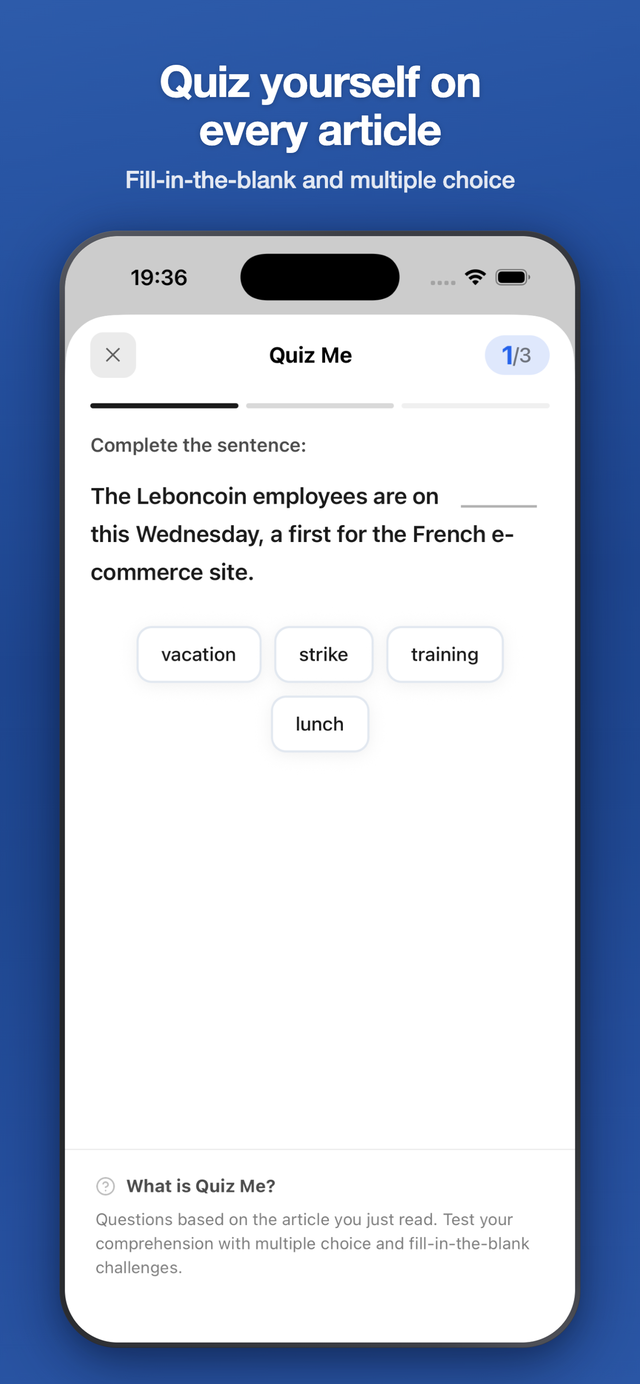
VocaMatch does the third pass: the vocabulary from that same story, three lives, no clock, the words spoken as you play. By the time a word has been read, tapped, said out loud in Breakdown and matched in VocaMatch, it has quietly stopped being a word you translate. Quiz Me, three questions, checks that you followed the story and usually teaches you something about France on the way out.
Within a few weeks of doing this, words I had only ever recognized on the page started jumping out at me in conversations. I would hear réforme on the radio and instantly know what was being discussed, not because my ear had suddenly got better, but because my brain had already linked that sound to a word and to a whole web of context from reading about it that morning.
What I Actually Do Every Day
I am not going to give you a numbered exercise list. What I will share is what actually became part of my routine -- the habits that stuck because they fit into a normal day.
Morning: read one story, then say it back. I read the day's story over coffee, tapping the words I do not know as I go, which takes about five minutes. Then I run the same story through Breakdown: hear the phrase, rebuild it, say it out loud. Another five. Doing the reading first is the whole point -- my brain already has the story, the names and the vocabulary loaded before it has to deal with any sound at all. Going in cold, listening to something I have not read, is a different and much harder exercise, and at my level a less useful one.
Commute: shadow the radio. On the métro or walking, I listen to France Inter and repeat what I hear about one second behind the speaker. This is called shadowing, and it sounds ridiculous -- you are mumbling French to yourself on the street. But it forces your mouth and brain to process spoken French in real time. Breakdown had already built the reflex on sentences I understood; the radio is where I find out how far it stretches. I do not catch everything. I catch more every month.
Evening: French TV with French subtitles. Never English subtitles. English subtitles are a trap -- your brain reads the English and completely ignores the French audio. French subtitles let you see and hear the same words simultaneously, which builds exactly the sound-to-word connections your brain needs. I started with shows I had already seen in English, so I already knew the plot and could focus on the language.
Whenever I have five minutes: go back to yesterday. Re-opening a story I read yesterday and running its Breakdown again, this time without re-reading the text first, is where the real gains happen. The first time, I needed the words in front of me. The second time, I catch about 70% without them. The third time, 90%. Each repetition strengthens the connection between sound and meaning, and because I already know the story, it costs me almost nothing to do -- which is the only reason it actually happens.
The words that keep coming back: save them. When a word turns up for the third time and I still hesitate, I save it. Saved Words keeps the story I met it in and the cultural note along with it, and that matters more than it sounds. Remaniement as a dictionary entry means nothing to me. Remaniement attached to the week the government fell, I will never lose again.
None of these habits felt productive in the first few weeks. I felt like I was just going through motions. Around week six, something shifted. I was on the métro and the overhead announcement played -- la station suivante est... -- and I realized I had understood it without thinking. Not translated it. Understood it. That tiny moment was when I knew the approach was working.
How Long This Actually Takes
I am going to be honest because I wish someone had been honest with me.
After three months of daily practice, I started catching full sentences in conversations. Not every sentence -- maybe one in four. But full, complete thoughts that I processed in French without translating. That was a meaningful shift.
After six months, I could follow most news broadcasts. Not every word, but the thread. I knew what the story was about, caught the key facts, and understood the conclusion. Group conversations were still hard, but one-on-one I could keep up.
After a year, I caught jokes. That was the moment I realized the gap had mostly closed. Humor requires speed -- by the time you translate a joke, the moment is gone. Understanding a joke in real time means your brain is processing French directly.
The curve is not linear. The first three months feel painfully slow. You will question whether anything is happening. Then the gains start compounding. Each month brings noticeably bigger improvements than the one before. The vocabulary you built from reading starts paying dividends in listening. The sound patterns you drilled start appearing in new contexts. Your brain reaches a tipping point where it stops fighting French and starts expecting it.
Twenty minutes a day. Every day. That is the minimum effective dose. Two hours on a Saturday does not replace twenty minutes on each of the seven days. Consistency matters more than intensity because your brain needs daily repetition to build and maintain the neural pathways that process spoken French.
Frequently Asked Questions
Why does spoken French sound so different from written French?
French spelling was standardized centuries ago while pronunciation kept changing. Spoken French uses liaisons that link words together, elisions that drop vowels and whole syllables, and a syllable-timed rhythm that sounds flat and fast to English ears. The written version preserves word boundaries and silent letters that disappear entirely in speech.
What is the translation trap in French comprehension?
When you hear French, your brain runs every word through English before reaching meaning. This relay was useful as a beginner, but at normal conversation speed, it is far too slow. The fix is building direct French-to-meaning pathways through massive reading and listening exposure. The more you encounter a word in context, the faster your brain processes it without the English detour.
How does reading French help with listening comprehension?
Reading builds the vocabulary and context your brain uses to predict what it will hear next. You never actually hear every word in a conversation -- your brain predicts most of them. The more you have read about French politics, culture, or daily life, the better your brain fills in gaps when you hear those topics discussed at native speed.
How long does it take to understand spoken French at natural speed?
With daily practice: full sentences at three months, most news broadcasts at six months, jokes and cultural nuances at a year. The curve accelerates -- the first three months feel slow, but each month after that brings bigger gains. Twenty minutes a day, every day, beats two hours on the weekend.
Does Better French read whole articles out loud?
No. There is no whole-article narration, and that is deliberate. Audioplay works on the unit that trains your ear: tap any word or short phrase and you hear it in natural French, spoken a shade under native speed. Breakdown then gives the story back to you one phrase at a time, so you can hear each phrase, hear any word inside it, and say it out loud yourself. VocaMatch speaks the vocabulary from the same story. The sound arrives attached to words you have just read, which is the part that builds the link.
How do you practise listening with French news when it is written for native speakers?
That is the real obstacle. French news is written for readers who already know who the ministers are and what the acronyms mean: jargon with no explanation, no help with the words, nothing to test yourself against. Better French exists for that gap. It reads around 800 articles a day from more than forty French sources, picks the fourteen that matter to a French learner, and rewrites each one at five levels. Tap any word or short phrase for Better French Context: translation, explanation and cultural note. Quiz Me, VocaMatch and Breakdown are built from the same story. You understand what is going on in France, and your French improves because you know what a sentence is about before you have to hear it.
Read the Story, Then Say It Back
Better French reads around 800 French articles a day and picks the fourteen worth your time, then rewrites every one of them at your level. Tap any word for the translation, the explanation and the cultural note. Hear any word or phrase in natural French. Then say the story back to yourself, one phrase at a time, in Breakdown. You read what French people are reading, you understand France, and your French improves because of it. Better French is a subscription and it starts with a free trial. It works out at under €5 a month, and the exact price for your country is shown in the app before you pay.
Download the App