Why French Jokes Go Over Your Head
Most French jokes aren't hard because of the words. They point at something people in France share: a 2001 film, a line from a 1962 comedy, a comic-book captain, three saints in May. If you didn't grow up with the reference, the sentence makes sense and the joke stays invisible. Below are some that come up again and again, what each one means and why it lands, and how to pick them up while you read real French.
French jokes go over your head because most of them aren't about the words. They point at something people in France share: a film from 2001, a line from a 1962 comedy, a comic-book captain, three saints in May. You understand the sentence perfectly, and the joke still isn't there, because it lives in the reference.
« Everyone laughs, and I still don't know why. » « I miss the jokes and references everyone shares. » People learning French say both, and they usually blame their French. Most of the time the French is fine. What's missing is the background everyone else grew up with: the films, the comics, the sayings, the dates on the calendar. Here are some that come up again and again, and how to pick them up while you read.
Films People Quote
« Un Tanguy »
Tanguy is a 2001 comedy by Étienne Chatiliez about a brilliant 28-year-old who has no intention of leaving his parents' home, and parents who are running out of patience. The name stuck. French Wikipedia notes that « Tanguy » is now used for a young adult who is happy to go on living with his parents, and people talk about le phénomène Tanguy. Call your 30-year-old cousin un Tanguy and the table laughs. Translate it word for word and nobody knows what you mean.
« Il s'appelle Juste Leblanc »
In Le Dîner de cons (a play by Francis Veber from 1993, filmed in 1998), Pierre Brochant tells François Pignon about a friend: « Il s'appelle Juste Leblanc. » Pignon answers: « Ah bon, il n'a pas de prénom ? » He hears juste as "only", as in "just Leblanc", and Brochant has to explain that Juste is the man's first name. It is one of the film's best-known lines, and it only works if you know that juste is both a word and a name.
« Si j'aurais su, j'aurais pas v'nu ! »
A line from La Guerre des boutons (1962), said by the small boy known as Petit Gibus. It's wrong twice: French doesn't put aurais after si, and venir takes être, so the correct sentence is Si j'avais su, je ne serais pas venu. The mistakes are the joke. French Wikipedia lists it among the répliques cultes of French cinema, and people quote it, mistakes included, when they wish they hadn't come. It may be the only time a French person will say, on purpose, the sentence your teacher corrected.
TV and Comics
« C'est pas faux »
In Kaamelott, a TV comedy about King Arthur's court that ran from 2005 to 2009, the knight Perceval has a reply for words he doesn't understand: « C'est pas faux. » It means "that's not wrong", it sounds like agreement, and it says nothing at all. French Wikipedia lists it among Perceval's best-known lines. Said with a straight face after someone uses a long word, it's a small joke about pretending to follow.
« Mille sabords ! » and Haddock's sticking plaster
Captain Haddock, from the Belgian comic Les Aventures de Tintin, swears in strange, harmless words. His two favourites, « Mille sabords ! » and « Tonnerre de Brest ! », first appear in L'Étoile mystérieuse, and French Wikipedia says some of his insults have passed into everyday French. So has a scene from L'Affaire Tournesol, where a piece of sticking plaster won't leave his fingers. Le sparadrap du capitaine Haddock now means something awkward that keeps sticking to you, however hard you shake it.
The Calendar
« Poisson d'avril ! »
On 1 April, people in France play tricks on each other, the classic one being a paper fish stuck on someone's back without them noticing, and the media run hoaxes of their own. When the trick is found out, you shout « Poisson d'avril ! » So if a French story dated 1 April sounds too strange to be true, check the date before you believe it.
The fève in the galette des rois
For Epiphany, on 6 January or the first Sunday after 1 January, the French share a galette des rois. A small charm, the fève, is hidden inside, and whoever finds it in their slice becomes the king or queen of the table. So when someone in January asks who got the fève, they aren't asking about beans, even though fève also means broad bean.
« Les saints de glace »
Saint Mamert, Saint Pancrace and Saint Servais fall on 11, 12 and 13 May. Old country wisdom says frost can return until they've passed, so many gardeners wait until mid-May to plant tomatoes and courgettes outside. French Wikipedia points out that frost very rarely strikes on those dates. The saying survives anyway, and it comes back every May as soon as the nights turn cold.
Wordplay in Headlines
French headline writers love to bend a reference to fit the story. On 8 October 2026 a story in Better French ran under « Restos du Cœur : les humoristes créent le spectacle Les Enflures ». For a French reader, Les Enflures echoes Les Enfoirés, the stars who perform every year for the Restos du Cœur, the charity Coluche founded in 1985. Both names are insults worn as a joke: Larousse marks enflure as familiar and insulting, meaning an idiot. A headline that borrows a film title, a proverb or a song, with one word changed, expects you to hear the original underneath. If you don't know the original, you read a slightly odd sentence and move on, and the wink is lost.
When a pun is so bad it's good, French has a name for it: une blague Carambar, after the caramel bars whose wrappers carried short jokes from 1969. In 2013 the brand announced the jokes were ending. The story went everywhere, petitions followed, and the announcement turned out to be a joke itself.
| Reference | Where it comes from | What people mean |
|---|---|---|
| un Tanguy | Film, 2001 | An adult who still lives with his or her parents |
| Juste Leblanc | Le Dîner de cons, 1998 | A joke on a name that is also a word |
| Si j'aurais su, j'aurais pas v'nu | La Guerre des boutons, 1962 | "I wish I hadn't come" |
| C'est pas faux | Kaamelott, TV, 2005 to 2009 | "I didn't understand, but I'll nod" |
| Mille sabords ! | Tintin comics | A harmless cartoon curse |
| Poisson d'avril ! | 1 April | "Got you!" |
| les saints de glace | 11 to 13 May | The last frost before planting |
| une blague Carambar | Sweet wrappers, from 1969 | A corny joke |
How to Catch Them While You Read
Nobody learns these from a list, this one included. People in France met them again and again until they stopped being strange. A learner can do the same, if something explains the reference the first few times, which is where a dictionary or a translator lets you down.
Take that same headline from 8 October 2026:
« Restos du Cœur : les humoristes créent le spectacle Les Enflures »
Word for word, that's "Restaurants of the Heart: the comedians create the show The Swellings", which tells you nothing. In Better French, you tap Les Enflures and Better French Context explains it where you are reading: « Comedy troupe name, a nod to Les Enfoirés. » Then the cultural note: « Pejorative term reclaimed to echo the famous Les Enfoirés. » Tap Restos du Cœur and you get « Charity organization distributing meals and social aid. » and « Founded by Coluche to feed the impoverished. » In English, French, German or Spanish.
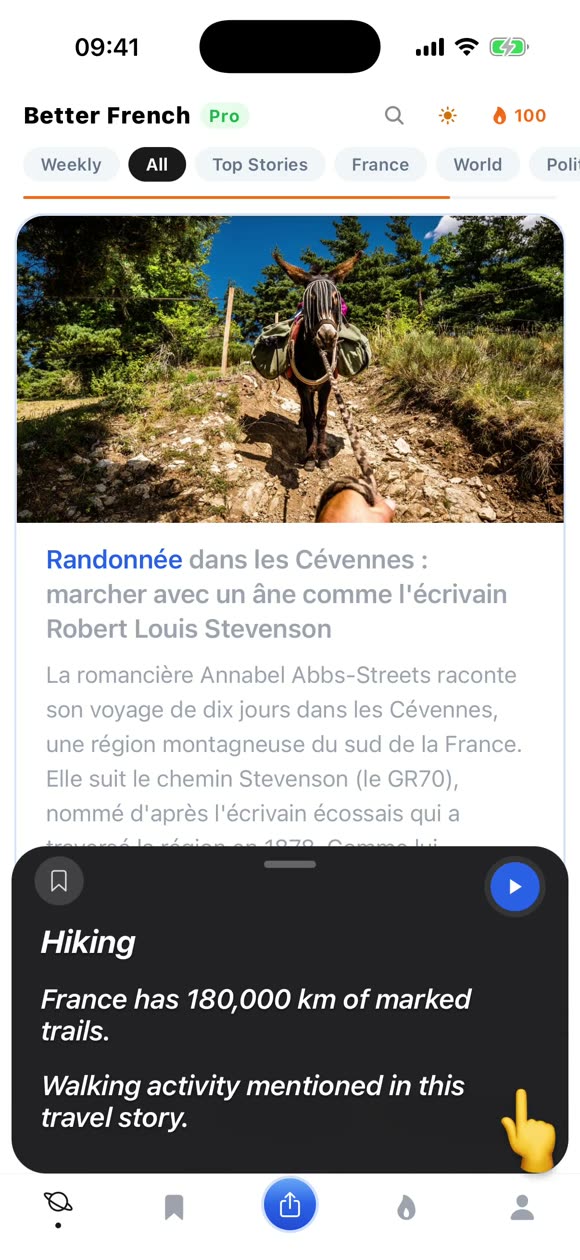

Every day, Better French picks fourteen stories from 40+ French sources about life in France and rewrites each one once in clear French, with the original one tap away. The references come with the stories, because French writers use them without thinking. Tap the ones you don't get, and keep the ones you like in Saved Words. VocaMatch then teaches you the vocabulary from what you read, the story's real words and expressions, at your level.
An honest limit: we can't explain the joke a colleague made at lunch. What we can do is explain the references as they turn up in what you read, so that week after week, the background everyone else grew up with becomes yours too.
Jokes are one part of a wider gap. If you understand the words but still feel a step behind, our guide for people who speak French but still feel like an outsider covers the rest: what France is talking about this week, the institutions every story assumes and the calendar of the French year.
For the habits behind the humour, read our guides to French social customs and why French people complain. For words that look English and aren't, see French false friends, and for the table where so many of these jokes get told, French food culture.
If you miss the jokes and references everyone shares, Better French is built for that: real French about France, with the meaning and the cultural note on the words and phrases you tap.
Frequently Asked Questions
Why don't I get French jokes even when I understand the words?
Because most French jokes point at a shared reference: a film, a TV series, a comic, a saying or a date on the calendar. If you didn't grow up with it, the sentence makes sense but the joke doesn't. Learning the references does more here than more grammar.
What does « un Tanguy » mean in French?
A young adult who goes on living with his or her parents, usually a little too comfortably. It comes from Tanguy, a 2001 comedy by Étienne Chatiliez about a 28-year-old who won't leave home. People also say jouer les Tanguy, and talk about le phénomène Tanguy.
What does « c'est pas faux » mean?
Literally "that's not wrong". It became a running joke in the TV comedy Kaamelott (2005 to 2009), where the knight Perceval says it when he hasn't understood a word. Used with a wink, it means you have no idea what was just said.
Which French cultural references come up most in jokes?
Some that come up again and again: the film Tanguy, Le Dîner de cons and its line about Juste Leblanc, Petit Gibus's « Si j'aurais su, j'aurais pas v'nu », Perceval's « C'est pas faux » from Kaamelott, Captain Haddock's « Mille sabords ! », the poisson d'avril on 1 April, the galette des rois in January and the saints de glace in May.
Can an app help me understand French humour?
It can help you catch the references. Better French gives you real French stories every day, and when you tap a word or phrase, Better French Context explains its meaning, how it is used and the cultural note behind it. It won't explain every joke at a dinner table, but the shared background builds with every story you read.
Get the Reference, Not Just the Words
Read real French stories about life in France and tap a word or phrase for its meaning, how it is used and the cultural note behind it. Better French is a subscription and it starts with a free trial. It works out at under €5 a month, and the exact price for your country is shown in the app before you pay. On the App Store and Google Play.

On a laptop? Point your phone camera at the code to get the app.