If you speak French and still feel like an outsider in France, the missing piece is rarely grammar. It is shared context: what everyone read and talked about this week, the institutions a sentence takes for granted, and the habits of the French year. People who grew up here carry it without noticing. You can build a good part of it by reading France's own stories every day.
Learners describe it to us in two lines that belong together: "I speak French, but I still feel on the outside." And: "Everyone laughs, and I still don't know why." You follow every word at the table. Then someone mentions something everybody knows, the table moves on, and you are one step behind.
The Three Layers of Shared Context
At B2 or C1, a missed moment usually comes down to a missed reference. Most of what French speakers take for granted sits in three layers:
- This week. What the country is reading and talking about right now: a vote, a new rule, a book everyone has an opinion on.
- Institutions. The names that stand for whole systems, from the school holiday zones to the meal vouchers in a colleague's wallet.
- The year. The calendar every French person lives by: la rentrée, the school holidays, the prize season.
Two of our guides cover the ground next door. Why French jokes go over your head explains the films, comics and sayings behind French humour. Living in France: the language barrier nobody mentions deals with mail, admin and fast talk. This guide is about the everyday background that stories, and the people around you, assume you already have.
The Calendar Everyone Lives By
Every autumn, French schools close for the Toussaint holidays, in the second half of October. If colleagues with children are suddenly away then, that is why.
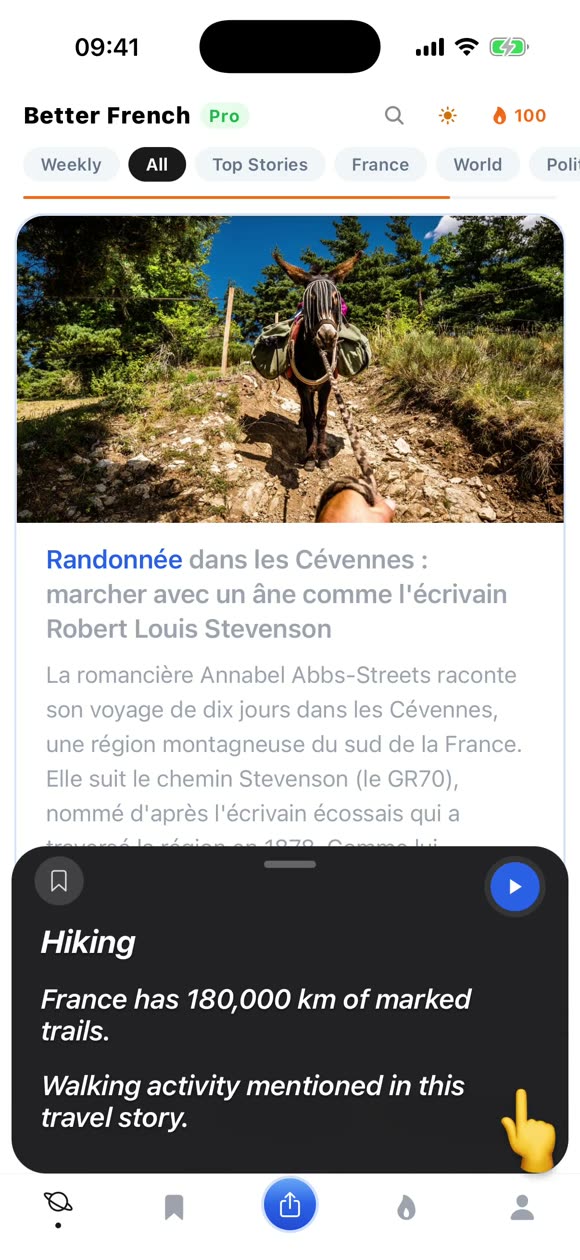
A story in Better French on 1 September 2026 laid out the school year. One sentence of it reads:
« Le calendrier officiel prévoit les premières vacances (la Toussaint) le 17 octobre. »
Tap la Toussaint, and Better French Context shows this:
la Toussaint
Meaning: Autumn holidays for all students.
Cultural note: Toussaint means 'All Saints', held November 1st.
So la Toussaint is two things at once: a public holiday on 1 November (Larousse, checked October 2026) and the name of the autumn school break around it. The official calendar runs the 2026 break from Saturday 17 October to Monday 2 November; pupils with no Saturday classes finish on Friday 16 October, after school (service-public.fr, checked October 2026).
The same story ends with a sentence that explains a lot of French small talk:
« En France, les dates des vacances d'hiver et de printemps changent selon votre zone géographique (A, B ou C). »
A, B ou C
Meaning: Three regional groups for staggered calendars.
Cultural note: Zone C includes Paris and Montpellier academies.
An académie is an education region. Zone C also takes in Créteil, Versailles and Toulouse; Lyon and Bordeaux are in zone A; Lille, Nantes and Strasbourg are in zone B (service-public.fr, checked October 2026). So when a colleague says « nous, on est en zone C » (a made-up example), they are telling you when their family goes away in February and in spring. Nobody will explain it, because everybody knows.
The Systems Every Story Assumes
Some words name a piece of French daily life with no neat English twin. On 13 October 2026, Better French ran:
« Tickets-restaurant : utilisables en supermarché jusqu'à 25 euros, même le dimanche »
Tap des tickets-restaurant in the story's summary:
des tickets-restaurant
Meaning: Payment vouchers for meals.
Cultural note: Also called "titres-restaurant"; "ticket" is common in speech.
Behind the note is a whole habit. Service-public.fr (checked October 2026) describes the titre-restaurant as a payment voucher an employer can give staff to pay for a meal when there is no canteen, with the employer paying between 50% and 60% of its value. Until 31 December 2026 it can pay for any food product, whether or not it is ready to eat, which is why supermarkets come into it. The story was about MPs voting to extend that use.
Once you know that, the headline reads the way it reads to a French person: a change to something people use at lunch on an ordinary working day.
What the Country Is Talking About This Week
The third layer moves fastest. Every autumn France has a season when books are news. On 5 September 2026, Better French ran:
« Rentrée littéraire 2026 : 461 nouveaux romans arrivent dans les librairies françaises »
Rentrée littéraire
Meaning: Period when hundreds of books are released.
Cultural note: The word refers to returning from summer break.
La rentrée is the return after the summer holidays; Larousse gives both the return to school and the period that follows the summer break. The rentrée littéraire is publishing's version, and it builds towards the autumn literary prizes, the Goncourt best known among them. For a while after the prizes, the winners are what a lot of people are talking about.
Why Daily Reading Builds Shared Context
People who grew up in France did not study any of this. They picked it up a little every day, from what they read, heard and talked about. Reading France's own stories every day is the closest a learner gets to that. The same names, institutions and dates come back week after week, until they stop being references and become things you know.
Two habits make it stick. Read short pieces about France daily rather than one long article a week. And when a name or a habit stops you, get the note behind it right there in the sentence, not in a new tab. For a wider tour of the habits that surprise newcomers, see French social customs that confuse foreigners.
Be clear about what this does. Reading will not make you belong, and it is no substitute for friends, colleagues and time spent somewhere. What it gives you is the background: when the Toussaint, zone C or the Goncourt comes up, you know what it is. What happens next is up to you and the people around you.
How Better French Helps
Better French reads around 800 articles a day from 40+ French sources and picks fourteen stories a day about what France is talking about. Each one is rewritten once in clear French, with the original article one tap away. That is this week's France, in a daily dose you can finish.
- Better French Context. Tap a word or phrase for its meaning, how it is used in that sentence and the cultural note behind it, in English, French, German or Spanish. The notes on la Toussaint, the zones and the tickets-restaurant above are what the app showed.
- Quiz Me. Three questions on the story you just read, and a short "Did you know?" about France.
- Read in Your Language. Flip the story into English when you want the gist fast, then flip back to French.
- Saved Words. Keep the names and expressions you want to recognise next time, with the story you met them in.
Better French is for reading and understanding. It will not teach you to speak, and it will not make friends for you. It does mean fewer references go past you.
Frequently Asked Questions
Why do I still feel like an outsider when I speak French?
Usually because the gap is shared context, not language. French speakers lean on what everyone read this week, institutions nobody explains and the rhythm of the French year. People who grew up in France absorbed it over years. You can build a good part of it by reading French stories every day.
Why don't I get French jokes when I understand every word?
Because most jokes rest on a reference: a film, a story in the news, a habit everyone knows. If you missed the reference, the words alone do not help. Our guide to why French jokes go over your head covers the films and sayings; daily reading covers what France is talking about this week.
What do people in France assume everyone knows?
Things like the school holiday zones, the Toussaint and la rentrée, everyday systems such as tickets-restaurant, the autumn literary prizes, and whatever the country has been reading about this week. None of it is in a grammar book, and nobody stops to explain it.
How long until I stop feeling like an outsider in France?
There is no honest number, and reading alone will not do it. Time in France, friends and work matter most. Reading France's stories every day speeds up the background part, because the same names, dates and institutions come back week after week.
How does Better French help with French cultural context?
It gives you fourteen French stories a day about what France is talking about, each rewritten once in clear French with the original one tap away. Tap a word or phrase for its meaning, how it is used and the cultural note behind it, and check yourself with three Quiz Me questions.
