Your French sounds like a textbook because a textbook is mostly what went in. You can only reach for words and turns of phrase you have met, and if nearly all of them came from a course, what comes out sounds like the course. So the fix starts with what you take in.
Learners tell us this in almost the same words: "My French still sounds like a textbook." The grammar is right and the sentences are correct. A French person still hears, within a few words, that it came from a book.
Why Correct French Can Still Sound Like a Textbook
A course has good reasons for the French it teaches. It picks the full, careful form, because that form is correct everywhere: nous for "we", cela for "that", the whole word rather than the short one. You can write it in an exam and nobody will mark you down.
But the careful form is one register of French, and French people move between registers all day. Much of what they say to friends and colleagues, and plenty of what they write in headlines and messages, uses the shorter, familiar forms. If you only ever met the careful one, it is the only one you have.
The Words Real French Uses Instead
A few pairs show the pattern. Each form on the right is marked in the dictionary as familiar or as a short form (Larousse and Le Robert, checked October 2026).
| Your course gave you | What you also meet | What the dictionary says |
|---|---|---|
| nous | on | Familiar language: the speaker and one or more others (Larousse) |
| cela | ça | From cela, familiar (Larousse) |
| réfrigérateur | frigo | Familiar (Larousse) |
| mathématiques | maths | Familiar (Larousse) |
| la Sécurité sociale | la Sécu | Abbreviation, familiar (Le Robert) |
| biologique | bio | Short for biologique (Larousse) |
Nothing on the left is wrong. It is what you would write in a formal letter. But someone who says nous, cela and réfrigérateur in every sentence sounds like a person who learned French from a book, because they did. The skill is knowing both, and when each one fits.
Then there are the words that never make it into a course at all. They are not rare. They are simply not on anyone's list, and you only meet them in French written for French readers.
Three Words From Real Stories in Better French
Here are three, from stories that ran in Better French in September and October 2026, with what the app shows when you tap them.
Épinglé: a Word No Course List Reaches
A story in Better French on 1 October 2026 ran under this title:
« Alimentation : plus d'un professionnel du bio contrôlé sur sept épinglé pour fraude »
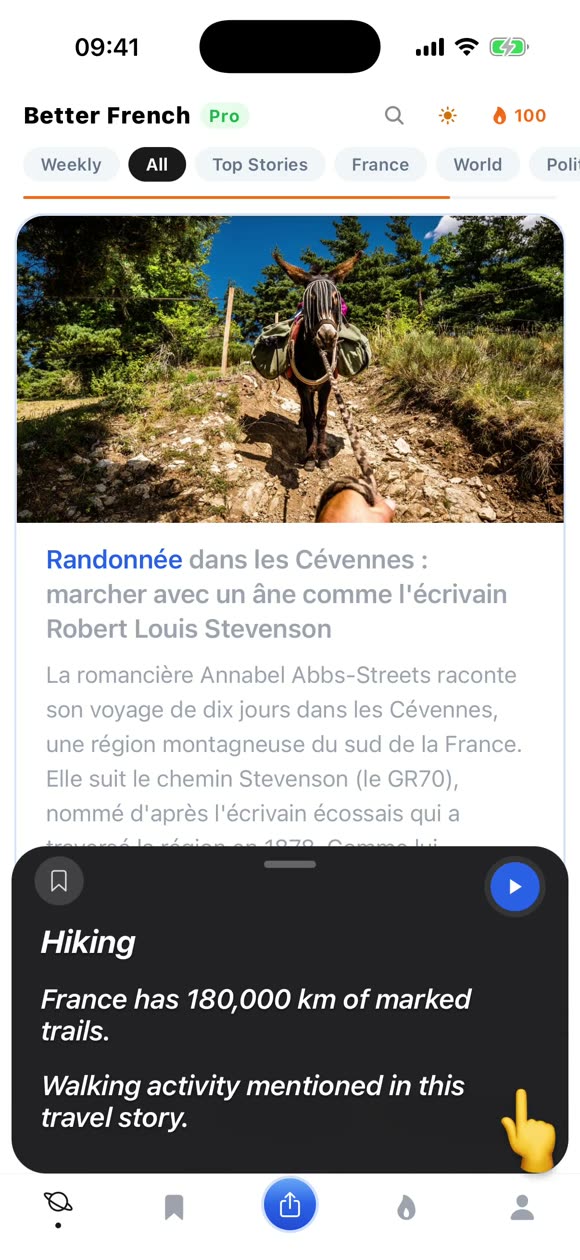
A course would give you sanctionné or pris. The headline says épinglé, literally "pinned". Tap it, and Better French Context shows this:
épinglé
Meaning: Penalized or caught committing an offense.
Cultural note: Colloquial figurative meaning for catching or exposing someone.
Larousse marks that sense of épingler as familiar, and its example could be a headline: « Le rapport épingle plusieurs sociétés ». The same title gives you du bio, and its note heads off a textbook reflex: "Short for 'biologique'; 'organique' is an incorrect translation here." Translate "organic" word by word and you land on organique. French people say bio. For more traps of that kind, see our list of French false friends.
L'Assurance Maladie, or La Sécu
On 4 October 2026, Better French ran « Hypertension en France : l'Assurance maladie veut renforcer le dépistage ». The headline uses the official name. Tap it:
l'Assurance maladie
Meaning: Public body managing mandatory health coverage.
Cultural note: Commonly called "la Sécu" by French people.
That note is the gap between course French and real French in one line. Strictly, la Sécu is short for la Sécurité sociale, the whole system, and the Assurance Maladie runs its health branch (securite-sociale.fr, checked October 2026). In everyday French, la Sécu is the name you will hear for it.
Les Maths
On 4 September 2026, the title was « Hugo Duminil-Copin : le Français médaillé Fields explique les maths autrement ». Tap explique les maths:
explique les maths
Meaning: The subject of the mathematician's new book.
Cultural note: In French, 'maths' is the informal abbreviation.
A small word, and exactly the point. The headline chose maths, not mathématiques, in a story about a Fields Medal winner. A course list often gives you the full word. France uses the short one, even here.
Why Reading Changes What Comes Out
You cannot reach for a word you have never met, and you rarely reach for one you met once. A word like épinglé or la Sécu becomes yours after you have seen it in several real sentences, with a sense of who uses it and where.
That is the case for reading every day. Texts written for French readers are full of the familiar forms, short forms and expressions that course texts leave out. Read enough of them and the textbook form stops being the only one in your head. The notes also tell you the register, so you learn when maths is fine and when a formal letter wants the full word.
If your French is correct but stiff and you feel stuck at B1, breaking through the B1 plateau covers that stage more widely.
What Reading Will Not Do
Here is the limit, plainly. Reading changes what you read and understand, and it widens the French you have to draw on. It does not teach speaking. Saying on and ça without thinking, at the speed of a real exchange, takes practice with people: friends, colleagues, a tutor, a language exchange.
Reading feeds that practice. You arrive with more real French in your head, so there is more to bring out. Listening is its own skill too, because spoken French squeezes words together in ways print does not. Our guide on why you can't understand spoken French covers that side.
How Better French Helps With Textbook French
Better French gives you real French every day without the wall. It reads around 800 articles a day from 40+ French sources and picks fourteen stories a day about what France is talking about. Each one is rewritten once in clear French, with the original article one tap away, and the familiar forms stay in.
- Better French Context. Tap a word or phrase for its meaning, how it is used in that sentence, and the cultural note behind it, in English, French, German or Spanish. The notes on épinglé, du bio and l'Assurance maladie above are what the app showed.
- Audioplay. Hear the word or phrase you tapped pronounced in French, so you know how it sounds as well as how it looks.
- Saved Words. Keep the words you want to come back to, with the story you met them in.
- VocaMatch and Breakdown. VocaMatch teaches you the vocabulary from what you read: the story's real words and expressions, at your level (A1-A2, B1-B2 or C1-C2). Breakdown rebuilds a key sentence from the story, one word at a time.
Better French is for reading and understanding. It will not correct your accent or practise with you out loud, so pair it with real people for that. What it changes is the French that goes in, fourteen stories a day.
Frequently Asked Questions
Why does my French sound like a textbook?
Usually because nearly all of it came from a textbook. Courses teach the careful form, such as nous, cela and full words like réfrigérateur. French people also use on, ça and frigo, and words like épinglé that no course list includes. You can only use what you have met.
Is textbook French wrong?
No. It is correct, and it is what you write in a formal letter or an exam. The problem is having only that one register. Knowing the familiar forms too, and when each one fits, is what makes French sound natural.
How do I learn the French that people actually use?
Meet it often, in real texts written for French readers, with an explanation of how each word is used and in what register. Short daily reading works well because the same familiar forms and expressions keep coming back. Then use them with people.
Will reading make me sound more natural when I speak?
Reading widens the French you have to draw on, so more natural words are there when you reach for them. It does not train speaking itself. For that you need practice with people: friends, colleagues, a tutor or a language exchange.
How does Better French help with textbook French?
It gives you fourteen real French stories a day, each rewritten once in clear French with the original one tap away. Tap a word or phrase to see what it means, how it is used and the cultural note behind it; the notes often tell you when a word is familiar or a short form. Save the words you want to keep.
