How Did SpaceX Catch Its Starship Rocket in Texas? Four French Words Explained
SpaceX caught the upper stage of its Starship rocket in Texas because metal arms on its launch tower grabbed the vehicle as it returned from orbit. The test proves an orbital stage can be recovered rather than destroyed.
The French in this story: déployer (to deploy), suivre de près (to follow closely), rattraper (to catch), faire le tour de (to go around).
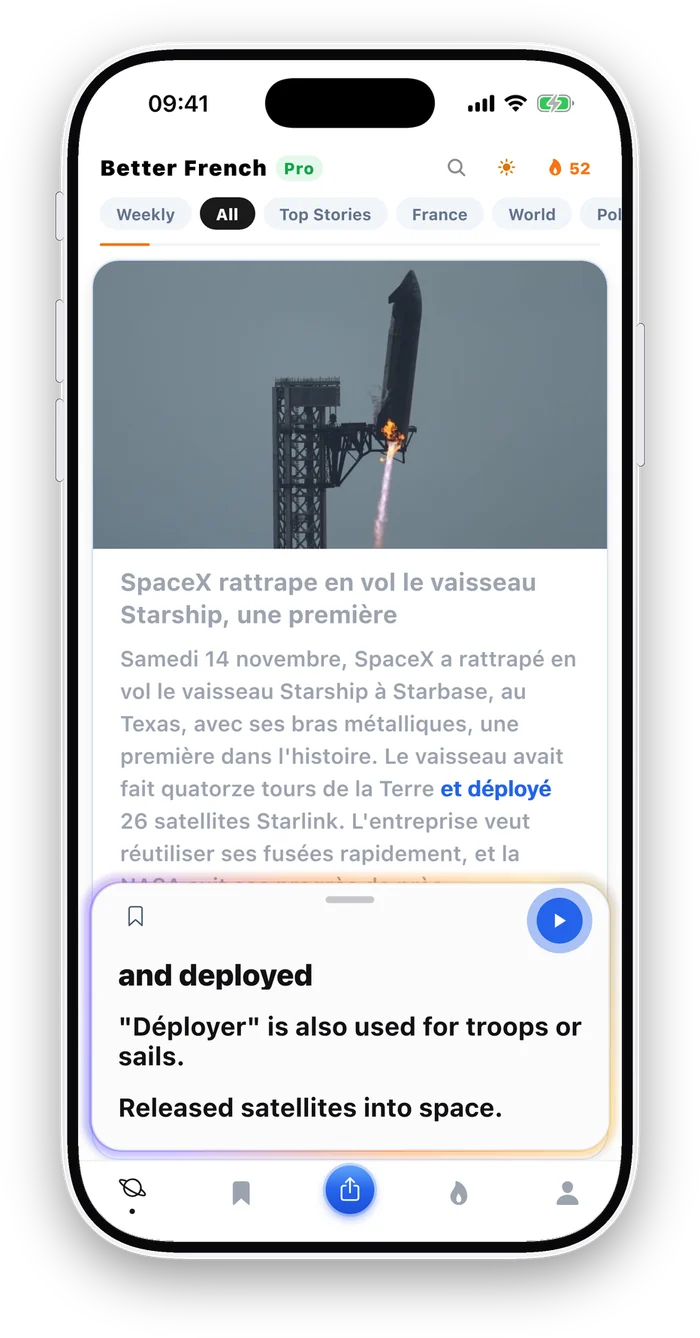
Stuck on a word in real French? In the app, tap it: Better French Context shows what it means in that sentence.

How did SpaceX catch its Starship spacecraft?
On Saturday 14 November, SpaceX caught the upper stage of its Starship rocket at its Starbase facility in southern Texas. After twenty-two hours in space and fourteen orbits around the Earth, the spacecraft descended through the clouds toward the launch tower called Mechazilla. At 3:20 p.m. local time, the tower's metal arms gripped the vehicle. A thermal shield made of thousands of tiles protected the craft from extreme heat as it re-entered the atmosphere at twenty-three times the speed of sound. CNN reported that recovering the vehicle intact lets engineers examine the engines and heat shield, supporting plans to reuse rockets rapidly and carry astronauts to the Moon.
1. Déployer and how to use it
It means to deploy or unfold. Le vaisseau avait fait quatorze tours de la Terre et déployé 26 satellites Starlink. (The craft had orbited the Earth fourteen times and deployed 26 Starlink satellites.) In everyday life, you might say: L'armée va déployer des équipes de secours dans la région. (The army will deploy rescue teams to the region.) In French, the verb changes its y to an i before a silent e in the present tense, and it also applies to opening an umbrella or spreading out a map.
2. Suivre de près and its meaning
It means to follow closely or keep a close eye on. L'entreprise veut réutiliser ses fusées rapidement, et la NASA suit ces progrès de près. (The company wants to reuse its rockets quickly, and NASA is following the progress closely.) For an everyday situation: Le médecin veut suivre de près l'évolution de votre santé. (The doctor wants to keep a close eye on your health.) Because the expression uses an irregular verb, its first-person present form is spelled and pronounced just like the first-person form of the verb to be.
3. Rattraper and common uses
It means to catch or catch up with. Samedi 14 novembre, SpaceX a rattrapé en vol le vaisseau Starship à Starbase, au Texas, avec ses bras métalliques, une première dans l'histoire. (On Saturday 14 November, SpaceX caught its Starship spacecraft in mid-air at Starbase, in Texas, using the metal arms of its launch tower, a first in history.) In daily life: Il court vite pour rattraper le bus. (He runs fast to catch the bus.) The prefix implies catching something that was falling, escaping, or already moving ahead of you.
4. Faire le tour de and travel phrases
It means to go around, circle, or tour something. It comes from the same sentence as déployer above: Le vaisseau avait fait quatorze tours de la Terre (The craft had orbited the Earth fourteen times). Around town, people often say: Nous avons fait le tour de la ville à pied ce matin. (We walked all the way around the city this morning.) The final preposition contracts normally with definite articles depending on whether the noun that follows is masculine, feminine, or plural.
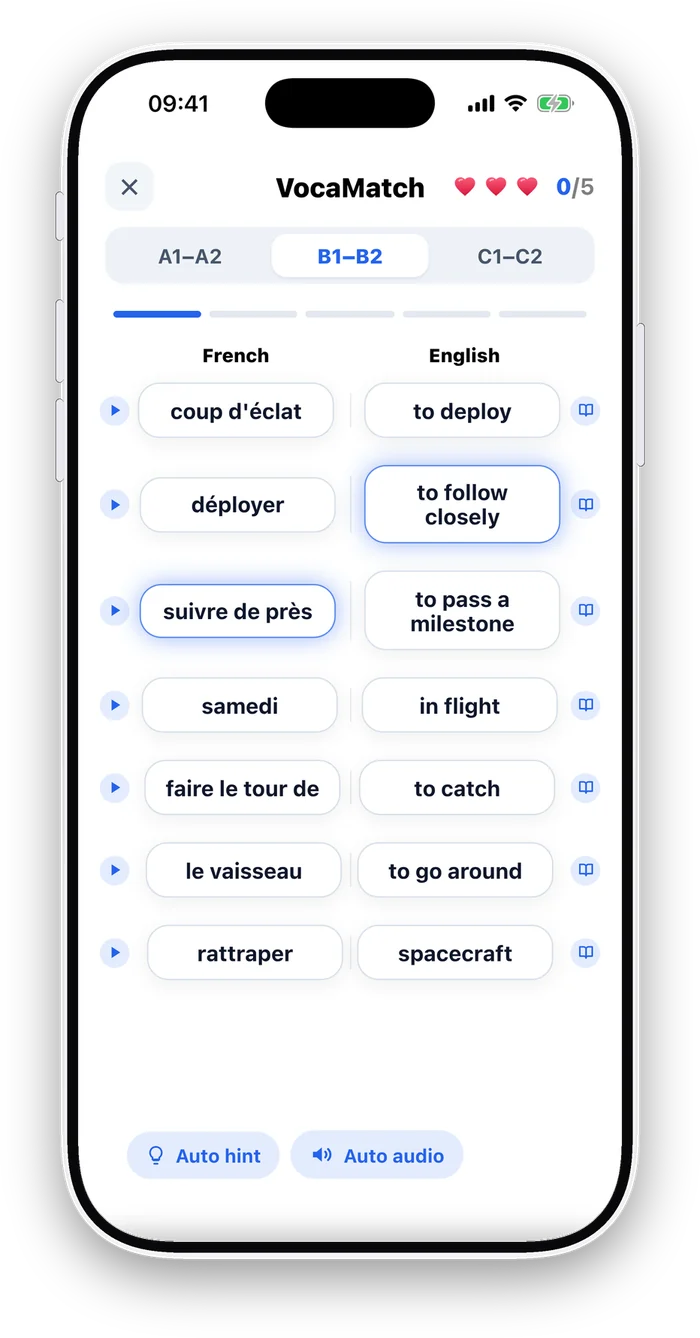
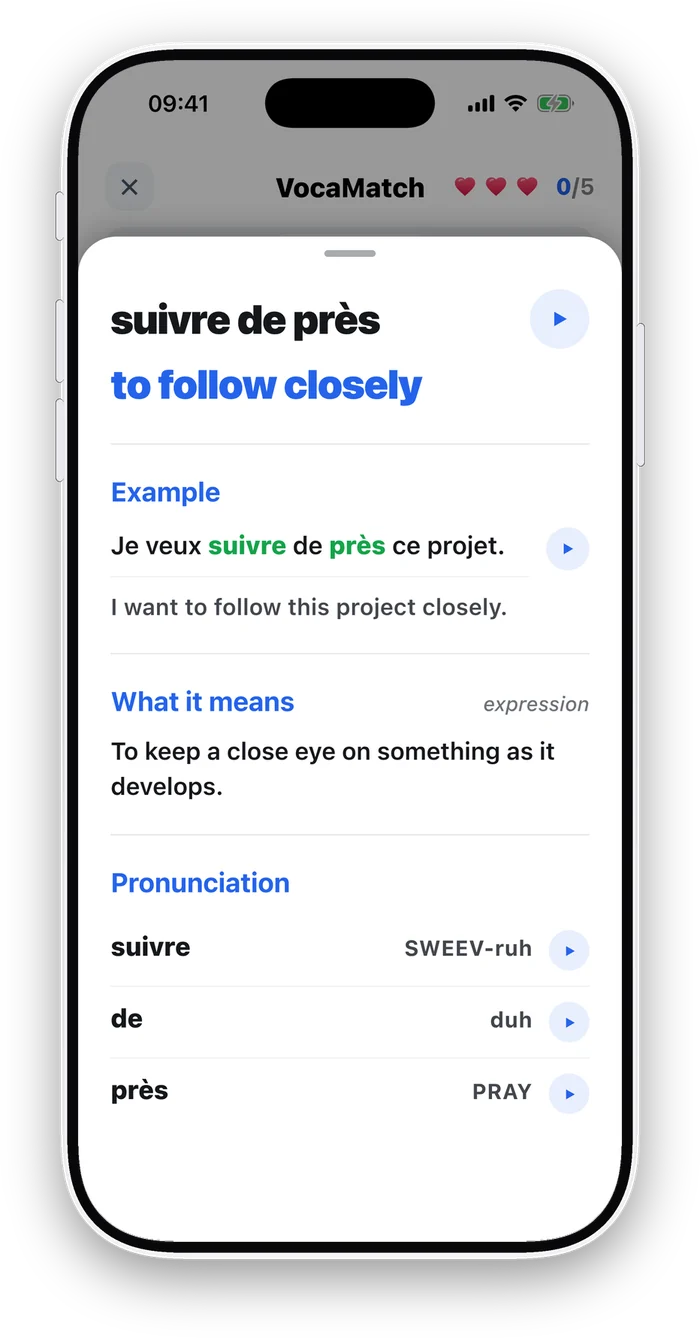

This page gave you four words from one story.
In the app, every story is in clear French, or in English when you are stuck. Tap any word to see what it means there. Then learn the story's words in VocaMatch.
Fourteen stories a day, France and the world. Free to download.
France with you, from wherever you are.
Quick Answers
What does déployer mean in French?
It means to deploy, unfold, or spread out. Space agencies use it for releasing satellites into orbit, while everyday speakers use it for opening wings, unfolding a map, or sending emergency teams into the field.
Why was the Starship catch historic?
Second stages of orbital rockets always burned up in the atmosphere or stayed in space as debris after a flight. This test marked the first time an upper stage returned from orbit to a controlled landing.
What happened to the first-stage Super Heavy booster?
SpaceX cancelled the plan to catch the Super Heavy booster because of a low-fuel warning. The booster was redirected into the Gulf of Mexico, where it exploded before hitting the water.
Better French writes each story from several sources, with help from AI. A separate check compares every sentence with those sources. Published by Better French, contact and corrections.