Its maker, Linguistica 360, has been making news for learners since 2009, and for many learners it was the first time real French news felt possible. Its idea is simple and it works: take a few stories each week and read them slowly, with a transcript beside the audio. So why look for an alternative? Usually for one of three reasons. You want something free. You want something every day instead of every week. Or real French still moves too fast for you, and slowing it down has shown you that speed was only part of it: you can hear every word of a story and still miss what's behind it, because the names, the acronyms and the references stay exactly as hard as before.
This list covers all three. It is written by Better French, so one of the seven picks is ours, and we say so where it appears. Every fact about the other six comes from that product's own website or its own App Store or Google Play page, checked in October 2026. We do not quote prices or ratings for anyone: they change, and they differ by country. Each product's own page shows the current ones.
First, What News in Slow French Does Well
It is fair to start here, because a good alternative has to beat something real. According to its own site and app listing (checked October 2026), News in Slow French, part of Linguistica 360, offers:
- Three levels. Beginner (A1 to A2, starting with a course it calls G.U.T.S.), Intermediate (B1 to B2) and Advanced (C1 and up).
- New episodes every week, read at a slower pace, with transcripts and in-context English translations.
- Courses on top: grammar and expressions, plus quizzes.
- A free way in. The free app plays, in its own words, "two news stories per language every week with no payment and no need to sign up", and the full product is a subscription with a free trial. It runs on the web, iOS and Android.
If audio is how you learn, and slowed speech is what finally lets you hear where one French word ends and the next begins, it is a good product. Keep it. The alternatives below are for when you want something it does not do.
The 7 Alternatives at a Glance
| Pick | What it is | Levels (as stated) | New content | Cost model |
|---|---|---|---|---|
| RFI Journal en français facile | Audio news bulletin + transcript | Not stated | Monday to Friday | Free to listen |
| TV5MONDE EDU | Video exercises, news among the themes | A1 to B2 | Weekly | Free |
| Readle | Graded courses made from news and stories | A1 to B2 (App Store), up to C1 (Google Play) | Daily | Free download, paid plan |
| Newsdle | Graded news lessons written by teachers | Graded (range not confirmed) | 3 lessons a day | Subscription, free sample lessons |
| LingQ | Reader for anything you import, plus a library | You choose the content | Whatever you import | Free start, paid plan |
| 1jour1actu | News in simple French for French children | Written for ages 8 and up | Frequent | Site open to read |
| Better French (ours) | The day's French stories, rewritten in clear French, the key words and phrases explained | One clear-French version; games in 3 level bands | Fourteen stories a day | Subscription with a free trial |
If You Want to Keep Listening
1. RFI, Journal en français facile
This is the closest like-for-like swap, and it is free to listen. Radio France Internationale describes it as "un vrai journal d'information pour suivre l'actualité internationale en français": a real news bulletin, in easier French, broadcast Monday to Friday and then posted on its Le français facile avec RFI site "avec sa transcription". The episodes we saw run ten minutes, and the page adds two bonus exercises a week (checked October 2026, francaisfacile.rfi.fr).
Good for: learners who liked NISF's audio and want it daily, at no cost. Keep in mind: it is international news, read by journalists at a gentler pace rather than slowed right down, and the page does not state a CEFR level. Around B1 is a comfortable place to start.
2. TV5MONDE EDU
TV5MONDE's learning app builds exercises on its own videos. According to its App Store listing (updated October 2026), news is one theme among several; exercises run from A1 to B2 ("Les exercices s'adressent à des publics débutants (A1) à avancés (B2)"); every video has French subtitles and a transcript; new exercises arrive weekly; and the listing says plainly "Tout est gratuit." It also mentions TCF preparation, and the exercises are written by French teachers.
Good for: learners who want structure and video, for free. Keep in mind: it is a set of exercises, not a daily read of what France is talking about. (Its website would not load for us when we checked, so this entry rests on the app listing.)
If You Want Graded Reading Lessons
3. Readle
Readle is a polished, course-like reader. Its listings say its "language experts turn real-world news & stories into fun & bite-sized" French courses, with audio "sentence by sentence", a tap on a word for its translation, grammar tips in each course, quizzes in each story, and flashcards with spaced repetition. Its website adds "new stories and news every single day". The App Store listing says A1 to B2; the Google Play listing goes up to C1 (all checked October 2026). It is a free download with a paid plan, on iOS, Android and the web.
Good for: learners from A1 to B2 who want short, levelled lessons and sentence-by-sentence audio. Keep in mind: the stories become lessons, so it is a library you work through rather than the day's France as French readers see it. We compare the two in detail in Readle vs Better French.
4. Newsdle
Newsdle does one thing carefully: graded news lessons in French and Spanish. Its site promises "3 brand new news-based lessons each day" and is proud that they are "created by qualified teachers, never AI". Each lesson comes with audio read by a person, exercises, a live dictionary, keyword lists and flashcards. There is one free sample lesson at each level; the full library is a subscription (checked October 2026, newsdle.com).
Good for: learners who trust teacher-made material and want a little every day. Keep in mind: three lessons a day is a careful selection, so you see a slice of the day rather than most of it.
If You Want to Read Anything
5. LingQ
LingQ is the power tool. In its own words, you "import your own content and convert it instantly into interactive French lessons", for example a French article you found yourself. The reader tracks the words you know and the ones you do not, with spaced-repetition review, and there is a French library of audio lessons with transcripts. It runs on the web, iOS and Android, and you can get started for free (checked October 2026, lingq.com).
Good for: independent B1+ learners who already know what they want to read. Keep in mind: you do the choosing, and the help is a translation of the word, not an explanation of the country behind it.
6. 1jour1actu
An honest outlier. 1jour1actu is not for learners at all: it is a news brand for French children aged 8 and up, from the publisher Milan Presse (Bayard group), where, as its site puts it, "des journalistes spécialisés expliquent avec des mots simples l'info des adultes". The articles on the site are open to read; the weekly paper is a paid subscription (checked October 2026, 1jour1actu.com).
Good for: A2 to B1 readers who want real French explained simply, for free. Keep in mind: it is written for French children, so the tone is young, and it is not built as a learning tool.
If You Want to Understand France Itself
7. Better French (ours)
This is the one we make, so weigh this section accordingly. Better French starts from a different diagnosis than News in Slow French. What makes a French story hard is rarely its speed. The trouble is everything it assumes you already know: who the minister is, what the acronym stands for, why a single number in a headline makes French readers nod.
So the work happens before you open the app. Every day Better French reads around 800 articles from 40+ French sources and picks fourteen stories a day that matter to someone trying to understand France. Each one is rewritten once, in clear French you can actually read, with the original article one tap away. Then the help sits inside the text:
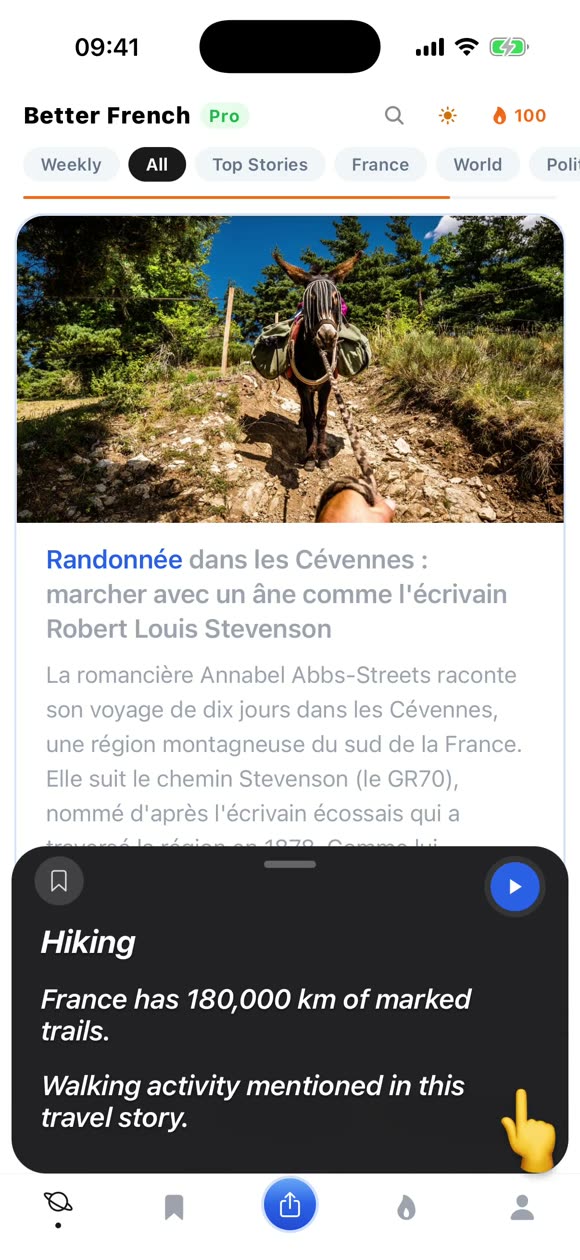

- Better French Context. Tap a word or short phrase for its meaning, how it is used in this sentence, and the cultural note behind it, explained in English, French, German or Spanish.
- Read in Your Language. Flip the whole story into English when you need solid ground, then flip back to French.
- Audioplay. Hear the word or phrase you tapped pronounced in French.
- Three games from the same story. Quiz Me asks three questions on what you read, with a short "Did you know?" about France after each answer. VocaMatch teaches you the vocabulary from what you read, the story's real words and expressions, in three level bands (A1 to A2, B1 to B2, C1 to C2). Breakdown rebuilds a key sentence from the story, one word at a time.
Here is what that looks like on a sentence from a story about the 2027 budget that ran in Better French on 13 October 2026: « Le Premier ministre pourrait recourir au 49.3 ou aux ordonnances […] » Slow that down and you still have no idea what "49.3" is. What you need is the note a French reader carries in their head: it is article 49, paragraph 3 of the French Constitution, which lets the government pass a text without a vote unless the National Assembly brings it down with a motion of censure. Tap au 49.3 in the story and Better French Context says: « Constitutional article to adopt a text without vote. » Then the note: « The text passes unless a censure motion succeeds. » That note, sitting on the phrase you tapped, is what Better French Context is for. Now you know why the sentence matters, and recourir à has somewhere to live: the app's note on pourrait recourir adds « "Recourir à" is a formal way to say "use". » That is what Better French is for: you come to understand the country behind the stories, and your French gets better because the words finally have something to hold on to.
Good for: readers from A2 up, people living in or moving to France, and anyone whose French has stalled because real French keeps assuming things they were never taught. Keep in mind: there is no narrator reading whole stories to you. Audioplay is for the word or phrase you tap. If listening on a commute is your only French time, one of the first two picks is the better fit.
How to Choose
- You love NISF's audio but want it daily and free: RFI's Journal en français facile.
- You want free, structured exercises with video: TV5MONDE EDU.
- You want short, levelled reading lessons with sentence audio: Readle or Newsdle.
- You want to read anything you find, with a word tracker: LingQ.
- You want simple French about real events, for free: 1jour1actu.
- You want to read what France is talking about today and understand why it matters: Better French.
You can combine them. One listening habit and one reading habit sit well together: a ten-minute bulletin on the way to work, a few stories with a coffee. If you are weighing News in Slow French against Better French directly, our side-by-side comparison goes deeper. For the wider field (Duolingo, Babbel and the rest), see the best French learning apps in 2026, and if you would rather build your own free routine from French outlets, start with the best French news sources for learners.
Frequently Asked Questions
What is the best free alternative to News in Slow French?
RFI's Journal en français facile is the closest free match: a ten-minute international news bulletin in easier French, Monday to Friday, posted with a transcript on RFI's Le français facile site. TV5MONDE's free EDU app is a good second, with video exercises from A1 to B2. Both were checked on their own pages in October 2026.
Is there an app like News in Slow French for reading instead of listening?
Yes. Readle and Newsdle turn news into graded reading lessons, LingQ lets you read anything you import with a word tracker, and Better French rewrites fourteen of the day's French stories in clear French, with words and phrases explained when you tap them. Which one fits depends on whether you want lessons, freedom, or the day's France.
Is News in Slow French still worth it in 2026?
For audio-first learners, often yes. Its own site lists three levels, new episodes every week, transcripts, grammar courses and a free way in. What slowing the speech cannot do is explain the names, acronyms and references a French story assumes you know. If that is where you get stuck, a reading tool with explanations is the better next step.
Does Better French read stories aloud like News in Slow French?
No. Better French is built for reading. Audioplay pronounces the word or phrase you tap, and Breakdown lets you hear the pieces of the sentence you rebuild, but no narrator reads whole stories to you. If you want full stories read aloud, News in Slow French or RFI's Journal en français facile does that.
Which News in Slow French alternative is best for intermediate learners?
At B1 and B2 the plateau is usually about context, not speed. Readle and Newsdle give graded practice, and LingQ suits independent readers. Better French is built for this stage: the day's real French stories, rewritten once in clear French, with the meaning and the cultural note on the words you tap, and three games built from the same story.
