B1 French for the 10-Year Card: The Reading Part
Since 1 January 2026, anyone from outside Europe asking for a first carte de résident (the 10-year card) has to prove French at B1, unless an exemption applies. You prove it with the TCF or the TEF (for these files, the TCF IRN or TEF IRN), or with a recognised diploma such as the DELF. The reading part of the TCF IRN is 25 multiple-choice questions in 35 minutes, from short practical messages up to complex texts. Reading at that pace is a skill you can build in twenty minutes a day. The rules here were checked on service-public.fr, Légifrance and France Éducation International in October 2026.
Since 1 January 2026, a first 10-year residence card in France asks for French at B1, and the change is easy to miss if you are not following French law. If you are preparing a file, this guide covers three things: what the rule actually says, with the official source for each point; how you prove your level; and what the reading part of the test looks like, so you can practise for it every day.
Maybe you already live here, you have studied, and you still worry it won't be enough on the day. That worry is common and reasonable, and a test date makes it louder. Nobody can promise you a result, and we will not. What we can do is show you what the test asks of your reading and help you get there.
The Rule, From the Official Sources
Service-public.fr, the French government's information site, puts it in one sentence (page F34501, checked October 2026):
« Depuis le 1er janvier 2026, les ressortissants étrangers non européens qui sollicitent la délivrance d'une 1re carte de séjour pluriannuelle ou d'une 1re carte de résident doivent justifier d'une maîtrise de la langue française, de niveau A2 pour les cartes de séjour pluriannuelles, de niveau B1 pour les cartes de résidents. »
In English: since 1 January 2026, non-European nationals applying for a first multi-year residence card must prove French at A2, and those applying for a first resident card must prove B1.
- Where it comes from. The law of 26 January 2024 (loi n° 2024-42, article 20) changed article L413-7 of the immigration code (CESEDA). The decree of 15 July 2025 (n° 2025-647) set the level at B1 of the Common European Framework and the start date at 1 January 2026.
- First cards only. The service-public page applies the condition to a first card, so renewing the same card is not covered. A first request for a carte de résident permanent, which you can ask for when a 10-year card expires, is listed as needing B1.
- Which resident cards. Service-public lists, among others: spouse of a French national, parent of a French child, family reunification, EU long-term resident, five years of residence with resources, and the permanent resident card.
- Exemptions. People over 65 (written into article L413-7), and people whose disability or chronic illness prevents it, with a medical certificate (service-public F34501).
- The other levels. A2 for a first multi-year card, and B2 for naturalisation (service-public F11926).
- A separate civic exam. Since the same date, first multi-year and resident cards also need a civic exam: 40 questions in 45 minutes, with at least 32 right answers needed (service-public, news of 18 December 2025). It tests knowledge of France and its institutions, and it is separate from the language test.
What is not clear. Three points come up often, and we could not settle them from an official page. If you hold refugee or subsidiary protection status, service-public lists those cards among the ones that need B1, while service-public's civic exam notice says beneficiaries of international protection do not take that exam; check your own case. Some nationalities have their own bilateral agreements with France, and no official page we read says how they apply to the language level. And the decree gives a start date but no rule for files submitted before it. For any of these, ask your préfecture or a lawyer, and recheck service-public.fr before you apply, since rules like these can change.
How You Prove B1
According to service-public F34501, you have two routes.
A language test
« Les seuls tests reconnus par le ministère de l'intérieur » are the TCF, run by France Éducation International, and the TEF, run by the Paris Île-de-France chamber of commerce. The test must have four separate parts (listening, reading, writing and speaking), taken in person on the same day. A test certificate is valid for two years. The versions built for these files are the TCF IRN and the TEF IRN. IRN stands for Intégration, Résidence et Nationalité.
A diploma
The DELF, DALF, DELF Pro, DFP, DCL or DUEF at the required level, or certain French diplomas (CAP, BEP, CFG, the diplôme national du brevet, or a professional title at level 3 or above). Service-public is explicit that diplomas issued abroad by a foreign authority do not count, even from a French-speaking country.
What the Reading Part Looks Like
Here is the TCF IRN as France Éducation International describes it on its TCF IRN page, checked in October 2026:
| Part | Format | Time |
|---|---|---|
| Listening | 25 multiple-choice questions | 20 minutes |
| Reading | 25 multiple-choice questions, 4 answers each, one correct | 35 minutes |
| Writing | 3 tasks | 30 minutes |
| Speaking | 3 tasks, face to face | 10 minutes |
The whole test takes 1 hour 35 minutes and assesses up to B2. You can sit it as often as you like, but you have to wait 20 days between two attempts (checked October 2026). The format changed on 12 May 2025: the reading part grew from 20 questions in 20 minutes to 25 in 35, so a preparation book printed before then may describe the old test. The reading questions get harder as you go, from simple everyday messages up to what FEI calls « textes abstraits ou complexes ».
If you take the TEF IRN instead, its reading part is 20 questions in 30 minutes, in two parts of ten, according to the CCI Paris page on its April 2025 update.
For a daily routine built around the reading part, see our guide to TCF IRN reading practice.
How results are reported: France Éducation International's page Comprendre mes résultats au TCF says listening and reading each get a score turned into a level, from « niveau A1 non atteint » to B2, speaking and writing are each marked out of 20, and a table shows whether you reached A1, A2, B1 or B2 overall. B1 is the line for the 10-year card.
What B1 Reading Means in Practice
The Common European Framework's self-assessment grid, as reproduced on the EU's Europass site, describes B1 reading like this: « I can understand texts that consist mainly of high frequency everyday or job-related language. I can understand the description of events, feelings and wishes in personal letters. » B2 adds articles and reports on current problems in which the writer takes a position.
Two things follow for your practice.
- It is everyday French, not literature. Notices, messages, letters, short articles about life in France. If you can read a French story about rents, schools or a strike and say what happened and why, you are working at the right level.
- Pace matters. 25 questions in 35 minutes is under a minute and a half per question, including reading the text. If you still need a dictionary every other line, the clock becomes the problem. Reading has to become fast enough to be calm.
There is a third thing, and it is the one most courses skip. Everyday French texts assume you know France. A notice from the mairie, a letter from the CAF or an article about a grève is easy grammar wrapped around things a French reader already knows. When those references are new to you, a B1 text reads like a C1 text. A story in Better French on 25 September 2026, about a drought on the Garonne, opened with « La préfecture de Haute-Garonne ». Tap La préfecture and Better French Context says: « Institution managing the crisis at departmental level. » Then the cultural note: « Where French residence permits are requested. » That is why reading real French about France, every day, does more for this part of the test than another grammar chapter. (We explain the idea in our guide to the B1 plateau.)
A Daily Reading Routine for the Months Before the Test
Twenty minutes a day beats two hours on Sunday. Here is a routine that matches what the reading part asks for:
- Read one short, real French text. A news story about daily life in France is ideal: it is the kind of French the test uses, and it teaches you the country at the same time.
- Skim first, for two minutes. Before looking anything up, answer three questions: who, what, why. This is the skill a multiple-choice question tests.
- Look up only what blocks the meaning. Not every unknown word matters. Look up the ones that stop you from answering who, what or why.
- Test yourself. Answer a few questions on what you read, without looking back. If you get one wrong, find the sentence that would have told you.
- Keep a list of the French that keeps returning. Words like préfecture, allocations, syndicat or arrêté come back again and again in everyday French.
- Once a week, read against the clock. Give yourself 35 minutes for 25 questions' worth of reading and notice where the time goes.
For steps 1 to 4 in more depth, see how to improve your French reading comprehension, and for the vocabulary of letters and offices, our guide to French administrative vocabulary.
Where Better French Fits, and Where It Does Not
Better French is built for steps 1 to 5. Its whole idea is that the French on a notice, a letter or a news page gets easier once you understand the France behind it, so it gives you France to read, every day, with help on the words you tap. It picks fourteen stories a day from 40+ French sources and rewrites each one once in clear French you can read. Then:
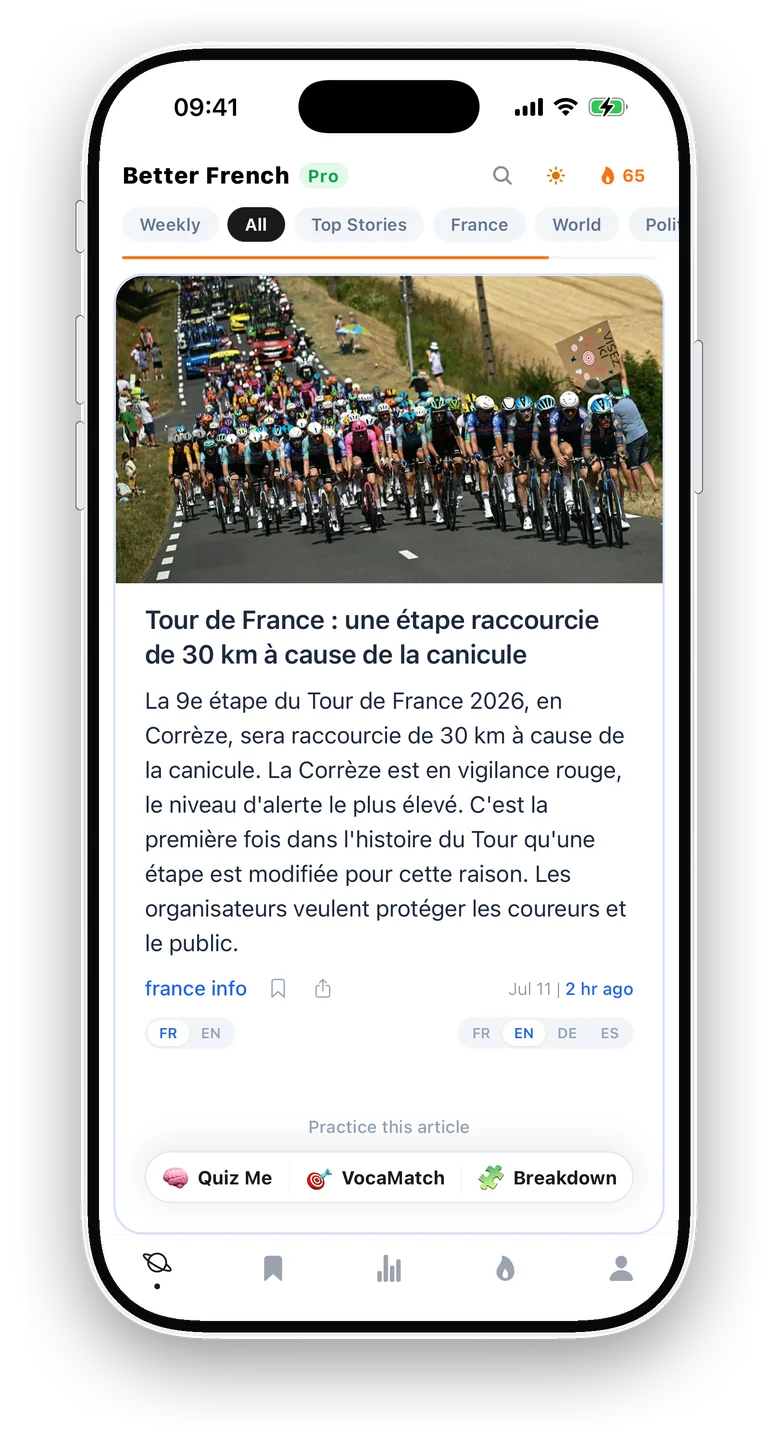
- Quiz Me asks three questions on the story you just read, multiple choice or fill in the blank, and after each answer gives a short "Did you know?" about France. It is the habit of steps 2 and 4: read, then prove to yourself that you understood.
- Better French Context is step 3. Tap a word or phrase in the story and you get its meaning, how it works in that sentence and, where it needs one, the cultural note behind it, explained in English, French, German or Spanish.
- Saved Words and VocaMatch are step 5. A saved word keeps the story you met it in and its note, and VocaMatch teaches you the vocabulary from what you read, the story's real words and expressions, at A1 to A2, B1 to B2 or C1 to C2.
- Read in Your Language flips the story into English, so you can check yourself after you have tried in French.
And what it does not do, plainly: Better French is not a TCF or TEF course. It has no mock exams, no writing practice and no speaking practice, and it does not train the listening part. If you need those, pair it with a test-preparation course or a teacher. What it gives you is the daily reading habit, on the French and the France the test is built from.
If you are preparing for a move rather than a card, start with the French you'll read in your first month in France, and for the bigger picture of life in French, our guide to living in France with the language barrier.
Frequently Asked Questions
What French level do I need for the 10-year card in 2026?
B1, for a first carte de résident applied for since 1 January 2026, unless an exemption applies (people over 65, or a disability or chronic illness with a medical certificate). A first multi-year card needs A2 and naturalisation needs B2. Source: service-public.fr page F34501 and article L413-7 of the CESEDA, checked October 2026.
Do I need B1 French to renew my carte de résident?
Not to renew the same card: the service-public.fr page applies the language condition to a first card. But a first request for a carte de résident permanent, which you can ask for when your 10-year card expires, is listed as needing B1. Check your own case on service-public.fr before you apply, as rules can change.
Which tests prove B1 French for a residence card?
Service-public.fr says the only tests recognised by the Interior Ministry are the TCF (France Éducation International) and the TEF (CCI Paris Île-de-France), with four separate parts taken in person on the same day, valid for two years. The versions for these files are the TCF IRN and TEF IRN. Diplomas such as the DELF, DALF or DCL, and some French diplomas, also count.
How long is the reading part of the TCF IRN?
25 multiple-choice questions with four answers each, in 35 minutes, according to France Éducation International. The questions go from short everyday messages up to more complex texts. The format changed in May 2025, so older preparation books may describe the previous 20-question version.
Can Better French help me prepare for the TCF IRN?
It helps with reading, and only reading. Fourteen real French stories a day, rewritten in clear French, with Better French Context on the words you tap and Quiz Me after each story. It is not a test course: no mock exams, writing, speaking or listening practice. Better French is a subscription that starts with a free trial.
Build B1 Reading, One Story a Day
Fourteen real French stories a day about life in France, rewritten in clear French. Tap a word for its meaning and the cultural note, then answer three Quiz Me questions to check what you understood. Better French is a subscription and it starts with a free trial. It works out at under €5 a month, and the exact price for your country is shown in the app before you pay. On the App Store and Google Play.

On a laptop? Point your phone camera at the code to get the app.