TCF IRN Reading: How to Practise Every Day
The reading part of the TCF IRN (the compréhension écrite) is 25 multiple-choice questions in 35 minutes, four answers each, and the texts get harder as you go: short notices and ads first, argued articles last. Your reading result is a level of its own, from « A1 non atteint » up to B2. Practise it in twenty minutes a day: one short practical text, one real article, three questions answered without looking back, and a timed session once a week. Test facts checked on France Éducation International, October 2026.
To practise TCF IRN reading every day, read one short practical French text and one real article about life in France, answer three questions on each without looking back, and race the clock once a week. That mirrors the test itself: 25 multiple-choice questions in 35 minutes, on texts that start easy and end hard.
If you picked « I'm preparing for the DELF, TCF or TEF and need to read real French », this page is for you. Every fact about the test was checked on the site of France Éducation International (FEI), which runs the TCF, in October 2026. The law behind the residence card, and why B1 now matters, is in our guide to B1 French for the 10-year card, so we won't repeat it here.
What the Reading Part Asks
On its TCF IRN page, FEI describes the reading part as 25 multiple-choice questions, each with four answers (A, B, C, D) and one correct, in 35 minutes. The whole test, with listening, writing and speaking, takes 1 hour 35 minutes.
The questions follow what FEI calls « un principe de difficulté progressive ». Its own list of what they test climbs roughly like this:
- very simple words and sentences in friendly or administrative messages and letters;
- information in everyday documents: « petites annonces, prospectus, menus et horaires »;
- personal letters about people, facts and events;
- everyday texts about daily life or work;
- articles and reports in which the writer takes a position;
- long, complex factual or literary texts, specialised articles and abstract texts.
FEI adds a sentence worth knowing: the TCF IRN « évalue exclusivement les compétences linguistiques ». It does not quiz you on French history or culture. But look at the texts on that list. A small ad, a timetable, a letter from an office: these are pieces of French daily life, written for people who already live it. The test never asks what a mairie does, yet a reader who knows gets through its notice faster.
Two practical rules from the same page. You can sit the TCF IRN as many times as you like, but you must wait 20 days between two sittings. Results arrive in your TCF-Candidat space within 15 working days of FEI receiving the papers from your centre, and the certificate is valid for two years.
How Your Reading Result Is Reported
FEI's page on understanding TCF results explains the TCF IRN certificate. Listening and reading each get a score, turned into a level of the Common European Framework, from « niveau A1 non atteint » up to B2. Writing and speaking each get a mark out of 20. A table then shows whether you reached each overall level: A1, A2 (the multi-year card), B1 (the resident card) and B2 (naturalisation).
So reading has its own line on the certificate. That helps when you prepare: after a first sitting, you can see whether reading is the part holding you back.
If you take the TEF IRN instead
Another accepted test, the TEF IRN, is run by the Paris Île-de-France chamber of commerce (CCI Paris). Its reading part is shorter. Here are the two side by side, from each organiser's own page, checked October 2026:
| TCF IRN | TEF IRN | |
|---|---|---|
| Reading questions | 25 | 20 |
| Time | 35 minutes | 30 minutes |
| Format | Multiple choice, 4 answers, one correct | Multiple choice |
| Result | A level, from A1 not reached up to B2 | 1 point per right answer, 0 for a wrong or missing one; levels A1 to B2 |
| Source | FEI | CCI Paris |
On the TEF IRN a wrong answer costs no more than a blank one, so never leave a question empty.
The Clock: 84 Seconds a Question
35 minutes for 25 questions is 84 seconds each, reading included. Two of FEI's test-day tips apply: « ne pas perdre de temps en prenant des notes pour les épreuves QCM » (don't lose time taking notes on the multiple-choice parts), and manage your time on the reading part.
Because the questions get harder, the early ones are where you save time. A timetable or a small ad should take you well under a minute, which leaves more than 84 seconds for the argued articles at the end, where most readers slow down. So practise both ends of the ladder, every day.
A 20-Minute Daily Routine
- Three minutes: one practical text. A shop's opening hours, a classified ad, a note from the people who manage your building, a school menu. Ask yourself what you have to do, when and where. This is the bottom of FEI's ladder.
- Ten minutes: one real article about life in France. Choose one where someone takes a position: a change to rents, a new rule for drivers, a debate about school hours. Read it once, all the way through, without stopping. This is the top of the ladder.
- Three minutes: three questions, eyes off the text. What happened, what one key word meant, and why it matters. If you can't answer one, you've found today's lesson.
- Three minutes: go back for the sentence that cost you the answer. Find it, and look up only the word or the reference that blocked you.
- One minute: keep one thing. One word, phrase or reference you want to meet again.
Once a week, replace the routine with a timed session at 84 seconds a question. FEI publishes example TCF questions, reading included, and its TCF IRN page points to free TCF training on TV5Monde's site. Use those for the format, and your daily reading for the French.
One Sentence, Three Questions
Here are two sentences from a story that ran in Better French on 16 September 2026, under the headline « Impôts : le fisc va prélever des millions de Français dès le 25 septembre »:
« Cette régularisation concerne les revenus de 2025. Si vous devez plus de 300 euros, le paiement est divisé en quatre fois jusqu'en décembre. »
The grammar is B1: a condition with si, a passive, a time limit. What slows a learner down is two pieces of France, le fisc in the headline and régularisation here. In Better French you tap either one, and Better French Context explains it where you are reading. On le fisc: « The administration in charge of collecting taxes. » On Cette régularisation: « Correction between amount paid and amount owed. » Its cultural note: « Happens when income varied during the year. » You get the meaning, how the word works in that sentence and the cultural note, in English, French, German or Spanish.
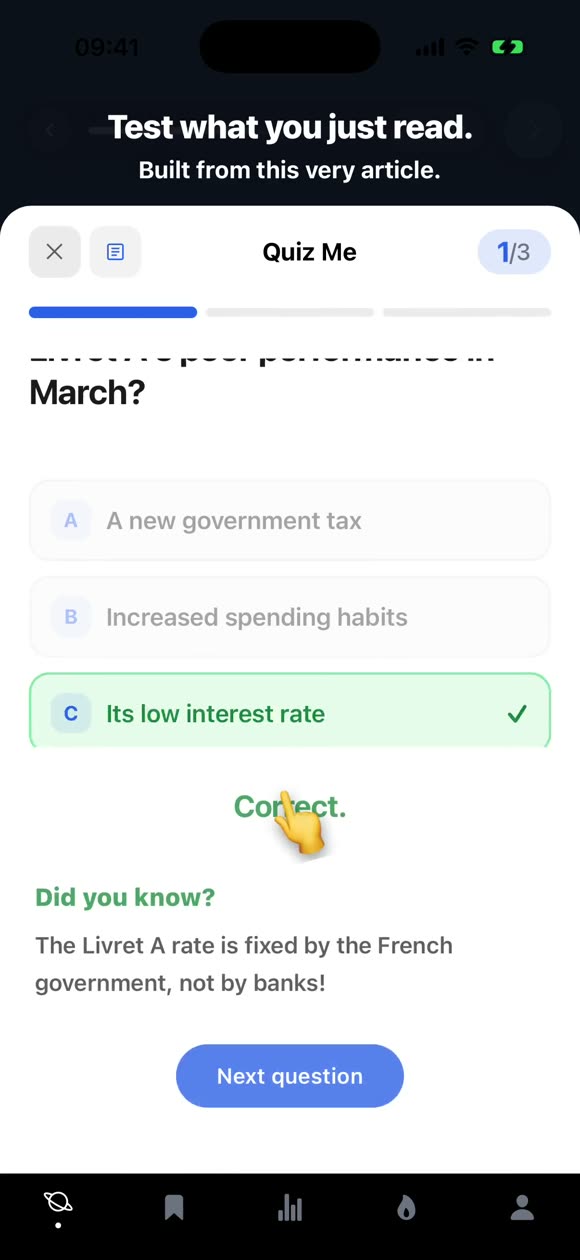
Then comes Quiz Me: three questions on the story you just read, mixing what the story said, a word from it and a fact about France behind it. Three of the questions written for this story:
- When will the French tax office begin withdrawing money from taxpayers? (September 25th.)
- In this article, what does 'le fisc' refer to? (The tax office.)
- How is the payment handled if a taxpayer owes more than 300 euros? (Split into four installments.)
What Better French Does, and What It Doesn't
Better French is a reading app about France. Every day it picks fourteen stories from 40+ French sources and rewrites each one once in clear French, with the original one tap away. You read, you tap what stops you, Quiz Me checks what you understood, and Saved Words keeps what you want to meet again.
It is not a TCF course. There are no mock tests, and no listening, writing or speaking practice, and nobody can honestly promise you a level on the day. What it gives you is the daily habit of reading real French about France, with help on the words and phrases you tap, which is the part of the test you can work on every day.
Preparing for the DELF instead? Our guide to DELF B1 reading practice covers that paper. If you need A2 for a multi-year card, start with A2 French reading, and for habits that work at any level, see how to improve your French reading comprehension.
If you are preparing for the TCF and need to read real French, that is the problem Better French is built for: one real story about France at a time, with the meaning and the context on the words and phrases you tap.
Frequently Asked Questions
How many questions are in the TCF IRN reading part?
25 multiple-choice questions, each with four answers and one correct, in 35 minutes. The texts start with short everyday documents and end with complex articles. Source: France Éducation International's TCF IRN page, checked October 2026.
How is the TCF IRN reading result shown?
As a level of the Common European Framework, from A1 not reached up to B2, on its own line next to the listening level. Writing and speaking get marks out of 20, and a table shows whether you reached A1, A2, B1 or B2 overall, according to France Éducation International, checked October 2026.
How long do I have to wait to retake the TCF IRN?
20 days between two sittings, according to France Éducation International's TCF IRN page, checked October 2026. There is no limit on how many times you can take it.
Is the TEF IRN reading part the same as the TCF IRN?
No. The TEF IRN, run by CCI Paris Île-de-France, has 20 multiple-choice reading questions in 30 minutes, with one point for a right answer and none for a wrong or missing one, according to its official page, checked October 2026.
Can Better French help me practise TCF IRN reading?
It helps with reading, and only reading: fourteen real French stories a day in clear French, Better French Context on the words and phrases you tap, and three Quiz Me questions after each story. It is not a TCF course. There are no mock tests, and no listening, writing or speaking practice.
Practise TCF Reading, One Story a Day
Read a real French story about life in France, tap a word or phrase for its meaning and cultural note, then answer three Quiz Me questions without looking back. Better French is a subscription and it starts with a free trial. It works out at under €5 a month, and the exact price for your country is shown in the app before you pay. On the App Store and Google Play.

On a laptop? Point your phone camera at the code to get the app.