DELF B1 Reading Practice With Real French
The DELF B1 reading paper (compréhension des écrits) lasts 45 minutes and is marked out of 25; you need at least 5 of those 25, and 50 out of 100 across the four papers. Two formats are still used in official sessions. The newer one has three exercises: four short practical documents to compare, then two press articles simplified to B1, with opinions in them. The best practice is short real French texts several times a week, with questions you answer without looking back. Exam facts checked on France Éducation International, October 2026.
The best DELF B1 reading practice is short, real French texts about everyday life, read several times a week, with questions you answer without looking back. That is what the paper is made of: 45 minutes, marked out of 25, on brochures, leaflets and press articles simplified to B1.
If you picked « I'm preparing for the DELF, TCF or TEF and need to read real French », this guide is the DELF half of the answer. Everything about the exam comes from France Éducation International (FEI), which runs the DELF, checked on its site in October 2026.
The Reading Paper Today
FEI's DELF B1 page lists four papers, each marked out of 25: listening, reading, writing and speaking. To get the diploma you need 50 out of 100 overall, and at least 5 out of 25 in each paper. Reading takes 45 minutes.
FEI sums up B1 reading in one line: the candidate « peut lire des textes factuels directs sur des sujets relatifs à son domaine et à ses intérêts avec un niveau satisfaisant de compréhension », which means reading straightforward factual texts on familiar subjects and understanding them well enough. The same page says the DELF B1 is for you if you can follow the main points of the news (« article de journal, journal télévisé, émission de radio »).
Old Format, New Format, and the 2023 Question
Many preparation sites talk about a DELF format change in 2023. FEI's own documents tell a slower story.
FEI's guide to the changes (first published in 2019, updated in June 2024) says the new format for the A2, B1 and B2 comprehension papers has been used in sessions since 2020, with a gradual rollout across levels set for 2024 to 2025. The B1 reading paper also grew from 35 to 45 minutes in March 2020. We found no FEI document that names 2023 as a switch date.
Today, FEI's B1 sample papers page still says two formats of the comprehension papers are used in official sessions, and that « aucun format n'avantage ni ne désavantage la réussite des épreuves »: neither format makes it easier or harder to succeed. You won't know in advance which one you get, so practise for both. The differences, from FEI's guide and its two sample papers:
| Older format | Newer format | |
|---|---|---|
| Exercises | 2 | 3 |
| Documents | 5 | 6, and shorter |
| Questions | 32 | 30 |
| Question types | Includes open questions, and true or false with a justification | Multiple choice, yes/no ticks, true or false with no justification; no open questions |
| Marks | 25 (10 + 15) | 25 (8 + 8 + 9) |
| Time | 45 minutes | 45 minutes |
The Texts the Paper Uses
Exercise 1: reading to choose
FEI calls it « lire pour s'orienter ». In the newer format you get four short practical documents (brochures, leaflets, ads) of around 100 words each, and a need to meet. In FEI's sample paper you are organising a business meal in Lyon and compare four restaurant ads against four criteria, ticking yes or no for each. FEI's advice page warns that your final choice must match your ticks, or you lose a point. The older format has the same kind of task, worth 10 marks.
Exercises 2 and 3: press articles with opinions
In the newer format, each is « un texte informatif authentique simplifié pour correspondre au niveau B1 et comprenant des opinions », taken from general French-language press: 300 to 350 words, seven questions, four of them multiple choice with three answers and three true or false. FEI's sample paper uses an online article about raising bilingual children and a magazine article about seasonal rentals and housing. The older format has one longer article, worth 15 marks.
Why Short Real Texts Are the Right Practice
Look at FEI's own words: authentic, informative, simplified to B1, with opinions. That is a real French article, made clearer, in which people disagree. Textbook dialogues don't train that. Real stories about France do.
The paper also tells you what to practise. For exercises 2 and 3, FEI's guide to the changes lists telling apart the different points of view in the article, or the writer's own, among the skills tested. So a question can turn on whose view a sentence gives: the writer's, an expert's, or one group's. FEI's advice adds a few habits: underline the key information on the first read, and before answering on the article, work out the type of document, its title and its author. For exercise 3, answer every question even when you're unsure, because a wrong answer costs no marks, and keep five minutes to reread.
Short matters too. The longest text in the newer format is 350 words. One article of that length a day, read properly, is closer to the exam than a chapter of a novel on Sunday.
A Weekly Routine
| Day | What to do | Time |
|---|---|---|
| Monday | One practical text: an ad, a programme, opening hours. Set yourself four criteria and tick yes or no for each. | 10 min |
| Tuesday | One real article. Read it once, then answer three questions without looking back. | 15 min |
| Wednesday | One article with opinions. Write down who thinks what, one line each. | 15 min |
| Thursday | Go back over the words you kept this week and test yourself on them. | 10 min |
| Friday | One article. Write three true-or-false statements about it, close it for an hour, then answer them. | 15 min |
| Saturday | A full reading paper against the clock. Start with FEI's two sample papers, one in each format. | 45 min |
| Sunday | Rest, or read anything in French for pleasure. |
Weekdays add up to about an hour. If a week gets busy, keep Tuesday and Saturday.
One Sentence, Read the Way the Paper Reads It
Here are two sentences from a story that ran in Better French on 12 October 2026, under the headline « SNCF : fatbikes et gyropodes interdits dans les TGV dès le 13 décembre »:
« La SNCF invoque la sécurité et la fluidité des embarquements. Des usagers et une plateforme de vente de gyroroues critiquent cette mesure. »
It is B1 paper material: a decision, its reasons, then two groups who disagree. A made-up true-or-false question on it (our own, not from the app or the exam) could say « Les usagers sont favorables à la mesure », and the answer turns on one word, critiquent.
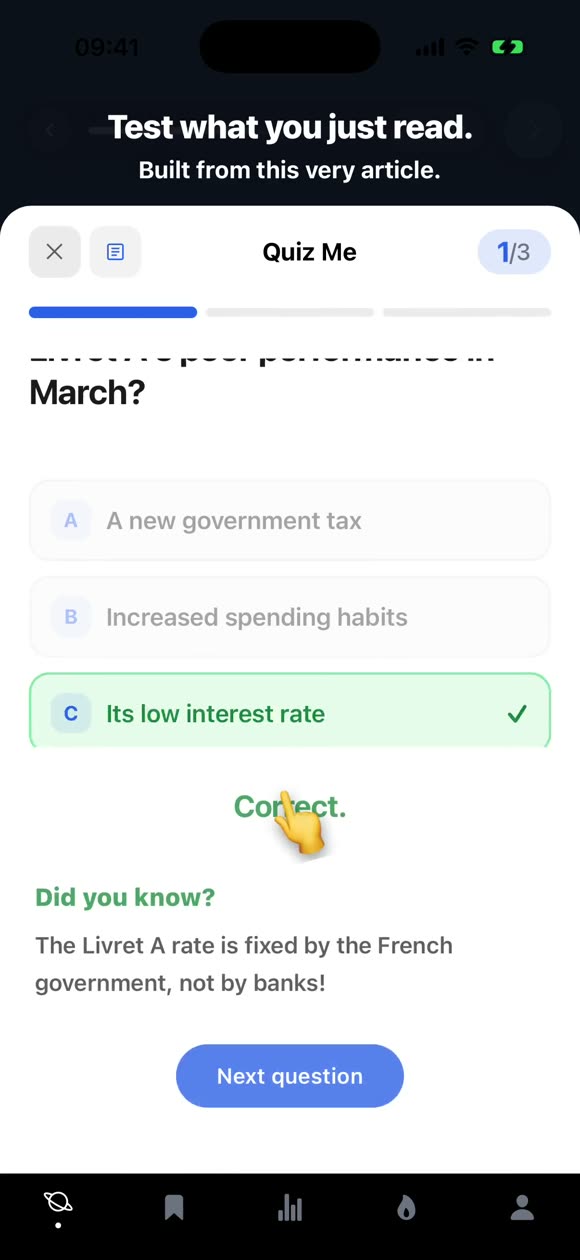
In Better French you tap La SNCF invoque, and Better French Context explains it in place: « The reasons given by the SNCF. » Its note: « Invoquer means to cite as justification. » Tap Les gyroroues and you get « Single-wheel electric devices, still accepted. » and « A gyroroue is an electric unicycle you stand on. » Then Quiz Me asks three questions on the story, such as "According to SNCF Voyageurs, which device stays allowed on TGV trains?" (Gyroroues). That is Tuesday's exercise, done in the app.
Where Better French Fits
Better French gives you the texts and the help. It picks fourteen stories a day from 40+ French sources and rewrites each one once in clear French, with the original one tap away. Tap a word or phrase for Better French Context, answer three Quiz Me questions after each story, keep the words you need in Saved Words, and learn the story's vocabulary in VocaMatch, at A1 to A2, B1 to B2 or C1 to C2.
It is not a DELF course. There are no sample papers, and no listening, writing or speaking practice. Use FEI's sample papers for the format, and a teacher or a course for the other three skills. Better French is for the reading you do on all the other days.
Also looking at the TCF? Our guide to TCF IRN reading practice covers that test, and the law behind the residence card is in B1 French for the 10-year card. If B1 feels like a wall, read about breaking through the intermediate plateau, and for habits at any level, how to improve your French reading comprehension.
If you are preparing for the DELF and need to read real French, Better French was made for that problem: real stories about France every day, in French you can read, with the context on the words and phrases you tap.
Frequently Asked Questions
How long is the DELF B1 reading paper?
45 minutes, marked out of 25. You need at least 5 out of 25 in reading, and 50 out of 100 across the four papers, to get the diploma. Source: France Éducation International's DELF B1 page, checked October 2026.
Did the DELF B1 format change in 2023?
France Éducation International's documents don't name 2023. A new format for the comprehension papers has been used in sessions since 2020, with a gradual rollout set for 2024 to 2025. In October 2026, FEI's sample papers page says two formats are still used in official sessions, and that neither makes success easier or harder.
What is the new DELF B1 reading format?
Three exercises, six documents and 30 questions, with no open questions. Exercise 1 compares four short practical documents against four criteria. Exercises 2 and 3 are press articles of 300 to 350 words, simplified to B1, with multiple-choice and true-or-false questions. Source: France Éducation International's guide to the changes.
What kind of texts are in the DELF B1 reading paper?
Practical documents such as brochures, leaflets and ads, and informative press articles that include opinions, adapted to B1. France Éducation International's sample paper uses restaurant ads, an article about raising bilingual children and an article about seasonal rentals.
Can Better French help with DELF B1 reading?
With reading, yes: fourteen real French stories a day in clear French, Better French Context on the words and phrases you tap, and three Quiz Me questions after each story. It is not a DELF course. There are no sample papers, and no listening, writing or speaking practice.
Read Real French Before the DELF
Read a real French story about life in France, tap a word or phrase for its meaning and cultural note, then answer three Quiz Me questions to see what you understood. Better French is a subscription and it starts with a free trial. It works out at under €5 a month, and the exact price for your country is shown in the app before you pay. On the App Store and Google Play.

On a laptop? Point your phone camera at the code to get the app.