The best Duolingo alternatives for French past the basics depend on what you want next. To read real French, try Better French, Readle or LingQ. To understand spoken French, try RFI's free Journal en français facile, Coffee Break French or News in Slow French. To talk with people, book a tutor on italki or find a partner on Tandem.
Many learners at this point describe the same feeling: "I study every day, but my French feels stuck." The streak keeps growing. The lessons feel fine. Then a real French sentence shows up and none of it seems to help. That does not mean Duolingo failed. It means you are ready for something it was never built to give you on its own.
What Duolingo Does Well
Credit first, because it has earned it. Duolingo calls itself "the fun, free app" for learning languages through bite-sized lessons, and its App Store page says every course is free (checked October 2026). It is very good at the hardest part of learning anything: turning up every day. Rewards, achievements and leaderboards keep millions of people practising.
It has also grown. In April 2026, Duolingo announced that almost anyone learning French on it can now learn through B2 on the CEFR scale, with lessons meant to help learners understand news, movies and jokes, plus advanced Stories and DuoRadio episodes (Duolingo blog, 22 April 2026). If you enjoy it, keep it. Nothing below asks you to quit.
Why It Can Still Feel Stuck
Inside an app, French lives in a controlled world. You answer questions about sentences someone chose for you. Outside, French is written by French people for French people, and it assumes you know France. Take a headline that ran in Better French on 24 September 2026:
« Zinédine Zidane à la tête des Bleus : ses grands débuts de sélectionneur vendredi en Turquie »
Almost every word in it is beginner French: la tête, grands, vendredi. The meaning is not:
- Les Bleus is France's national team, especially in ball sports (Larousse). Not "the blue ones". Better French Context on the story: « Popular nickname for the French team. » Then the cultural note: « The shout 'Allez les Bleus!' is famous. »
- À la tête is literally "at the head". Here it means in charge. The app's note: « Zidane now holds the management position. »
- Sélectionneur is the national team's coach, the one who picks the players (Larousse). The note: « Specific title for a national team coach. » And: « Use 'entraîneur' for clubs, 'sélectionneur' for countries. »
So the headline means: "Zinédine Zidane takes charge of France, with his first match as national coach on Friday in Turkey." No vocabulary drill gets you there. Reading French written for French readers does, with help on the phrase that stops you. If this sounds like your stage, our guide to breaking through the B1 plateau covers it in more depth.
If You Want to Read Real French
Better French
Better French reads around 800 articles a day from 40+ French sources and picks fourteen stories about what France is talking about. Each one is rewritten once in clear French, with the original article one tap away.
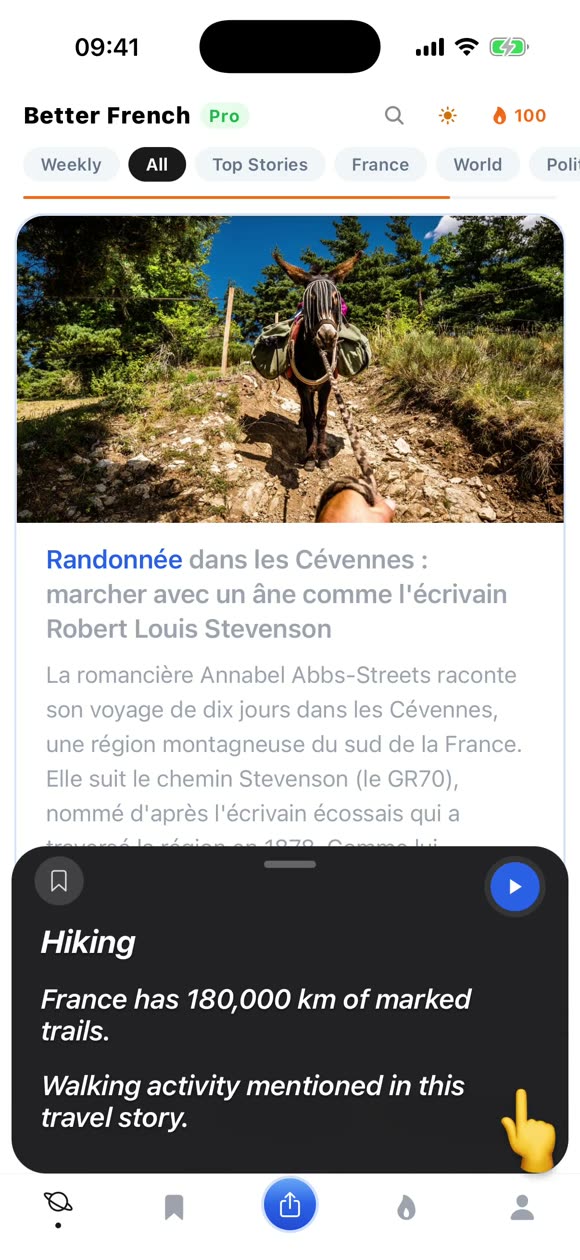

Tap a word or phrase and Better French Context gives you its meaning, how it works in that sentence, and the cultural note behind it, in English, French, German or Spanish. That is the help a line like the one about les Bleus needs. Read in Your Language flips a story into English when you are stuck, and Quiz Me checks what you understood with three questions and a short "Did you know?" about France. If you are deciding between the two apps, read Better French vs Duolingo.
Readle
Readle turns news and stories into graded French courses, from A1 to B2 on its App Store page, with tap-to-translate, sentence-by-sentence audio and a quiz in each story. It suits you if you want the step after Duolingo to still feel like a course.
LingQ
LingQ lets you import your own content and turns it into interactive lessons, with a reader that highlights words you know and words you are learning. It suits confident readers who want to choose every text themselves. Our guide to the best app to learn French by reading compares these by level.
If You Want to Understand Spoken French
RFI Journal en français facile
RFI describes it as a real news bulletin for following international news in French, on air Monday to Friday and posted on its Le français facile site with a transcript. It is free to listen to, and the transcript lets you read what you missed.
Coffee Break French
Coffee Break French offers free podcasts, and its main course runs in four seasons of 40 lessons each, from beginner to advanced. A paid online course adds lesson notes, video and bonus audio.
News in Slow French
News in Slow French publishes weekly news episodes at three levels, from Beginner (A1 to A2) to Advanced (C1+), narrated at a pace designed for learners, with transcripts and contextual translations. Our guide to understanding spoken French has more on training your ear.
If You Want to Talk With People
No app replaces a real conversation, and Better French does not try to: it is for reading and understanding France, not for conversation practice.
italki
italki connects you with French tutors for one-to-one online lessons. It lists professional tutors, who are certified teachers, and community tutors, who are native or highly skilled in French but have no formal teaching credentials. You can book up to three trial lessons, one per tutor, to find the right fit.
Tandem
Tandem pairs you with people who want to learn your language while you learn theirs. You can talk by text, voice note, audio or video call, and signing up is free. It works best once you can write a few sentences without help.
A Simple Week After Duolingo
- Every day, 15 minutes: read one or two short real French stories, with help on tap.
- Two or three times a week: one short listening session with a transcript.
- Once a week: a conversation, with a tutor or an exchange partner.
- If you still enjoy it: keep your Duolingo lesson for the streak.
Reading every day is the base because it is the easiest to keep up, and it feeds the other two: the words and references you meet in reading come back when you listen and when you talk. For more options across every skill, see our best French learning apps in 2026.
If your French feels stuck after months of daily lessons, the next step is real French, a little every day. Better French gives you fourteen stories a day about France, and help one tap away whenever a word or phrase stops you.
Frequently Asked Questions
What should I use after Duolingo for French?
It depends on what you want next. To read real French, try Better French, Readle or LingQ. To understand spoken French, try RFI's free Journal en français facile, Coffee Break French or News in Slow French. To talk with people, book a tutor on italki or find a partner on Tandem.
Can Duolingo take you past the basics in French?
Duolingo said in April 2026 that almost anyone learning French on it can now learn through B2, with advanced Stories and DuoRadio episodes. Many learners still find real French a big jump, because it is written for readers who already know France.
Is there a free alternative to Duolingo for French?
Several. RFI's Journal en français facile is free to listen to and posted with a transcript, Coffee Break French offers free podcasts, LingQ lets you get started for free, and Tandem is free to sign up. Each was checked on its own pages in October 2026.
Should I stop using Duolingo?
There is no need. If the daily lesson keeps you practising, keep it for the habit, and add real reading, listening and conversation around it. Stop only if it takes the time you would rather give to real French.
Does Better French help with conversation?
No. Better French is for reading and understanding France: real stories in clear French, help on the words and phrases you tap, and games that check what you understood. For conversation, use a tutor or a language exchange alongside it.
