You studied French for years and you still can't read a French article because course French and real French are written for different readers. A course is written so a learner can follow it. A French news site is written for people who already know the country. The missing piece is mostly that shared knowledge, and you can build it.
It is one of the problems learners tell us about most often, and they put it in nearly the same words: "I've studied French, but I still can't read the real thing." You can conjugate the subjunctive. You may have a certificate on the wall. Then you open a French site, and by the second line you are translating words one at a time and the story has gone.
Why Course French and Real French Feel Like Two Languages
A course chooses its texts for you. Every new word arrives with a translation, sentences are complete, and the topic exists to practise the grammar of the chapter. Nothing in it assumes you have ever been to France.
Real French does the opposite. A journalist in Paris writes for readers who share a country with them. Those readers know the rail company, the address of the Prime Minister's office, and last week's row. Nobody inside France needs any of that explained, so nobody explains it.
What Real French Does That Your Course Never Prepared You For
Take a headline that ran in Better French on 2 October 2026:
« SNCF : de nouveaux trains remplaceront les rames Corail à l’été 2027 »
You probably know nouveaux trains (new trains) and remplaceront (will replace). After that, the headline trips you up in four places, and a second story adds a fifth.
It drops words
Headline French cuts verbs and articles. SNCF : means "the SNCF says that" or "at the SNCF", and the colon does the job a whole clause would do in your textbook. The story itself spells it out: « La SNCF va déployer de nouveaux trains ».
It abbreviates
SNCF is the Société nationale des chemins de fer français, the national railway. French news uses acronyms like this constantly and almost never spells them out: RATP for the Paris transport network, CAF for the family benefits office. A French reader stopped noticing them years ago. We decode the ones that come up most, from CAF to Smic, in French abbreviations and acronyms.
It names buildings instead of people
Matignon is a building in Paris, the Hôtel de Matignon, where the Prime Minister has their offices. In a headline it means the Prime Minister and their team (Larousse gives that use, checked October 2026). L’Élysée works the same way for the President, and Bercy for the finance ministry. A story in Better French on 14 October 2026 opened a sentence with « L’Élysée estime que l’IA… », and the note on L’Élysée read: « The French Republic’s presidency. »
It uses words in a sense your course skipped
If your course taught you rame at all, it was an oar. On the railway, une rame is a set of coaches running together on the same route, a trainset (Larousse lists it as a separate word, checked October 2026). Tap les rames Corail in the story and Better French Context says: « Passenger cars put into service since 1975. » Then the note: « A trainset designates coupled railway cars. »
It assumes the context
The headline only lands if you know what Corail trains are: the intercity coaches France has run since 1975. The headline assumes you know; the story only adds that they date from the 1970s and 1980s and that their air conditioning stops above 38 degrees. A French reader carries that in their head. You were never given it.
So the gap is not five missing grammar points. It is a layer of shared knowledge that sits on top of the language. More grammar will not fill it, and more course texts will not either, because course texts were written to leave that layer out.
Why "Just Read a French Newspaper" Rarely Works
The usual advice gets the goal right and the dose wrong. Open a full article from a national daily and you stop every other line. A dictionary gives you "oar" for rame and nothing useful for Corail. Twenty minutes later you have read three paragraphs and understood the words, not the story. After a week of that it is easy to quit and decide your French is worse than it is.
Your French is usually fine. You were reading without the layer every French reader has.
What Actually Closes the Gap
- Short real texts, every day. A few short pieces about France each day beat one long article on a Sunday. The shorthand repeats: SNCF, Matignon, la rentrée, le 49.3 come back week after week, and repetition is what turns them from obstacles into vocabulary. Fifteen to twenty minutes is enough.
- Help on the exact word that stops you, inside the sentence. You need the meaning here, plus the piece of France behind it. If help costs you a new tab, you will skip it or stop reading.
- A way to check yourself. Read once for the gist, then again. Then answer a few questions on what happened. Recognising words and understanding the story are different things, and only a check tells you which one you did.
- The habit. Reading gets easier over weeks, not days. The daily rhythm is most of the method.
If you are around A2, start with what you can already read at A2. For the habits themselves, see how to improve your French reading comprehension and our French reading practice routine. If you are at B1 and the progress has stopped, breaking through the B1 plateau covers that stage.
How Better French Helps You Read the Real Thing
Better French is built for this exact problem. Every day it reads around 800 articles from 40+ French sources and picks fourteen stories a day about what France is talking about. Each one is rewritten once, in clear French you can actually read, with the original article one tap away. The acronyms, the names and the references stay in. The help sits on top of them.
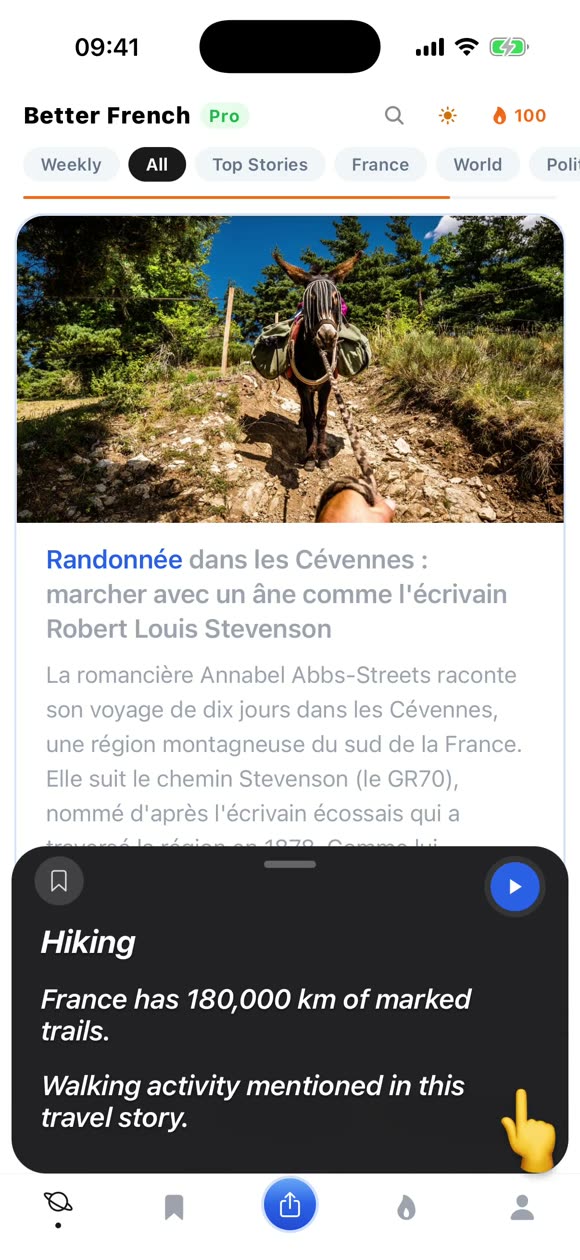
- Better French Context. Tap a word or phrase in the story for its meaning, how it works in that sentence, and the cultural note behind it, explained in English, French, German or Spanish. A note of that kind is what turned L’Élysée, in a story on 14 October 2026, from a puzzle into "The French Republic's presidency".
- Read in Your Language. Flip the whole story into English when a paragraph beats you, then flip back to French and try again.
- Audioplay. Hear the word or phrase you tapped pronounced in French.
- Quiz Me. Three questions on the story you just read, and a short "Did you know?" about France. That is your check.
- VocaMatch and Breakdown. VocaMatch teaches you the vocabulary from what you read, the day's real words and expressions, in level bands from A1-A2 to C1-C2. Breakdown rebuilds a key sentence from the story, one word at a time.
What it does not do, plainly: Better French is for reading and understanding. It does not teach grammar from scratch, and it is not a conversation course. It pays off from A2; below that, you will lean on the English flip and the games at first.
If years of French still leave you outside a French article, what you are missing is mostly France. Better French puts it back inside the sentence, one tapped word at a time, fourteen stories a day.
Frequently Asked Questions
Why can't I understand French articles after years of study?
Because articles are written for people who live in France. Headlines drop words, acronyms like SNCF go unexplained, a building such as Matignon stands in for the Prime Minister, and every story assumes you followed last week's news. Your course left that layer out on purpose.
What level do I need to read real French?
You can start at A2 if you have help on tap: short pieces, an English version to check against, and a quick explanation for the words that stop you. The higher your level, the less help you need, but even advanced learners meet references nobody taught them.
How long does it take to read French articles comfortably?
There is no honest single number. It depends on your level, how often you read and how much of France you already know. Short daily reading tends to move faster than a long article once a week, because the same acronyms, names and expressions keep coming back.
Is Google Translate enough to read French news?
It tells you what the words say, and it is fine for checking one sentence. It rarely tells you what Matignon stands for or why a renewed strike matters, and translating whole articles means you stop reading French. Use it for a sentence, not for a story.
How does Better French help me read real French?
Every day it rewrites fourteen real French stories in clear French, with the original one tap away. Tap a word or phrase for its meaning, how it works in the sentence and the cultural note behind it, flip to English when you are stuck, and check yourself with three Quiz Me questions.
